Behavior Change
- Explain the gap between knowing and doing — why understanding anger management isn't the same as changing.
- Name the six ingredients real change requires, and tell internal motivation from external motivation.
- Locate yourself honestly on the Stages of Change, and recognize that relapse is part of the process, not failure.
- Use the Firework Model to find the points where you can step in before, during, and after an anger reaction.
- Use the ABC Model to see that it's your thoughts about an event — not the event itself — that create your anger.
- Put change into motion with practical tools: the 1% Better principle, if-then plans, and a support system — and plan for the obstacles that trip most people up.
1 · The Gap Between Knowing and Doing
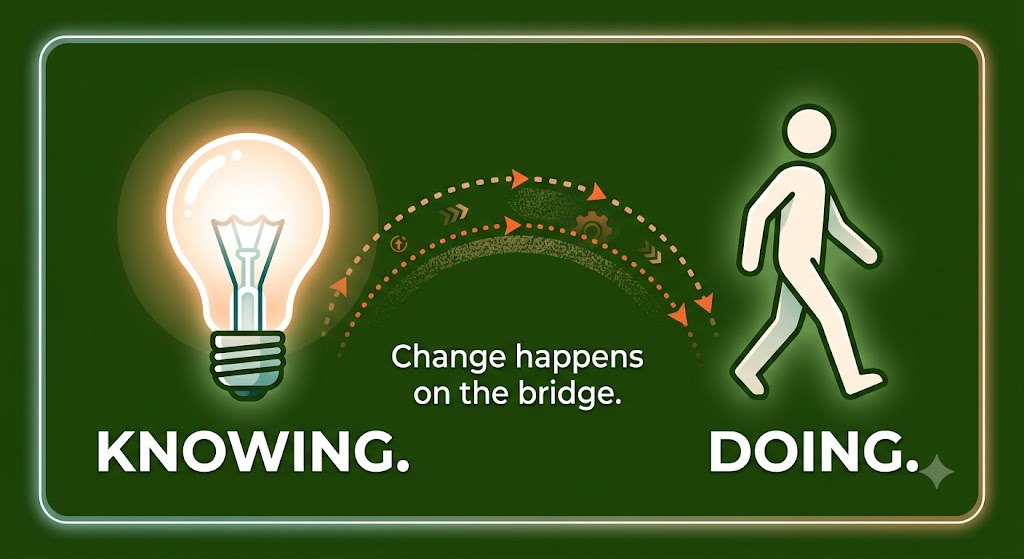
Let me ask you the question I ask everyone: "I understand everything you're teaching me. I know what I should do when I get angry. So why do I keep doing the same old stuff?"
If you've ever thought that, you're not broken — you're human. After three decades working with people who were trying to change, here's what I can tell you for certain: successful change isn't just about knowing what to do. It's about understanding how change actually works, and then using strategies that work with the way your brain learns — not against it.
You can understand every technique in this program and agree with every principle, and still explode at the wrong moment. That's not a sign you're failing. It's a sign you've reached the exact place where the real work begins.
2 · The Six Ingredients of Real Change
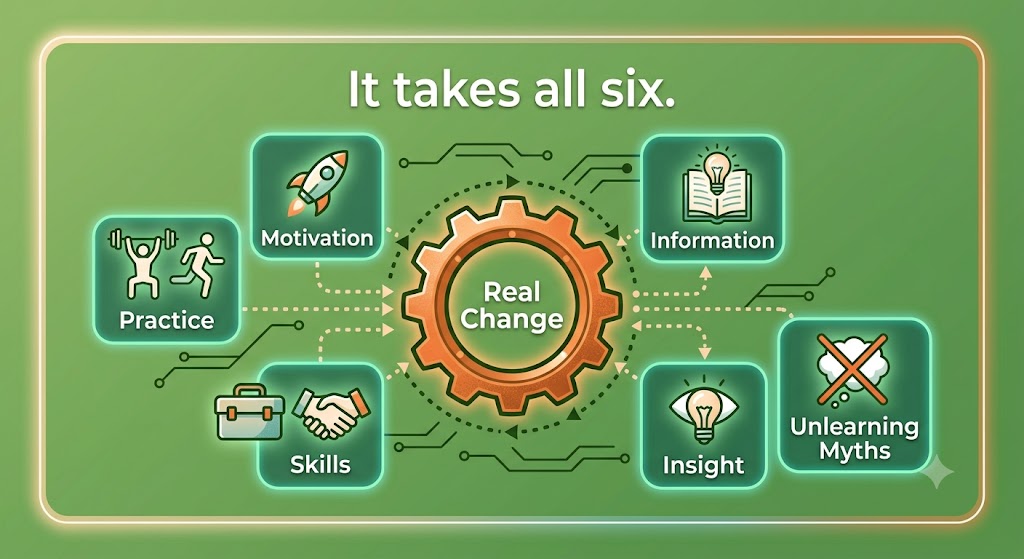
So what does real change actually take? Not willpower alone, and not just a court order. In my experience it takes six ingredients — and if one is missing, change tends to stall.
- Motivation — the fuel. We'll separate two kinds in a moment.
- Learning new information — you need to understand why to change, what to change, and how to change.
- Unlearning myths — clearing out the inaccurate beliefs and thinking errors you've been carrying.
- Insight — understanding why you do what you do, which reshapes your attitudes, values, and beliefs.
- Skills — knowing what to put in place of the old reaction.
- Practice — because the old anger behaviors got that strong through years of practice, and the new ones get strong the same way.
Oklahoma common-sense moment: you didn't learn to drive by reading the manual once. You practiced until it ran on autopilot. Anger-management skills work exactly the same way.
Motivation: internal vs. external
There are two kinds of motivation, and the difference matters more than almost anything else in this module.
- Internal motivation comes from within you — and only you. It's genuine; it's the result of something you truly want. It can't be court-ordered.
- External motivation usually shows up as some kind of pressure or threat — a judge, a probation officer, a boss, a spouse saying "change or else."
Here's my reality check: external motivation might get you started, but internal motivation is what keeps you going when things get hard. Court orders and ultimatums have expiration dates — they last about as long as that person holds power over you. Personal commitment renews itself every single day.
And here's the good news: external motivators often spark internal motivation. Maybe you're here mostly because someone made you. That's okay — that's a start. My hope is that somewhere in this program, the reason you keep going quietly shifts from "because I have to" to "because I want this for myself." That's the moment change gets real.
Information, unlearning myths, and insight
The next three ingredients work together. Information gives you the why, what, and how of changing. Unlearning myths clears out the inaccurate beliefs and thinking errors that have been quietly running the show. And insight ties it all together — it's the moment you understand why you do what you do, when you stop listening to the self-serving chatter in your head that justifies the old behavior, and you line up your thinking, your words, and your actions with your real values.
Think back to cramming for a test in school — you memorized it, took the exam, and dumped the information the next day. That's not insight. Insight is knowledge that actually changes how you see the world and the people in it. Insight is what gives you the power to change your anger behaviors — because it rewrites your own rules about who you are and what you stand for.
Skills and practice
Insight tells you why. Skills tell you what to do instead — and that's a different thing entirely. A lot of anger trouble traces back to missing problem-solving skills: knowing how to respond differently when the heat rises, how to build an anger plan, how to replace the old reaction with a better one.
And practice makes permanent. Your current anger habits are strong because you've practiced them — for years. New skills get that strong the same way: by repetition, until the better response becomes the automatic one.
3 · Where Are You Right Now? The Stages of Change
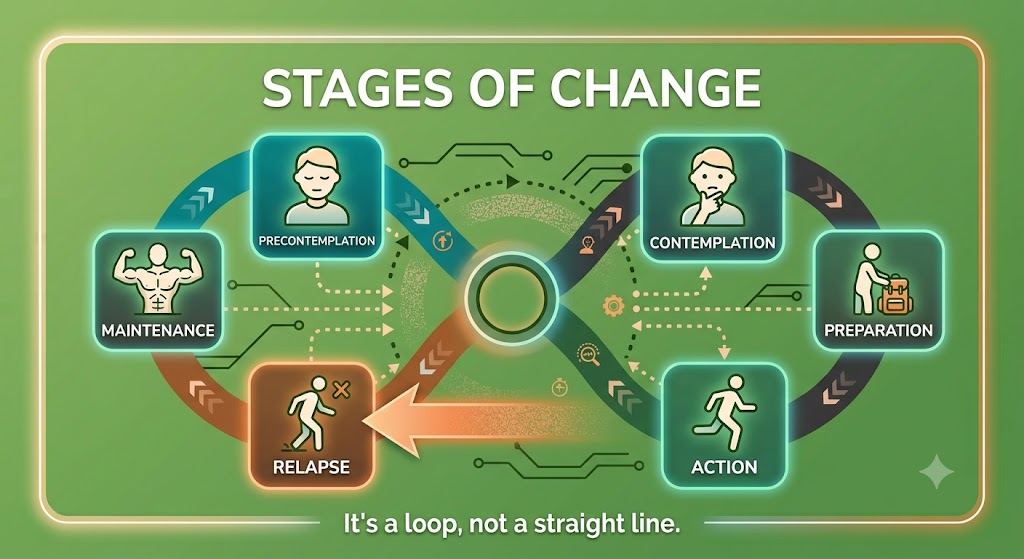
Before we talk about how to change, let's get honest about where you are. Most people badly overestimate how ready they are, and underestimate how much work it takes. Change rarely happens overnight — most people move through predictable stages:
- Precontemplation — "I don't have a problem." Not yet seeing a need to change.
- Contemplation — "I might have a problem." Aware, but not committed.
- Preparation — "I'm ready to do something." Getting ready, making a plan.
- Action — "I'm doing something." Putting new behaviors in place.
- Maintenance — "I'm keeping it up." Sustaining the change and guarding against slipping.
- Relapse — "I slipped up." Returning to old patterns — and this is a normal part of the process, not a failure.
My change reality check: almost nobody walks these stages in a straight line. You might bounce between contemplation and preparation for months, or cycle through action and relapse several times before it sticks. That's normal. A slip isn't proof you can't change — it's information about what to adjust.
Why we resist — even when change is good for us. It helps to name the pull backward: fear of the unknown ("better the devil you know"); loss of identity ("if I'm not the angry one, who am I?"); secondary gains (anger might be getting you attention, control, or distance); perfectionism ("if I can't do it perfectly, why try?"); all-or-nothing thinking ("I tried once and failed, so I'm hopeless"); and plain comfort with the familiar, even when the familiar hurts. Spot your own version of the pull — naming it loosens its grip.
4 · The Firework Model: Finding Your Intervention Points
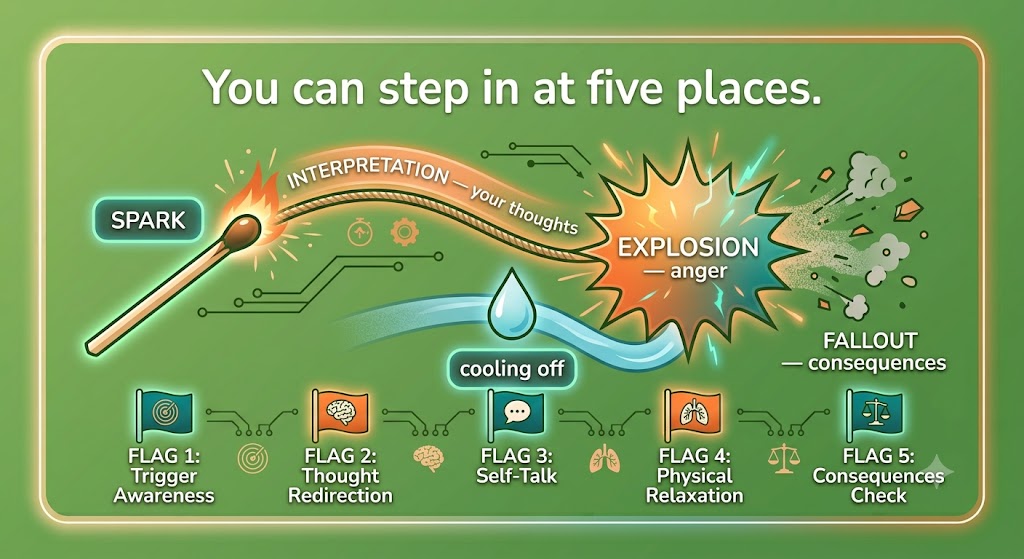
I like to use the Firework Model to show people how an anger reaction actually unfolds — because once you can see the steps, you can step in at any one of them.
A firework needs a spark to light the fuse, which burns down to the explosion. Anger works the same way:
- Step 1 — The Spark (Trigger). Something happens. It can be external (someone criticizes you) or internal (a memory surfaces).
- Step 2 — The Fuse (Interpretation). Your brain decides what the spark means. Your thoughts, beliefs, and assumptions live here — and the length of your fuse depends on how you interpret the trigger.
- Step 3 — The Explosion (Emotional Reaction). If you read the trigger as a threat or an injustice, you feel anger.
- Step 4 — The Fallout (Consequences). The reaction drives behavior, and the behavior leaves real consequences in your relationships, your work, your life.
- The Water. Cooling off — calming the system back down.
Here's the beautiful part — you can intervene at five points:
- Before the spark — prevention: lowering your overall reactivity (sleep, stress, the basics).
- At the spark — catching triggers early and responding on purpose.
- On the fuse — changing your interpretation (this is the big one — see the ABC Model next).
- During the explosion — managing the intense feeling when it's already here.
- After the fallout — learning from the consequences and repairing the damage.
Same trigger, different fuse — a real example. A woman I worked with — I'll call her Lisa — was having explosive reactions every time her teenage daughter left dishes in the sink.
Lisa's original firework. Spark: dirty dishes. Fuse: "She's disrespectful and irresponsible — she thinks I'm her maid." Explosion: a screaming match about respect. Fallout: her daughter shut down; the relationship went cold.
Lisa's new firework. Spark: the same dirty dishes. Fuse: "She forgot again. That's normal teenager stuff, not an attack on me." Controlled burn: mild frustration, no explosion. Outcome: a calm conversation about household expectations.
Same trigger. Different interpretation. Completely different outcome. That's the whole game.
5 · The ABC Model: Your Thoughts Create Your Feelings
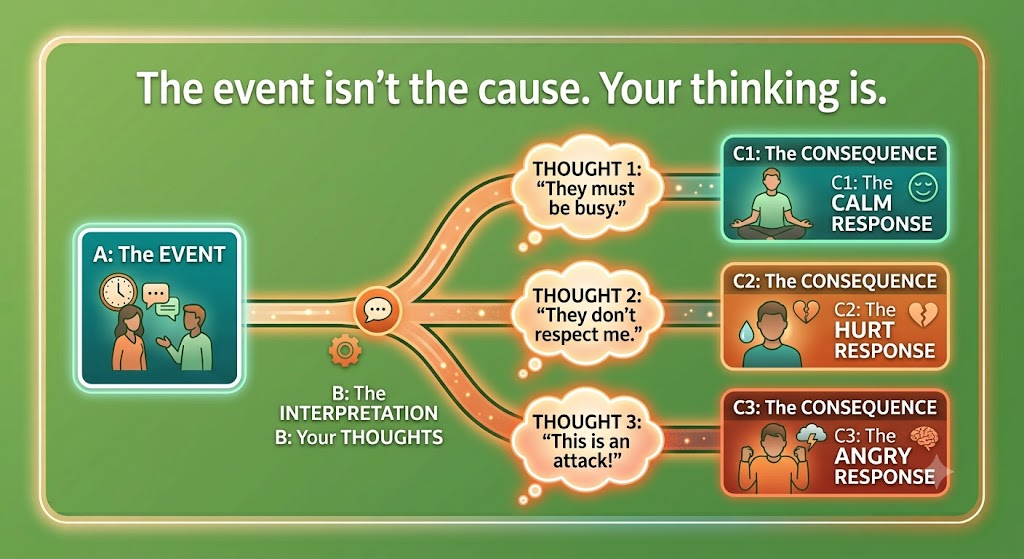
If you remember one tool from this module, make it this one. The ABC Model explains why two people can live through the exact same event and react in completely different ways.
- A — Activating Event. Something happens.
- B — Beliefs / Thoughts. Your interpretation of what happened.
- C — Consequences. Your emotional and behavioral response.
The key insight: A does not cause C. B causes C. The event doesn't create your emotion — your thoughts about the event create your emotion.
Same event, three different thoughts: your friend doesn't return your call (A).
- B1: "She's probably busy with work or family." → C1: you feel fine, maybe a little curious.
- B2: "She's ignoring me — I must have done something wrong." → C2: you feel hurt and anxious.
- B3: "She's being rude and inconsiderate." → C3: you feel angry and resentful.
One event. Three thoughts. Three completely different emotional outcomes. You can't always control A — what happens to you. But you have real power over B — how you think about it.
Watch for the B-patterns that manufacture anger: "They did that on purpose," "This is so unfair," "They should know better," "I can't stand this," "They don't respect me." And practice the alternatives that cool it down: "I wonder what's really going on here," "This is frustrating, but it's not the end of the world," "People aren't perfect — including me," "I can handle this."
This isn't about forced positive thinking. The goal is realistic thinking — not pretending problems don't exist, but seeing them accurately. Watch for the distortions: all-or-nothing ("if I'm not perfect, I'm a failure"), mind reading ("I know they think I'm stupid"), fortune telling ("this is going to be a disaster"), and emotional reasoning ("I feel stupid, so I must be stupid"). Then run the reality check: What am I thinking right now? Is it accurate — what's the evidence for and against? Is it helpful? What would I tell a friend in this exact situation?
6 · Disputing the Beliefs That Fuel Anger
The ABC Model has a next step. A recognized framework from Albert Ellis — Rational Emotive Behavior Therapy (REBT) — sorts your beliefs into irrational ones that crank up anger and rational ones that cool it down. To be clear: this is a thinking skill you're learning here — an educational tool, not a service of any kind.
Irrational beliefs that create anger:
- Demanding: "People must treat me fairly."
- Awfulizing: "It's terrible and awful when things don't go my way."
- Low frustration tolerance: "I can't stand it when people are difficult."
- Global rating: "People who do bad things are bad people."
Rational alternatives that reduce anger:
- Preference: "I'd prefer fair treatment — and I can handle it when I don't get it."
- Perspective: "It's disappointing when things go wrong, but it's not the end of the world."
- Frustration tolerance: "I don't like difficult people, but I can deal with them."
- Specific evaluation: "People who do bad things are people who did a bad thing — not all-bad people."
The three-step move: (1) Identify the demanding, awfulizing, or intolerant thought. (2) Dispute it — Where is it written that people must treat me fairly? Is this truly awful, or just unpleasant? What's my evidence that I can't stand it? (3) Replace it with a flexible, realistic belief that honors your preferences without demanding reality bend to them.
In practice: a coworker takes credit for your idea in a meeting. Irrational: "He should NEVER do that — it's awful — I can't stand working with people like this!" Disputed and replaced: "I'd prefer he gave credit where it's due, and I can handle it when he doesn't. This is frustrating, not catastrophic — and I can address it directly with him and my supervisor." Same event. A belief you can actually live and act on.
7 · Putting Change Into Motion: Practical Strategies
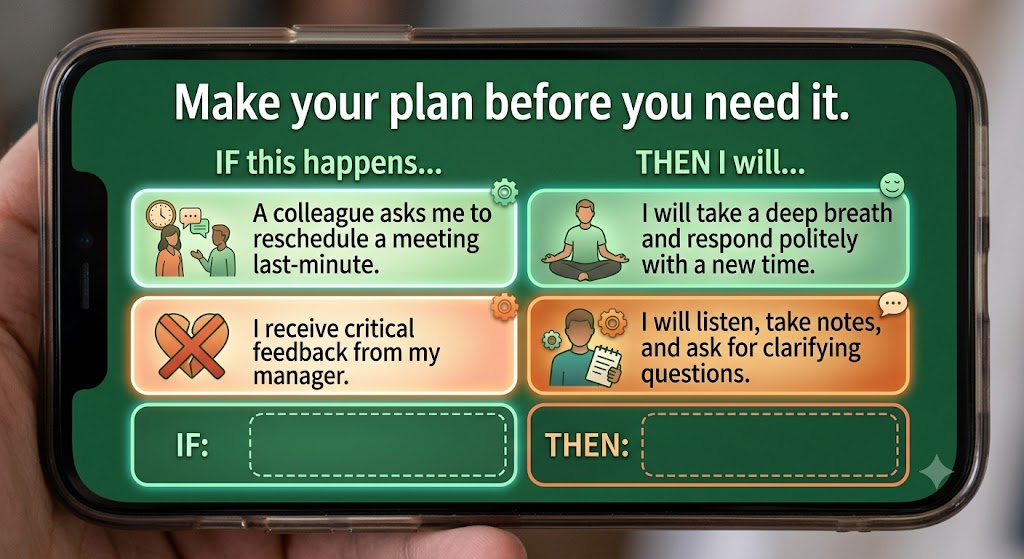
Models are the map. These are the tools you actually carry.
- The 1% Better Principle. Don't try to overhaul everything at once — aim to get 1% better each day. Small, steady improvements compound into dramatic change. One extra breath before responding. One "I" statement instead of a "you" attack. Catching yourself in one distorted thought a day.
- If-Then Plans (Implementation Intentions). Research shows that planning the response in advance dramatically raises the odds you'll actually do it. The formula: "If [situation], then I will [specific behavior]." For example: "If I feel my jaw clenching, then I will take three slow breaths," "If my teenager rolls their eyes, then I will pause and ask what I really need," "If I catch myself thinking 'they always…', then I'll swap in 'sometimes.'"
- A Practice Schedule. Change needs reps. Daily (5–10 min): a morning intention, an evening look back at any anger moments, one technique practiced. Weekly (20–30 min): review your anger log for patterns and rehearse hard conversations in your head. Monthly (45–60 min): assess progress, adjust, and ask trusted people for honest feedback.
- A Support System. Change is easier with a team: an accountability partner who checks in, a practice partner to rehearse tough conversations with, professional support — a specialist or coach — if you want it, and a learning community working on the same skills.
I love the 1% rule because it takes the pressure off. You are not trying to become a different person by Friday. You're trying to be one percent better than yesterday — one breath, one "I" statement, one caught thought. And the if-then plan is the secret weapon: don't wait until you're furious to decide what to do. Decide now, while you're calm. In the moment, you just follow it.
8 · Making It Stick: Obstacles and Identity
Every person who tries to change hits the same handful of traps. Expect them, and they lose their power.
- The Motivation Trap — waiting to feel motivated before you practice. The truth is backwards from what you'd think: motivation follows action, not the other way around. Practice even when you don't feel like it, and the feeling tends to show up.
- The Perfection Trap — expecting instant perfection and quitting after a setback. Progress isn't a straight line. Expect imperfection; treat setbacks as data, not verdicts.
- The Context Trap — practicing only when you're already calm, then blanking when you're hot. Practice during mild irritation, so the skill is actually available when the heat is high.
- The Isolation Trap — trying to change all alone. Build the support system and use it.
And the deepest lever of all — identity. Stop telling yourself "I'm trying to control my anger," and start telling yourself "I'm becoming someone who handles emotions skillfully." Connect the change to your real values — why does this matter to you? Design your environment to help (remove what you can, add reminders of your goals, surround yourself with people who pull you up). And celebrate the small wins — your brain needs the positive reinforcement to lock in new behavior.
Understanding how change works gives you a roadmap. The models and strategies in this module aren't just ideas on a page — they're the practical tools for becoming the person you actually want to be. You don't have to do it perfectly. You just have to start, and keep going.
Knowledge Check
Your knowledge check for this lesson is an interactive game you'll play right here in the course — no pencil, no pressure. Keep going to find it.