What Is a Trigger?
- Define a trigger in plain language and explain what it does — and what it doesn't do.
- Tell the difference between external triggers and internal triggers, and name examples of each in your own life.
- Explain the most important idea in this module: a trigger is not the cause of your anger — it's the match, not the fuel.
- Recognize the four ways people respond to triggers — Exploder, Imploder, Displacer, Healthy Responder — and spot your own pattern.
- Begin identifying your personal hot buttons so you can see anger coming instead of being surprised by it.
1 · A Trigger Is the Match, Not the Fire
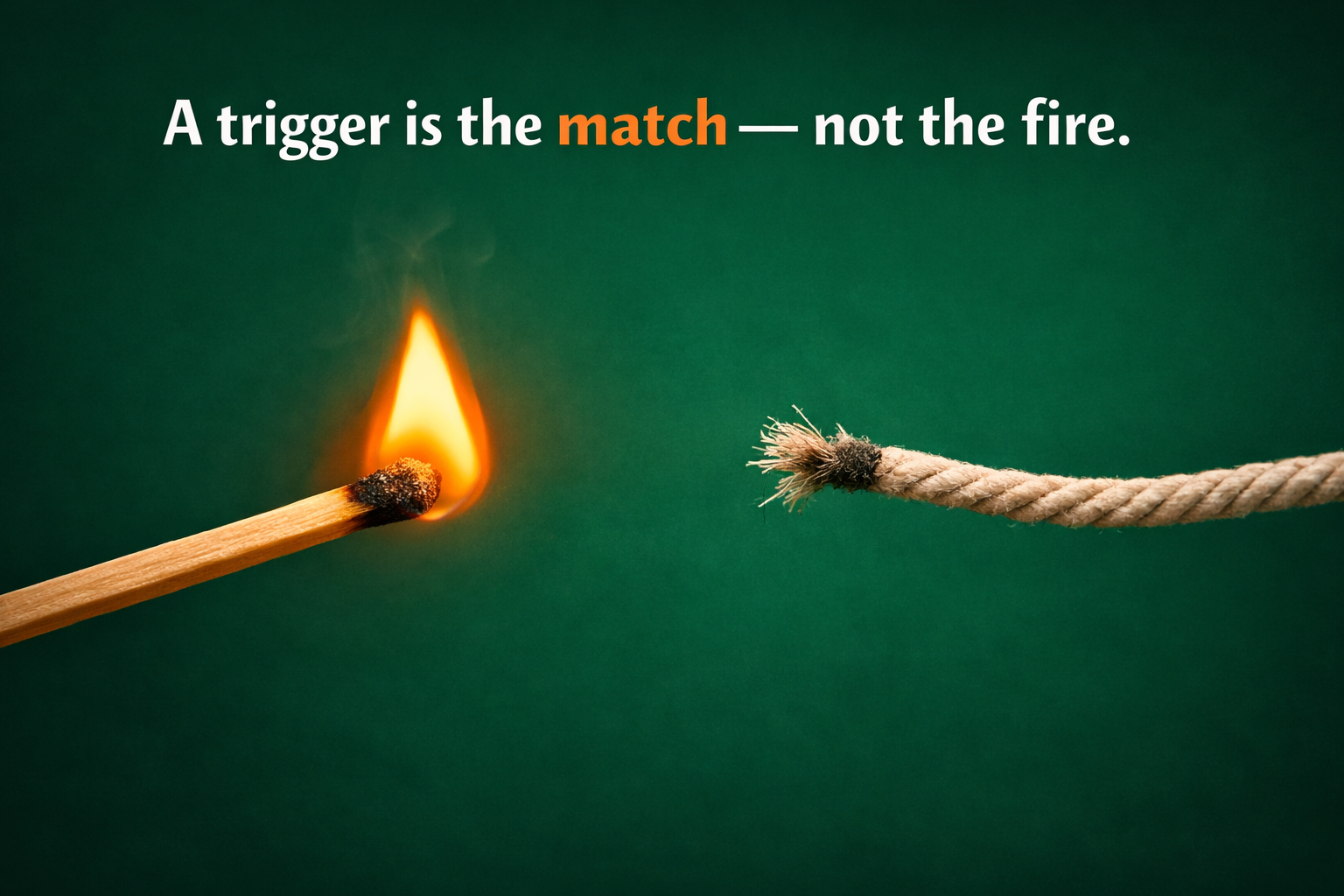
Here's the simplest definition I can give you, and it's worth memorizing:
A trigger is anything that activates your anger response.
A trigger is the moment something happens — out in the world or inside your own head — and your anger switches on. Someone interrupts you. A driver cuts you off. A memory surfaces. A thought lands: "They did that on purpose." Any of those can be a trigger.
But here's the part to hold onto for the whole module: a trigger is just the match. It is not the fire. The match lights a fuse — but the fuse only burns because there's already something there to burn. We'll come back to that. First, let's learn to spot triggers, because you can't manage what you can't see.
2 · The Two Kinds of Triggers
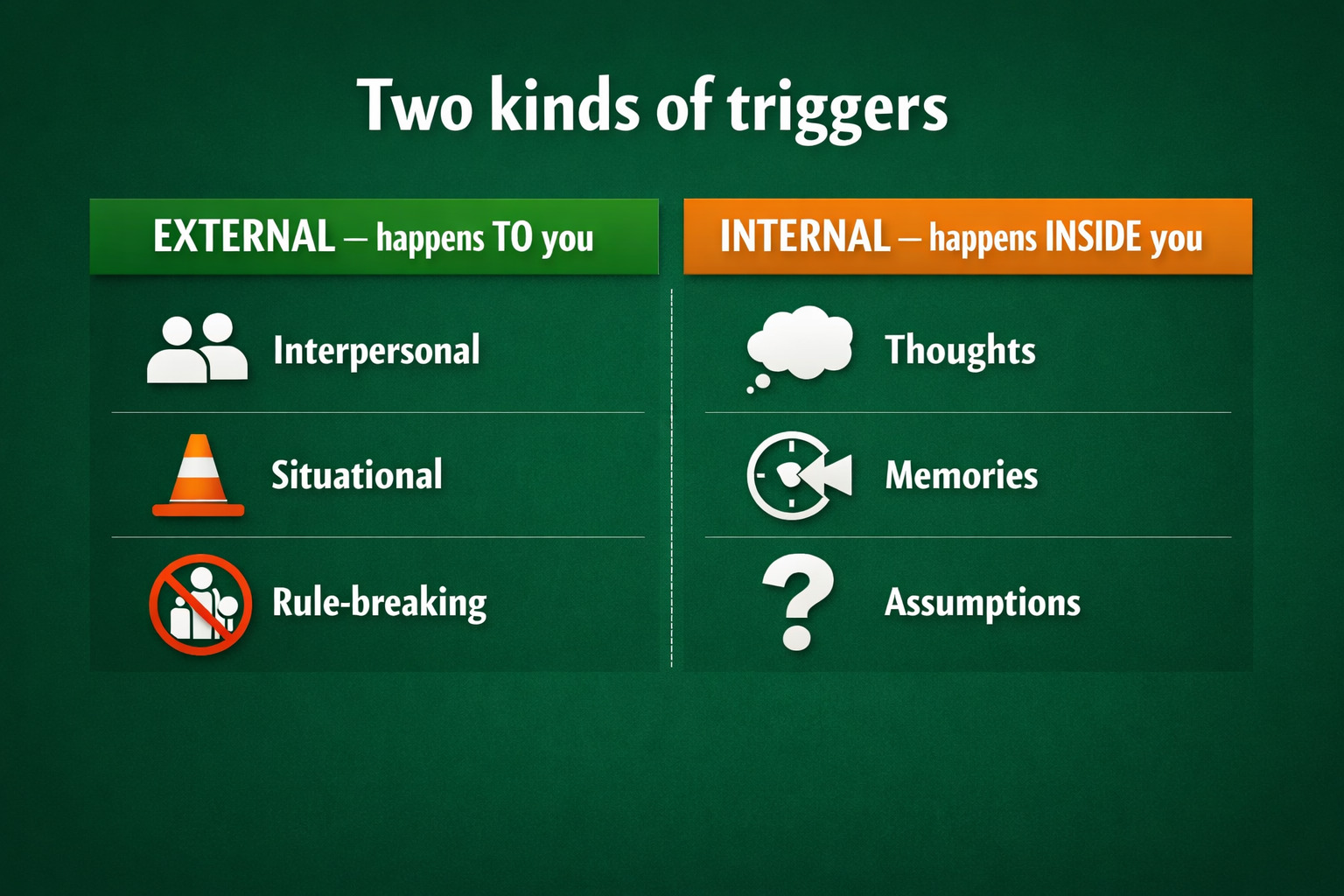
Triggers are made up of external triggers and internal triggers.
External triggers are the things that happen outside of you — events you didn't choose. Internal triggers are the messages you give yourself: the thoughts that get you all worked up, often built on assumptions, incorrect information, or unhelpful thinking. It's important to notice the signal cues your body gives you when one of these gets activated — because the sooner you notice, the better your chance of managing your anger before you're running on autopilot out of your primitive brain.
External triggers — things that happen outside of you:
- Interpersonal: being interrupted or talked over; feeling disrespected or dismissed; being lied to or deceived; having your words twisted; being blamed for something you didn't do.
- Situational: traffic jams or slow drivers; long lines or delays; technology not working; loud noises or disruptions; crowded, chaotic environments.
- Rule-breaking: people cutting in line; others ignoring established procedures; witnessing unfairness or injustice; someone taking advantage of others.
Internal triggers — thoughts, memories, and interpretations inside your head:
- Thought triggers: "They did that on purpose." "This is so unfair." "I always get treated badly." "Nobody respects me."
- Memory triggers: remembering past hurts or betrayals; situations that remind you of something painful; a person who resembles someone who hurt you.
- Assumption triggers: assuming negative intent; expecting the worst outcome; believing you already know what other people are thinking.
One quick truth worth pausing on. Anger is very often a cover for something else — guilt, shame, disappointment, resentment, frustration, sadness, or anxiety. Those feelings can be hard to express, so anger shows up first. Keep that in mind as you read your own triggers: the thing that looks like the trigger isn't always the whole story.
3 · The Most Important Idea: Trigger vs. Cause
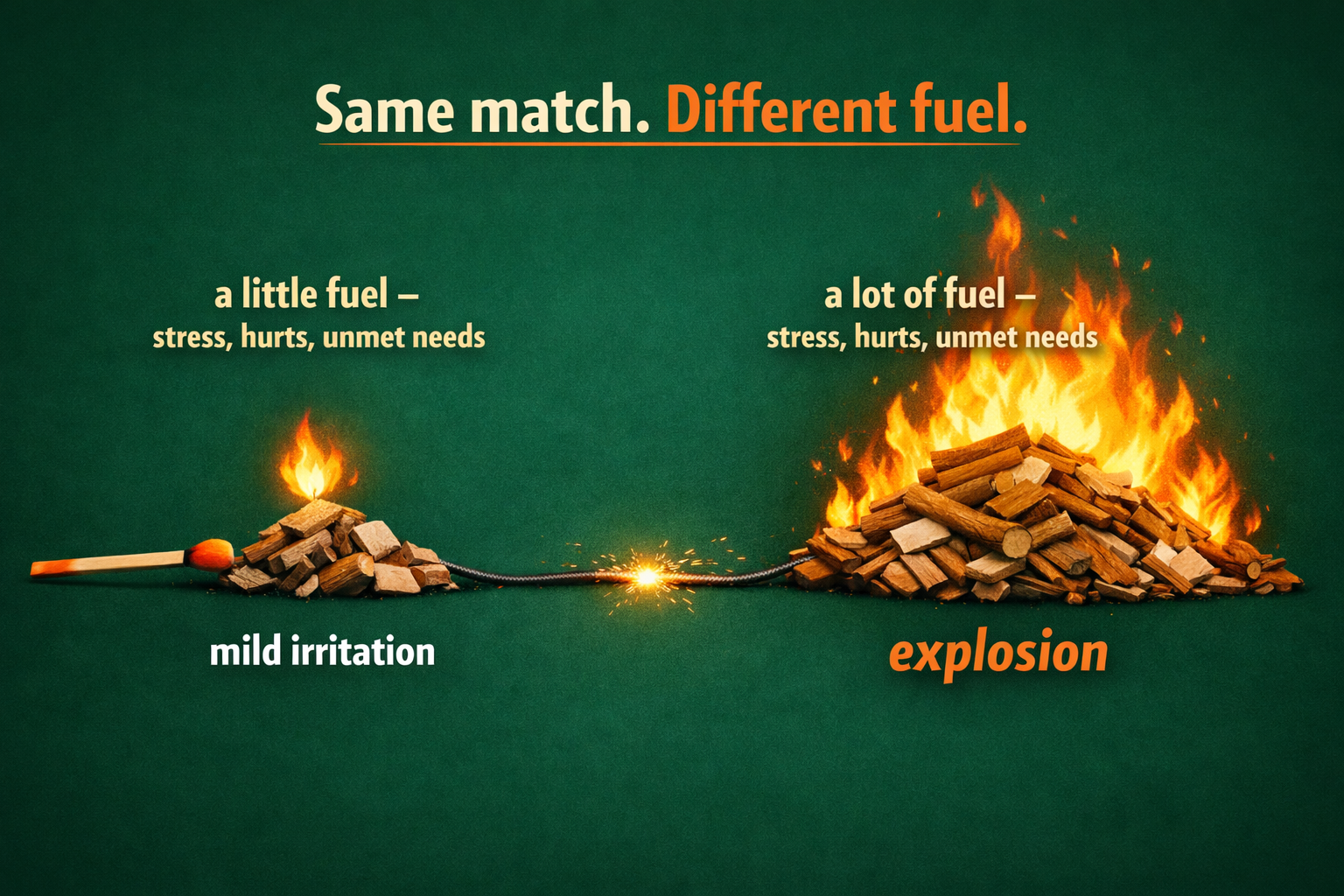
Here's something crucial: the trigger is not the cause of your anger. The trigger is just the match that lights the fuse. The cause is all the combustible material that was already there — stress, past hurts, unmet needs, unrealistic expectations, fatigue.
This is hard to keep straight, because many of us were raised by people who used guilt to motivate us, and we learned to point at the other person — "They made me angry." But watch what happens when you separate the two:
Same trigger. Different fuel. Completely different reaction.
Trigger: someone cuts in line.The trigger was identical. What changed was how much fuel was already stacked up.
- Low combustible material (rested, calm, needs met): mild irritation, easily managed.
- High combustible material (high stress, past hurts, unmet needs, running on empty): explosion.
And here's why that's such good news: you can't always control the triggers, but you have far more control over the underlying causes. People will cut you off in traffic — that's not up to you. How much fuel you're carrying when they do — that you can work on. That's most of what this program is about.
4 · Where Triggers Really Come From
Life experiences that once produced feelings like embarrassment, insecurity, or fear often come back as anger when a similar experience shows up later in life. Your present-day trigger reached back and touched an old wound — and that's why the reaction can feel bigger than the moment seems to call for.
The encouraging part: once you understand the source of a trigger, you can plan around it:
"If you know that going grocery shopping on Saturdays is a trigger for you because the store is crowded, then instead of getting angry — talk to your partner about finding an alternative."
That's the whole move. You're not trying to never feel the trigger. You're learning to see it coming and make a different choice before it lights the fuse. Figuring out your triggers is the first step to real self-awareness — and lasting change only happens once you take the time to understand them, not just notice them.
5 · Four Ways People Respond to Triggers
When a trigger lands, most people fall into one of four habitual styles. See if you recognize yours — there's no shame in any of them, but only the last one tends to serve you well.
- The Exploder. Immediate, intense reaction — let it all out right now. "I have to let them know how I feel!" Looks like: yelling, arguing, aggressive confrontation. Often feels better for a moment — and damages the relationship.
- The Imploder. Turns the anger inward, suppresses it, pretends it isn't there. "I shouldn't feel this way." "It's not worth making a fuss." Looks like: silent treatment, withdrawal, "I'm fine" when clearly not. The anger builds until it explodes or turns into physical symptoms.
- The Displacer. Can't aim the anger at the real target, so it lands somewhere "safer." "I can't say anything to my boss — but I can let my family have it." Looks like: pleasant at work, angry at home. The real problem never gets solved, and innocent people get hurt.
- The Healthy Responder. Recognizes the anger, understands what it's about, and responds on purpose. "I'm angry about this, and I need to find the best way to address it." Looks like: direct but respectful communication, focused on solving the problem. The problem gets handled, and the relationship stays intact — or even improves.
The destination. None of the first three styles are "bad people" styles — they're just learned habits, and habits can change. The Healthy Responder isn't a personality type you were either born with or not. It's a skill, and the rest of this program is how you build it.
6 · Your Hot Buttons: Personal Landmines
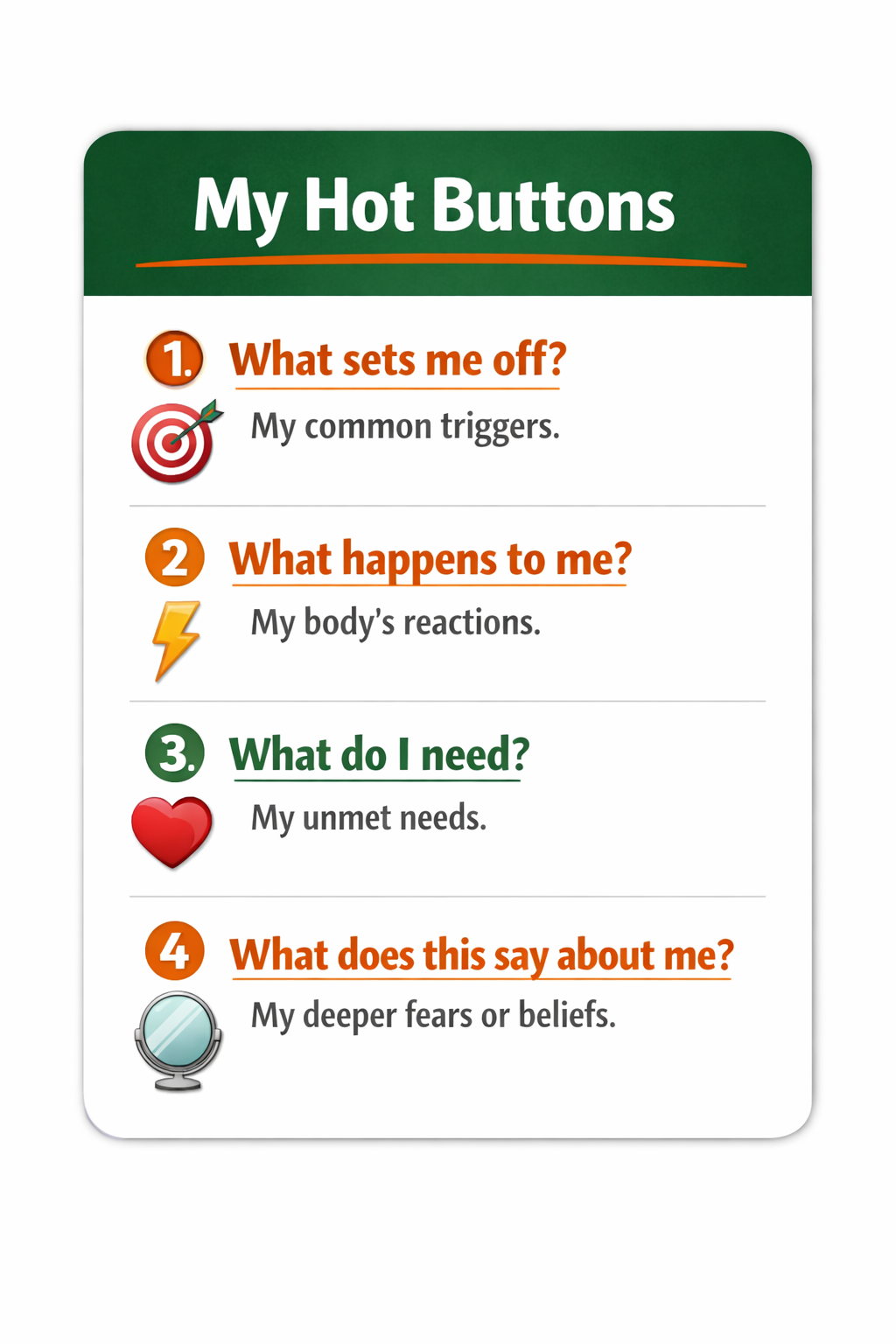
Hot buttons are the triggers that reliably set you off. They're not the real cause of your anger — like all triggers, they're still the match that lights the fuse — but they're the ones that spark the strongest reactions in you specifically. Triggers vary in intensity: some bring mild irritation, others can bring near-uncontrollable rage. A hot button is usually the one that elicits an intense reaction, or the one that frequently sparks your anger.
Hot buttons tend to be things that:
- fall short of your expectations,
- block your goals,
- attack your self-esteem,
- violate your values, or
- give you a feeling of loss or helplessness.
To start mapping yours, sit with these questions (you'll go deeper on them in your workbook activity):
- Which category of trigger resonates most strongly with you?
- What specific situations in that category set off your strongest reactions?
- What core need is threatened when those buttons get pushed? (respect? fairness? safety? control?)
- How do you typically react when those buttons are activated?
Putting it together. A trigger is the match. Your hot buttons are the matches that light your fuse fastest. And the cause — the fuel — is what you actually have the power to change. You won't always control what happens to you. But the more clearly you can name your triggers and your hot buttons, the sooner you'll see anger coming — and the more often you'll get to choose your response instead of being surprised by it. That's awareness, and awareness is the superpower you already have.
Knowledge Check
Your knowledge check for this lesson is an interactive game you'll play inside the course. Look for it when you reach the end of this section — it's designed to help the ideas stick in a way that's actually fun. You've got this.