The REBT Model
- Explain the single most important idea in this module: it isn't what happens to you that makes you angry — it's what you think about what happens.
- Use the ABC Model (Activating event → Beliefs → Consequences) to break down any anger episode and find the real driver.
- Recognize the four kinds of irrational beliefs that manufacture anger — demandingness, awfulizing, low frustration tolerance, and global rating — and tell them apart from rational ones.
- Walk through the three steps of the REBT thinking method: identify the belief, dispute it, and replace it with a flexible, realistic alternative.
- Catch a hostile interpretation in the moment — the "they did that on purpose / they don't respect me" reflex — and run it through the model before you react.
1 · The Idea That Changes Everything
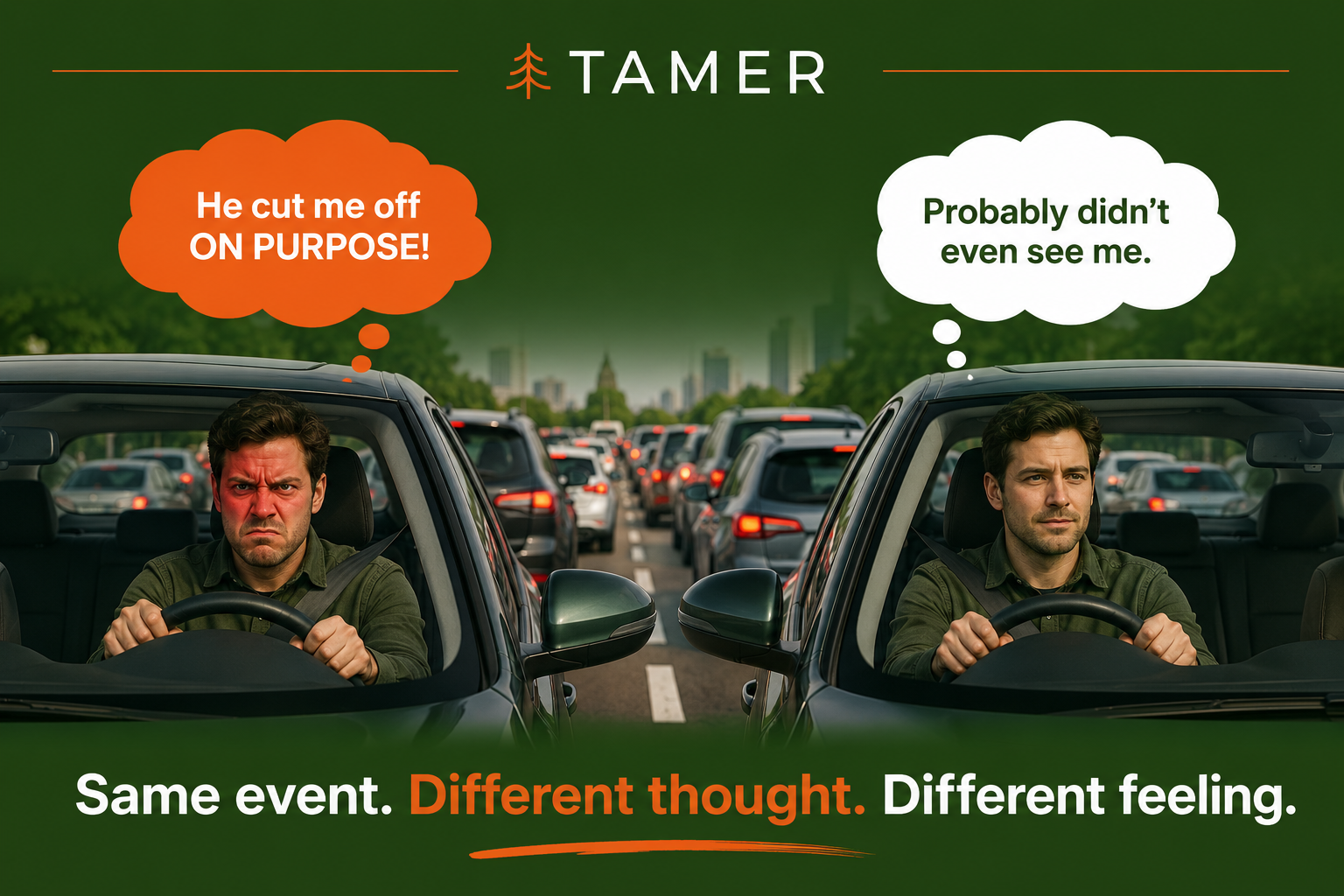
Let me tell you the truth I open this chapter with: the biggest factor in whether you get angry isn't what happens to you — it's what you think about what happens to you. Two people can experience the exact same event and have completely different emotional responses, based entirely on the stories they tell themselves about it.
After thirty years in criminal justice and anger management, I can tell you the difference between someone who gets angry once in a while and someone who's angry all the time usually isn't their circumstances — it's their thinking patterns. The person who's angry constantly has built thinking habits that practically guarantee anger. The good news, and the whole point of this module, is that those patterns were learned — which means they can be unlearned and replaced with better ones.
Fair warning: this might be a little uncomfortable. We're going to look at some thoughts you may have been carrying around for years without ever questioning them. But that discomfort is the work paying off.
2 · Meet the ABC Model
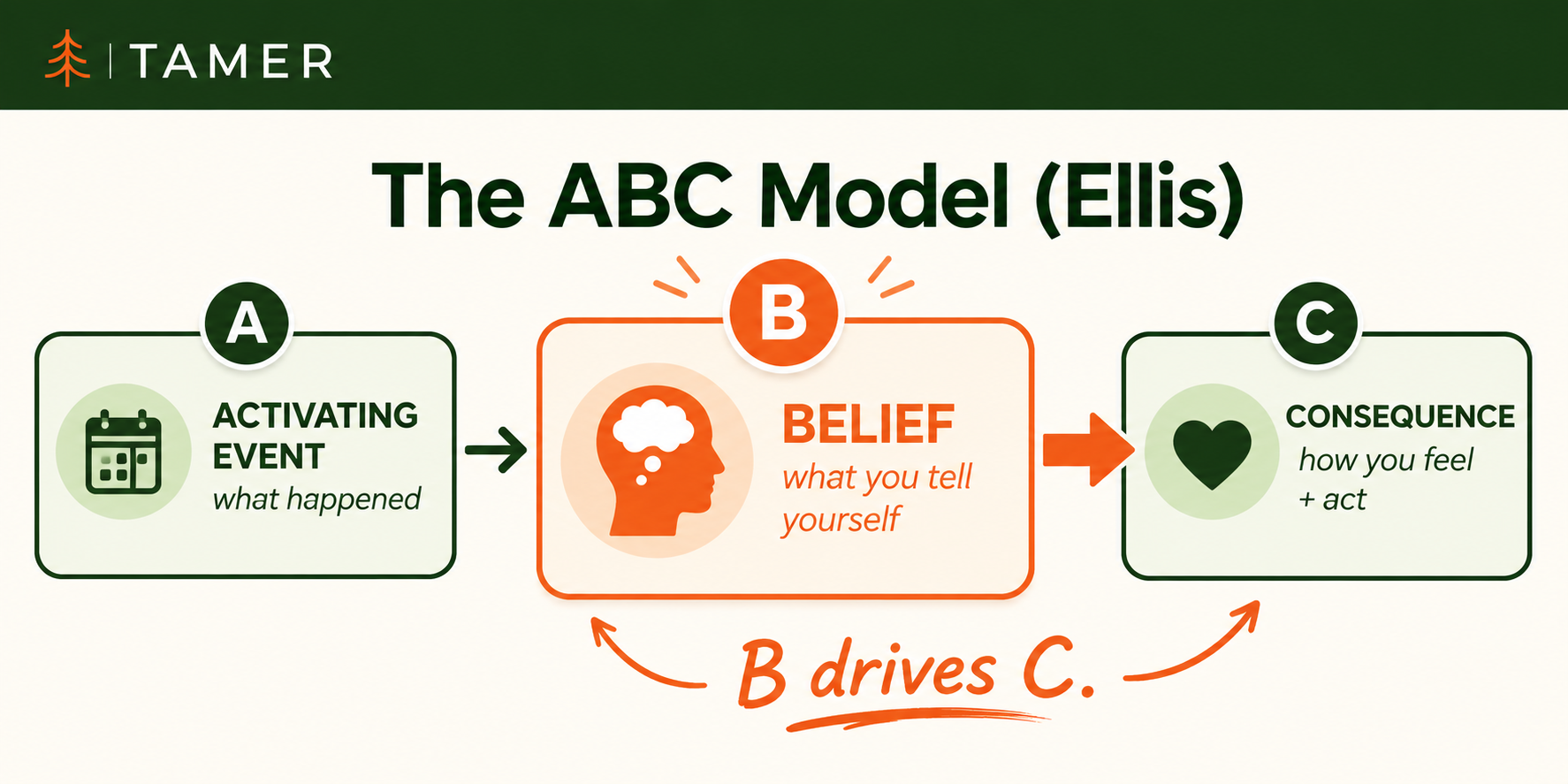
The ABC Model was developed by the psychologist Albert Ellis, and it's one of the most useful ideas you'll ever learn for managing anger. Three letters:
- A — Activating event. Something happens. Just the facts: what actually occurred.
- B — Beliefs. Your interpretation — the story you tell yourself about what happened.
- C — Consequences. Your emotional and behavioral response — how you feel and what you do.
Now here's the key insight that changes everything: A doesn't cause C. B causes C. The event doesn't create your emotions — your thoughts about the event create your emotions. You can't always control A (what happens to you), but you have real, significant control over B (how you think about it). That's where your power lives.
The unreturned phone call.
A — Your friend doesn't return your call.
B1 — "She's probably busy with work or family." → C1 — You feel fine, maybe a little curious.
B2 — "She's ignoring me. I must have done something wrong." → C2 — You feel hurt and anxious.
B3 — "She's being rude and inconsiderate." → C3 — You feel angry and resentful.
Same event. Three different thoughts. Three completely different emotional outcomes. The phone call didn't pick your feeling — your belief did.
3 · The Hostile Read: When B Assumes the Worst
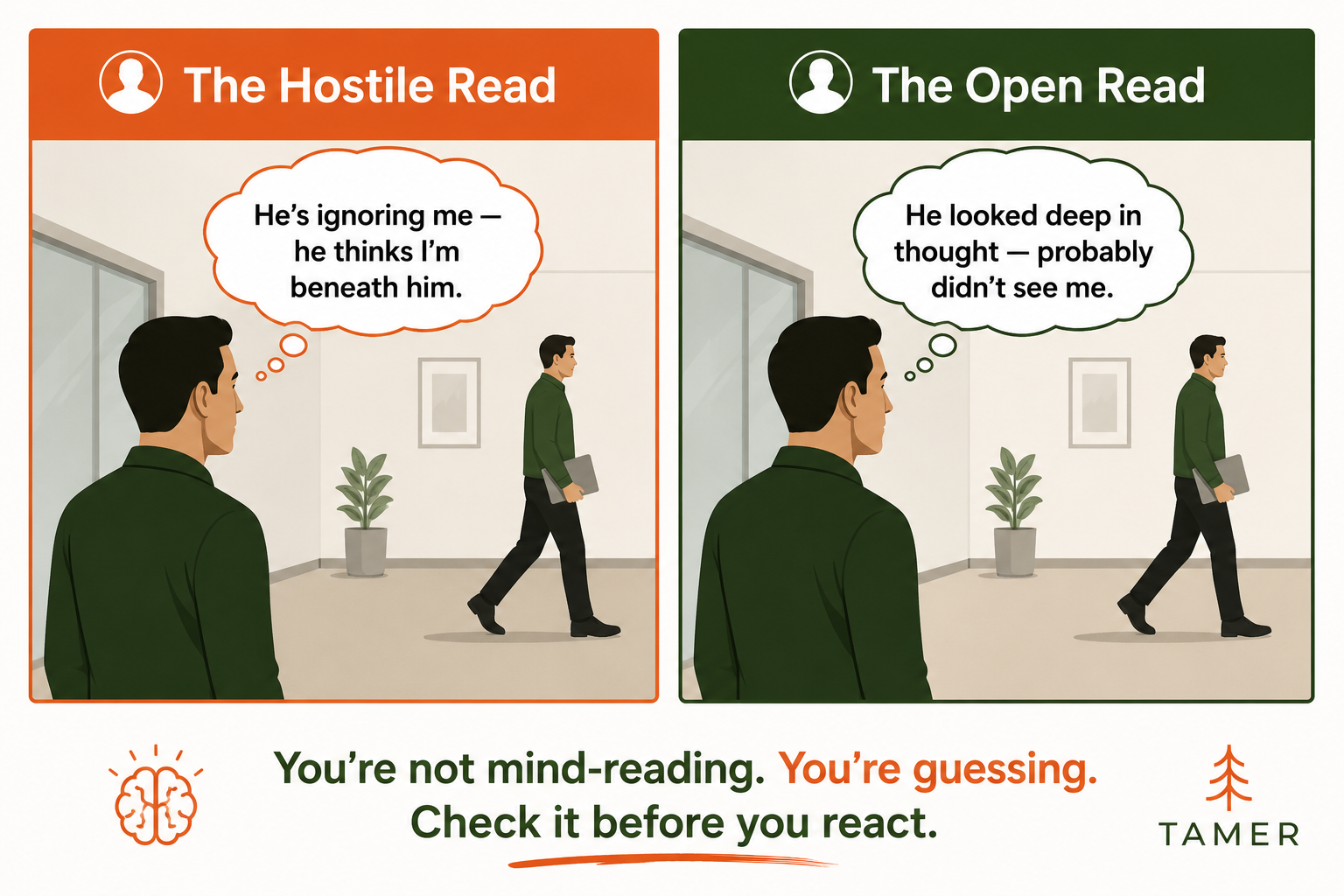
Of all the beliefs that manufacture anger, one deserves its own spotlight: the hostile read — automatically assuming someone meant to wrong you. It sounds like:
- "They did that on purpose."
- "They're disrespecting me."
- "They don't take me seriously."
This is the mind-reading trap: you assume you know what someone else is thinking — usually something negative about you — and then you respond to your assumption instead of to reality. Here's the problem with that: you're not psychic. You're making an educated guess from limited information, and most people are terrible guessers. Most of the time, the other person isn't thinking about you at all — they're wrapped up in their own concerns.
The cousin of mind-reading is personalization — taking everything as if it's aimed at you. "The waiter is slow on purpose to annoy me." "She's in a bad mood because of me." When you take everything personally, you spend your whole day defending yourself against attacks that were never launched.
Watch how the B changes the C:
| Belief that creates anger | Alternative belief that reduces anger |
|---|---|
| "They did that on purpose" | "I wonder what's really going on here" |
| "This is so unfair" | "This is frustrating, but it's not the end of the world" |
| "They should know better" | "People aren't perfect, including me" |
| "I can't stand this" | "I can handle this situation" |
| "They don't respect me" | "Maybe there's something I don't understand" |
The trap in one line: when you assume the worst about someone's intent, you respond to a story in your head — not to the person in front of you.
4 · The Four Beliefs That Manufacture Anger
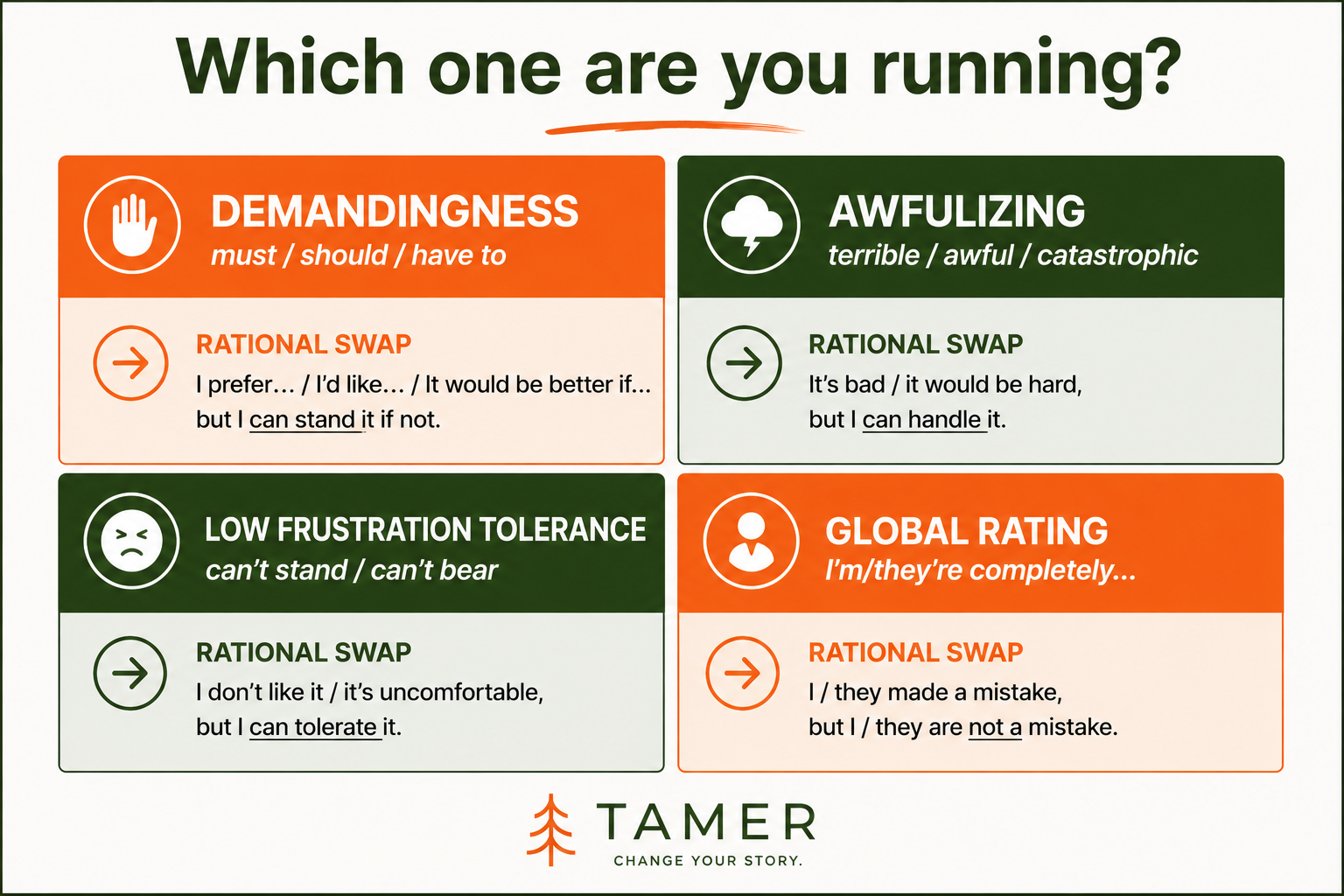
Ellis took the ABC model further by asking a sharper question about B: is that belief rational or irrational? An irrational belief is rigid and extreme — inconsistent with reality, illogical, and it leads to unhealthy results for you and your relationships. A rational belief is flexible and reasonable. Almost every anger-producing thought falls into one of four types. Learn to name them:
| Irrational belief (fuels anger) | Rational alternative (cools it) |
|---|---|
| Demandingness — "People MUST treat me fairly." | Preference — "I prefer fair treatment, but I can handle unfairness." |
| Awfulizing — "It's terrible and awful when things don't go my way." | Perspective — "It's disappointing, but it's not the end of the world." |
| Low Frustration Tolerance — "I can't stand it when people are difficult." | Frustration Tolerance — "I don't like difficult people, but I can handle them." |
| Global Rating — "People who do bad things are bad people." | Specific Evaluation — "People who do bad things are people who did a bad thing." |
Notice the pattern. The irrational column is full of musts, shoulds, terribles, can't-stands, and always/nevers. As I say in the book: "should" is often code for "I want the world to work differently than it does." It's like getting angry at gravity for making things fall down instead of up.
5 · The REBT Method: Identify, Dispute, Replace
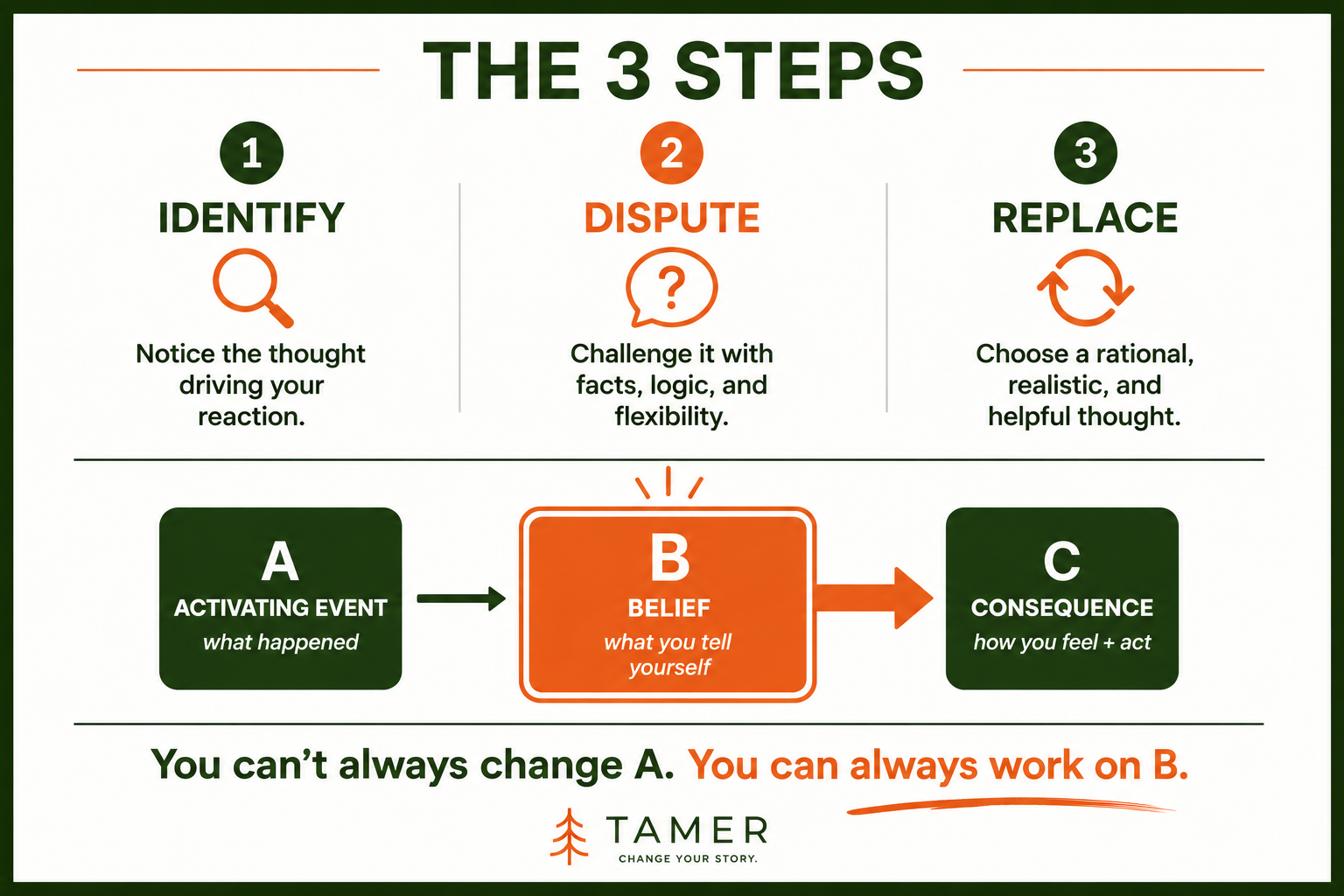
So how do you actually change a B? That's the job of REBT — Rational Emotive Behavior Therapy, a recognized short-term thinking model developed by Albert Ellis. We use it here as an educational self-help tool — a way to challenge a self-defeating thought and swap it for a healthier one. It comes down to three steps:
- Identify the irrational belief. What demanding, awfulizing, or intolerant thought is driving your anger right now? (Use the four types from Section 4 to name it.)
- Dispute the irrational belief. Put it on trial and ask for the evidence:
- Where is it written that people must treat me fairly?
- How is this truly awful rather than just unpleasant?
- What actual evidence do I have that I can't stand this?
- Replace it with a rational alternative. Build a flexible, realistic belief that honors your preference without demanding that reality obey it.
Here's the worked example straight from the Workbook:
REBT in practice.
Situation: A coworker takes credit for your idea in a meeting.
Irrational belief: "He should NEVER do that! It's awful that he's so dishonest! I can't stand working with people like this!"
Dispute: "Where is it written that coworkers should never take credit for others' ideas? How is this awful rather than just frustrating? What evidence do I have that I genuinely can't handle this?"
Rational belief: "I prefer that coworkers give credit where it's due, and I can handle it when they don't. This is frustrating and disappointing — but it's not the end of the world. I can address it directly with him and my supervisor."
Look at what just happened. The event never changed. The coworker still took the credit. But the belief changed from a rigid, explosive "should/awful/can't-stand" into a flexible "prefer/disappointing/can-handle" — and that's what drops the anger from a 9 down to a 3, and frees you to actually solve the problem.
6 · Robert's Story — Putting It to Work
Let me tell you about Robert, who came to my program after some road-rage incidents that were starting to cost him his job — he was a delivery driver. Robert's thinking was packed with shoulds and hostile reads: "People should know how to drive," "Idiots shouldn't be allowed on the road," "They're doing this on purpose to make me late."
When we worked through his belief system, Robert discovered his anger wasn't really about other drivers at all — it was about his fear of being criticized at work for late deliveries. Once he saw that, he could address the real problem: he talked to his supervisor about realistic delivery times and built better stress-management habits.
Here's the honest ending. Robert didn't become a perfect driver, and he didn't stop noticing bad traffic. He just stopped taking it personally — and that made all the difference. That's the whole goal of this model. Not to pretend nothing bothers you. To think accurately and helpfully about what's happening, so you respond with wisdom instead of reactive anger.
Two ways to start this week (small and doable):
- The 1% Better rule. Don't try to rewire everything at once. Catch yourself in one thinking pattern per day. Small, consistent reps compound.
- The If-Then plan. Decide your move in advance: "If I catch myself thinking 'they always…', then I'll swap in 'sometimes' instead." "If my jaw clenches, then I'll take three slow breaths and ask, 'what am I really telling myself right now?'"
Knowledge Check
Your knowledge check for this lesson is an interactive game waiting for you inside the course — play it to put the ABC Model, the four belief types, and the Identify–Dispute–Replace steps to the test. You've got this.