Stress and Anxiety
- Explain what the stress-and-anxiety response (“fight-or-flight”) is and why your body has it.
- Describe how chronic stress lowers your anger threshold — why a high-stress day puts you on a short fuse.
- Tell the difference between stress (pressure happening now) and anxiety (worry about what might happen next), and recognize each in yourself.
- Map the Stress–Anger–Anxiety triangle and explain how the three feed each other.
- Notice your own early warning signs of stress building, so you can step in before it turns into anger.
1 · Why We Start Here
I want to begin this whole part of the program in a place that might surprise you. Not with anger — with stress and anxiety.
Here’s why. In thirty years in criminal justice and anger management, I learned that anger almost never shows up alone. It grows in soil, and that soil is usually stress and anxiety. So before we dive into anger specifically, we need to understand these two, because they set the stage for how intensely you’ll experience anger when it arrives.
Think of it this way: anger is the fire, but stress and anxiety are the dry brush all around it. You can stomp out one flame after another, but if the whole field is bone-dry, you’re going to be fighting fires all day. Clear the brush first, and a stray spark has nowhere to go.
2 · Your Body’s Emergency Response System
Stress and anxiety are common, normal responses to anything that makes you feel threatened, or that upsets your sense of being OK in some way. When you sense danger — whether it’s real or just imagined — your defenses kick into high gear in a rapid, automatic process you’ve probably heard of: “fight-or-flight.” It’s also fair to call it the stress-and-anxiety response.
And here’s the part I most want you to hold onto: this response is your body’s way of helping you survive. When it’s working the way it’s supposed to, it keeps you focused, energetic, and alert. In a true emergency it can save your life — giving you extra strength to protect yourself, or slamming on the brakes before an accident. It can even help you rise to ordinary challenges: it’s what keeps you sharp during a presentation or energized to get a hard job done.
So the response itself is not the enemy. It’s a gift from a few hundred thousand years of survival.
Beyond a certain point, the stress-and-anxiety response stops being helpful and starts doing real damage — to your health, your mood, your thinking, your relationships, and your ability to function normally. And it’s all happening automatically, mostly outside your awareness.
That matters. You are not weak, and you are not “choosing” to feel this way. Your biology is doing exactly what it was built to do. Our job in this program isn’t to shut the system off — you couldn’t if you tried. Our job is to learn to work with it instead of being blindsided by it.
3 · Stress: The Background Music of Your Emotions
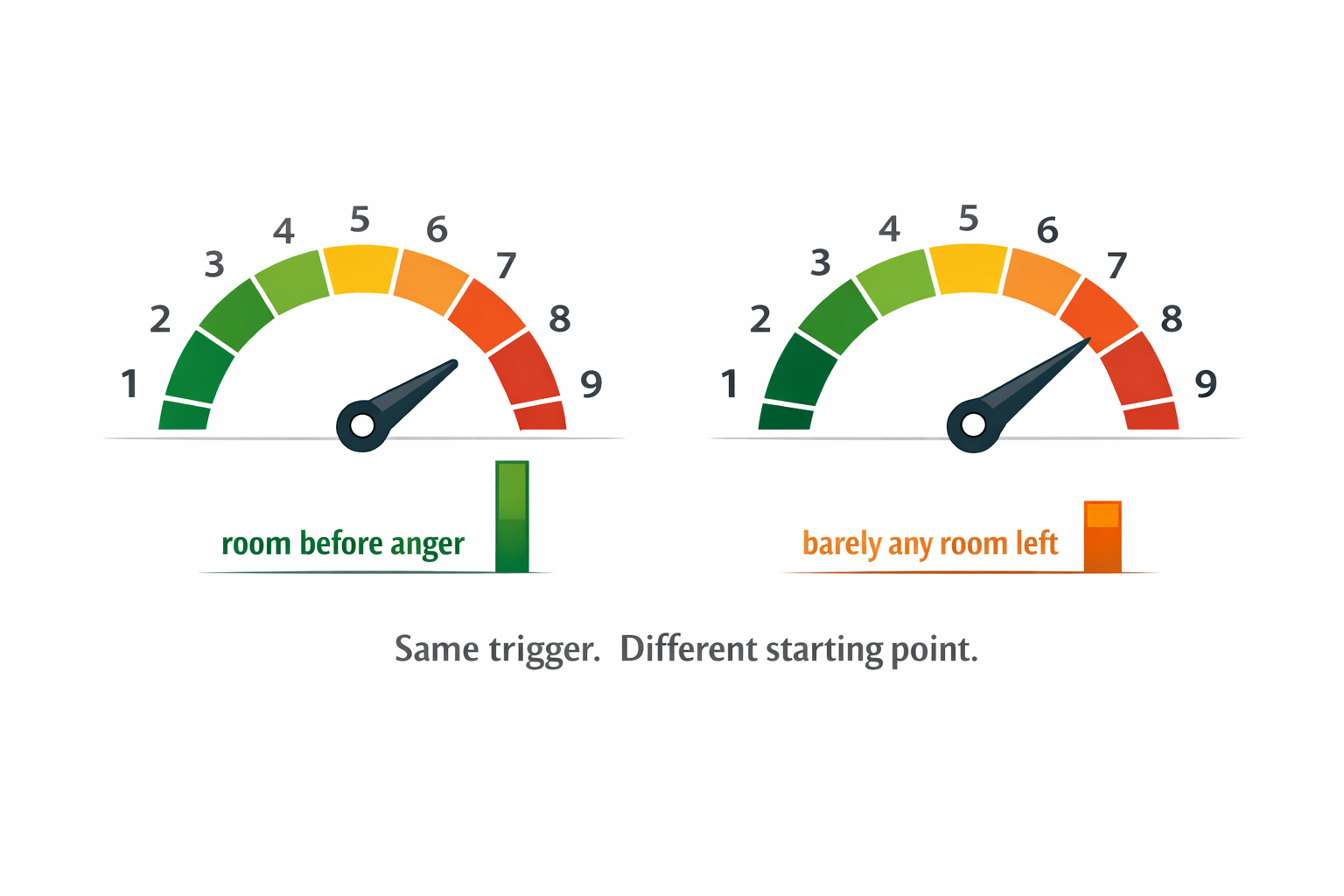
Let me give you the single most useful idea in this module. Stress is like background music for your emotions — it’s always there, quietly influencing everything else you feel. And here’s what it does to anger: when your stress is high, your anger threshold drops.
Picture a dial from 0 to 10. If your stress normally sits at a 3, it takes a pretty significant trigger to push you into real anger. But if your stress is already sitting at a 7, even a small annoyance can send you straight over the edge — the line in front of you, the dropped fork, the kid who won’t put their shoes on.
I worked with countless people over the years who couldn’t understand why they’d “suddenly” become so irritable. And when we looked honestly at their lives, we found the same thing almost every time: their stress had been quietly climbing for months — work pressure, money worries, health problems, relationship strain. They hadn’t become “angrier people.” They were people whose stress had lowered their threshold. The fuse got shorter without them ever noticing.
This is good news, even though it doesn’t sound like it. If your short fuse is really a stress problem, then you don’t have to become a different person. You have to lower the background noise. That’s something you can actually do.
4 · Anxiety: Stress’s Future-Focused Cousin
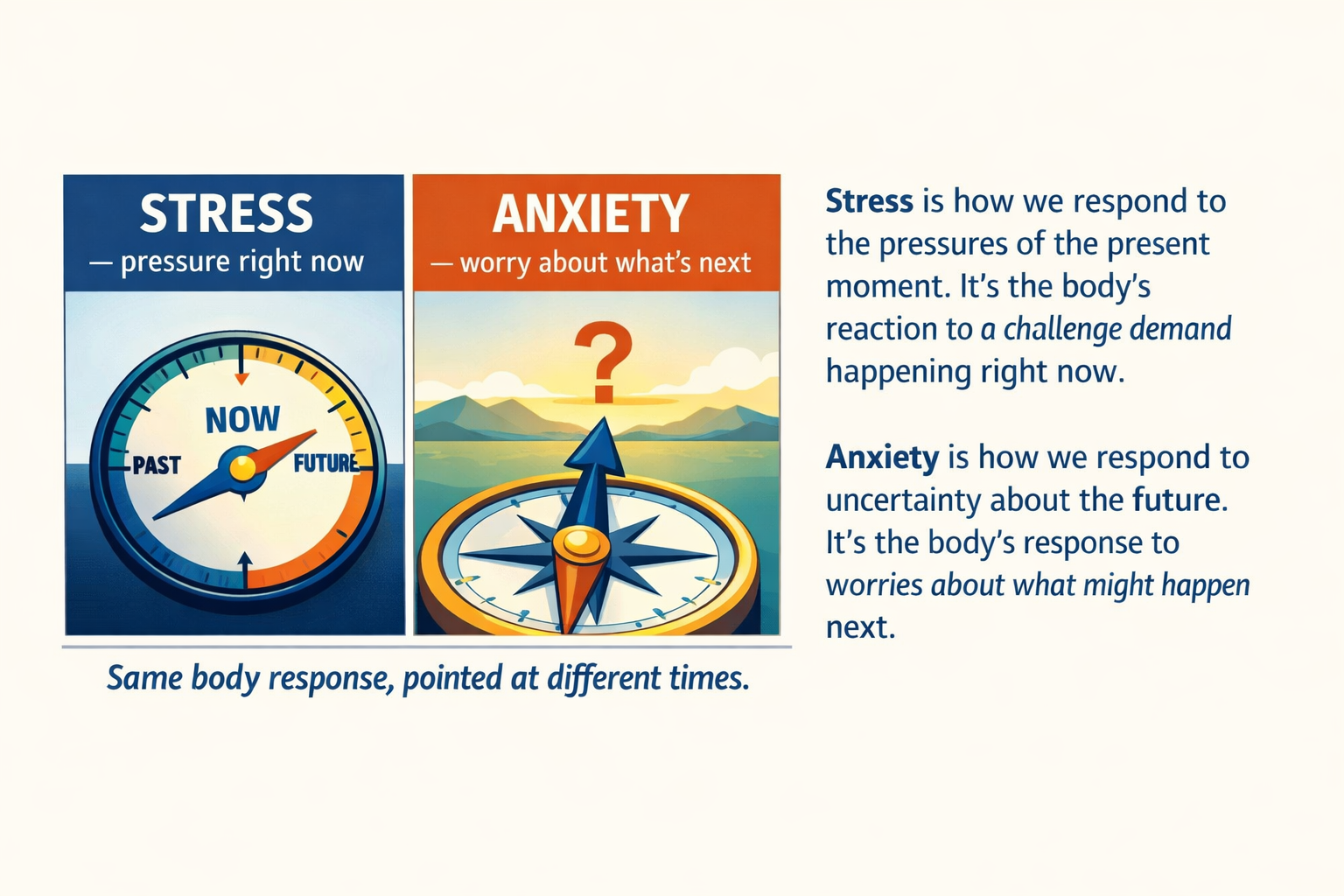
Stress and anxiety are close cousins, but they look in different directions.
Stress is usually about current pressure — the deadline today, the bill due now, the argument you’re in the middle of.
Anxiety is about future threats — real or imagined. It’s the worry about what might happen. And when you’re anxious, your brain is constantly scanning the horizon for danger, which makes you far more reactive to anything that pops up in front of you. You’re already braced for trouble, so trouble finds you faster.
Consider someone — let’s call her Maria — who couldn’t understand why she’d started snapping at her coworkers over little things. As she looked closer, she realized the real source wasn’t her coworkers at all — it was her anxiety about her mother’s declining health. That worry was running in the background all day, leaving her emotionally raw and reactive. Once she faced the anxiety directly, her workplace blowups practically disappeared.
Notice what happened there. The coworkers were never the real problem. They were just the spark that landed on a field that anxiety had already dried out. Maria didn’t need to manage her coworkers better — she needed to tend to the worry underneath.
Everybody feels stress and anxiety — it’s part of being human, and learning to notice it is exactly what this program is for. But if your stress or anxiety is heavy enough that it’s getting in the way of your daily life, that’s worth talking through with a qualified professional. This module is here to build your self-awareness, not to size up or label anything you’re carrying.
5 · The Stress–Anger–Anxiety Triangle
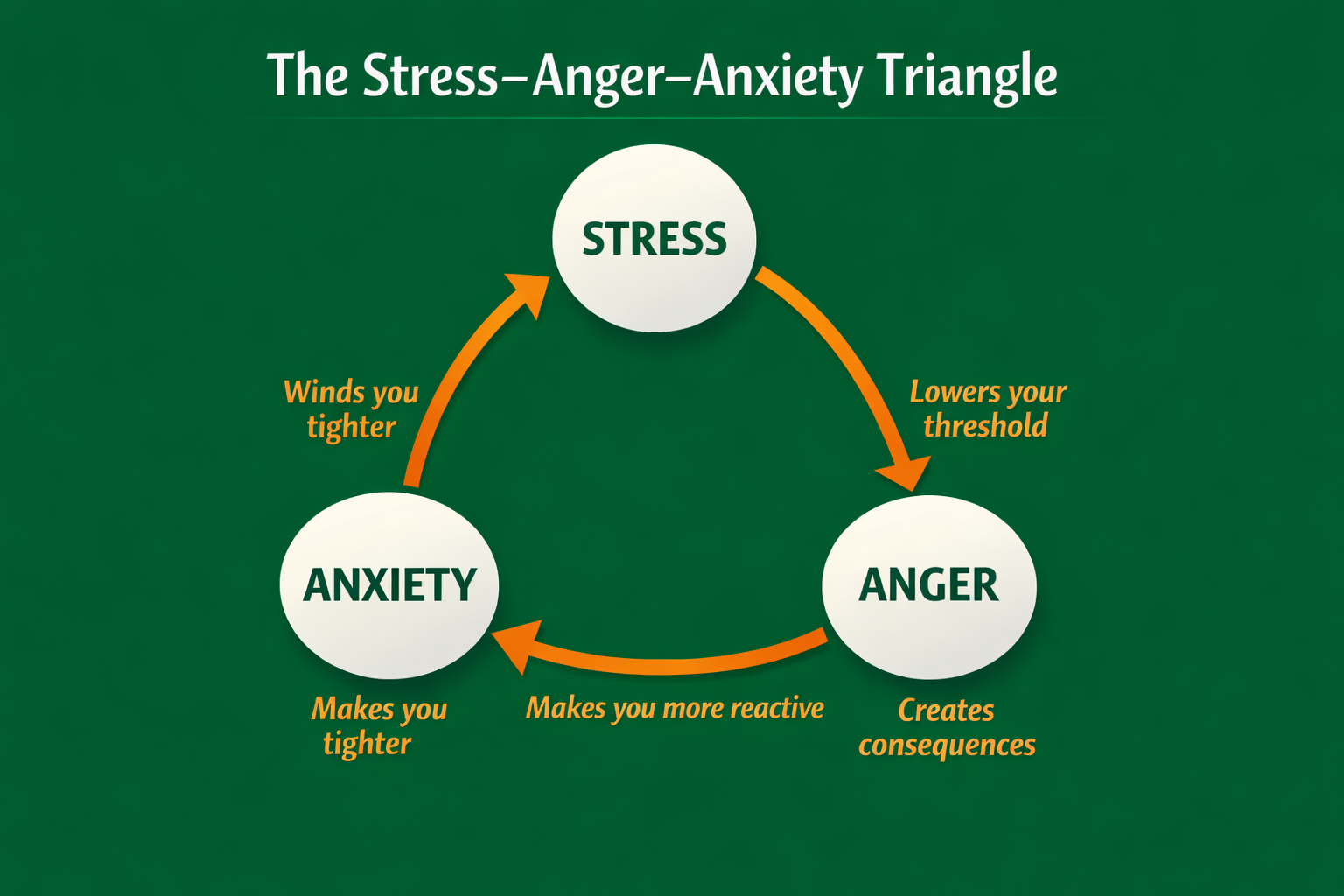
These three don’t politely take turns. They feed each other in a vicious cycle, and once you see the loop, you can’t unsee it:
- Stress makes you more prone to anger — your threshold is already low.
- Anger episodes create more stress — and often consequences (a damaged relationship, a problem at work) that pile on even more stress.
- Stress and anger both feed anxiety about the next conflict — “what if I lose it again?”
- Anxiety makes you more stressed and reactive — and you’re right back at the top of the loop, threshold lower than ever.
Round and round it goes, each lap a little tighter than the last.
Breaking this cycle means addressing all three corners — not just the anger. If you only ever fight the anger, you’re stomping out flames while the field stays dry and the worry keeps scanning the horizon. We work the whole triangle.
And one more honest note: even a moderate amount of stress or anxiety tends to nudge you toward the older, reactive part of your brain — the part that just reacts instead of thinking things through — and increases the likelihood of an angry reaction. That’s not a character flaw. That’s biology. We’ll go deep on the brain in the modules ahead.
6 · Identify Your Stressors
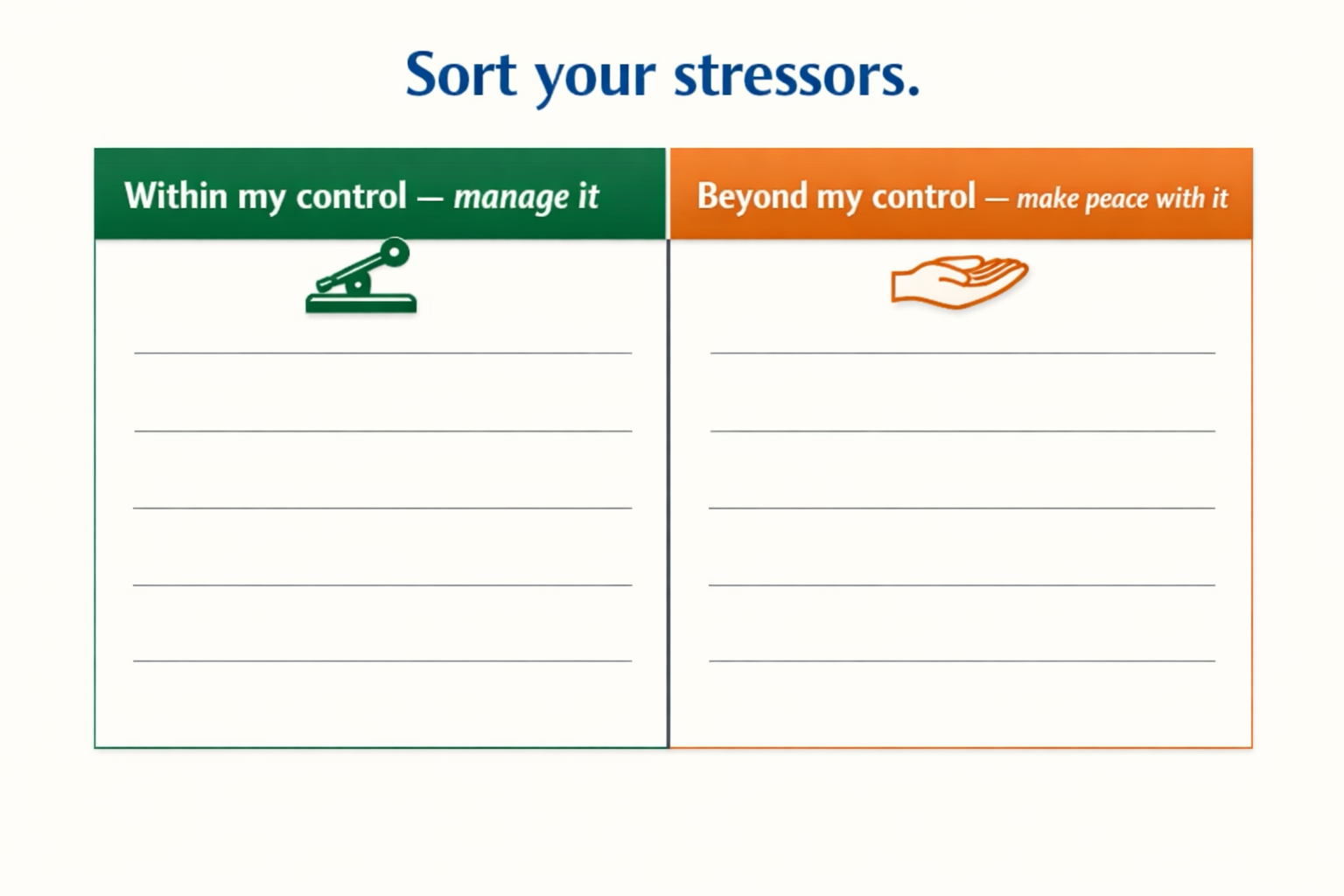
Knowing all this is one thing. Doing something with it is another. The first practical move is simple but powerful: identify your stressors and get specific.
Vague stress feels enormous and unbeatable — a gray cloud sitting over your whole life. But when you actually name your stressors and write them down, one at a time, two things happen. They shrink to a manageable size, and you can start sorting them.
So sort them into two piles:
- Things within your control to manage better. Maybe you can’t quit a deadline-driven job — but maybe you can protect a short lunch break each day, or go to bed earlier so you’ve got more energy to cope. Small, real levers.
- Things beyond your control. Some stressors you simply can’t change without changing your whole situation. For these, the work is different: it’s about acceptance and not burning your energy fighting what won’t move.
When stress runs unmanaged, it’s usually your work performance and your relationships that pay the price first — they’re the early-warning gauges. So this isn’t busywork. Identifying and sorting your stressors is how you start turning the background music down.
Don’t try to eliminate stress — that’s not possible, and chasing it just adds more stress. Sort it. Change what you can, make peace with what you can’t, and stop spending your fuel on the second pile.
7 · Catch It Early: Your Personal Warning Signs
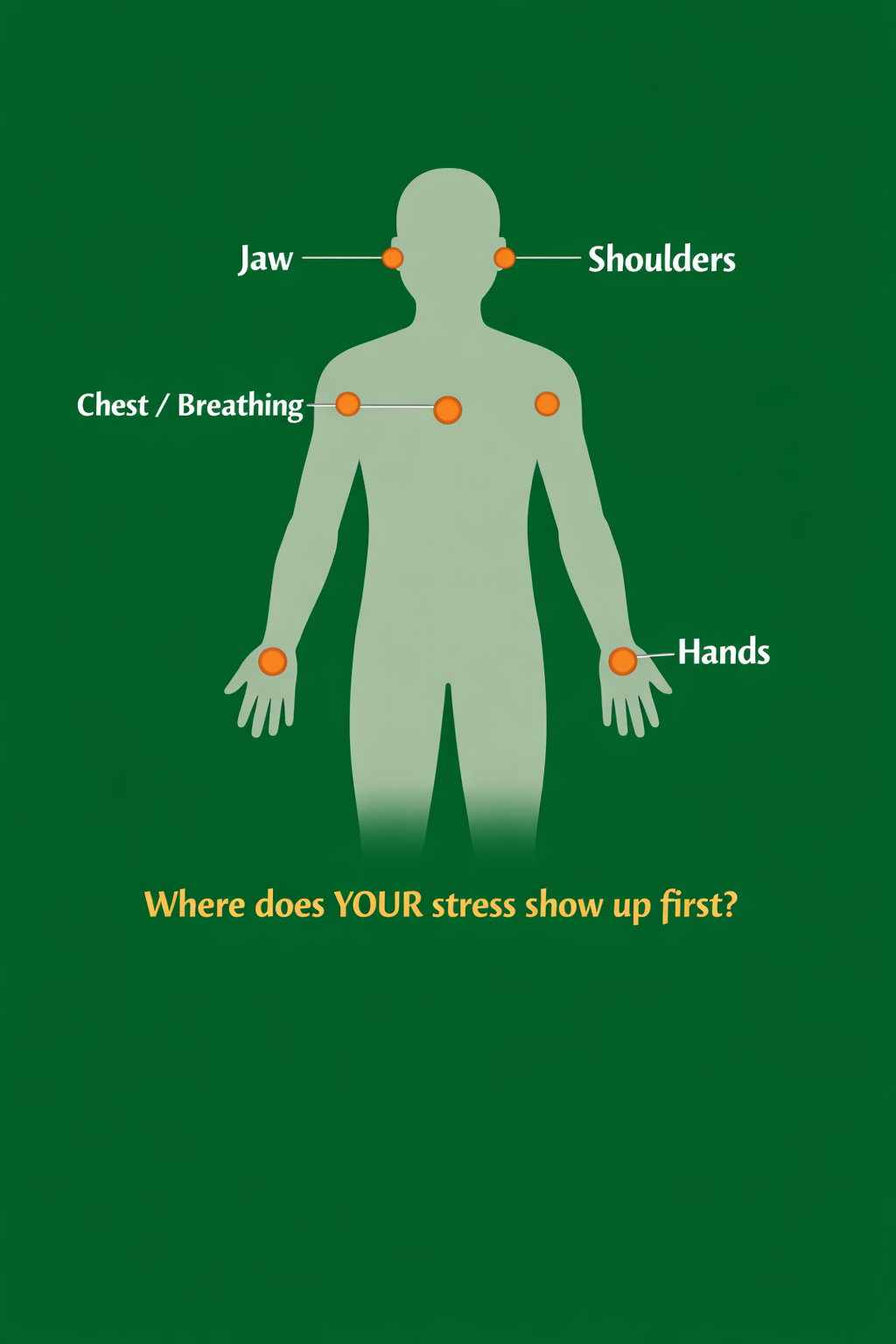
Let me leave you with the move that makes everything else work. Stress and anxiety almost always send up warning flares before they boil over into anger — and your body is usually the first to tell on you, if you’re paying attention.
Everyone’s signals are a little different, but common early signs that your stress is climbing include:
- Body: tight shoulders or neck, a clenched jaw, shallow or faster breathing, a headache building, restlessness or fidgeting.
- Mood: feeling irritable over small things, snapping at people you love, a sense of being overwhelmed or “done.”
- Behavior: sleep getting worse, appetite changing, reaching for substances to take the edge off, withdrawing from people.
The reason this matters so much: the earlier you catch it, the more choices you have. Once stress has already tipped you into full-blown anger, your options narrow fast — your thinking brain is running on fumes. But catch the rising tension at a 4 or a 5, and you’ve still got the whole toolkit available: a few slow breaths, a short walk to burn off the stress, a hard conversation rescheduled for when you’re steadier, a stressor you finally name and sort.
This is the bridge into everything that comes next in the Physiology arc. You’re learning to read your own gauges — and a person who can read the gauges can steer.
Understanding stress and anxiety isn’t just interesting information — it’s practical. Your body is doing exactly what it was designed to do. The work isn’t to fight your biology like you’re arm-wrestling it. The work is to learn its signals, turn the background noise down, and give yourself a little room. Do that, and you’ve already taken the first real step in managing your anger — before it ever shows up.
Knowledge Check
Your knowledge check for this lesson is an interactive game you will play inside the course. Keep going — it counts toward your progress.