Rumination
- Define rumination in plain language and explain why it is the "anger amplifier" — the habit that keeps anger alive long after the moment is over.
- Recognize the five common shapes rumination takes (replaying conversations, building your case, catastrophizing, victim stories, revenge fantasies) and catch them in yourself.
- Explain why rumination is so destructive — how it grows anger, stretches it out, blocks problem-solving, wears on the body, and strains relationships.
- Use the four-step Rumination Buster — Recognize, Name, Redirect, Set Limits — to interrupt the loop early.
- Swap the questions that feed the loop for the questions that break it.
1 · The Broken Record in Your Mind
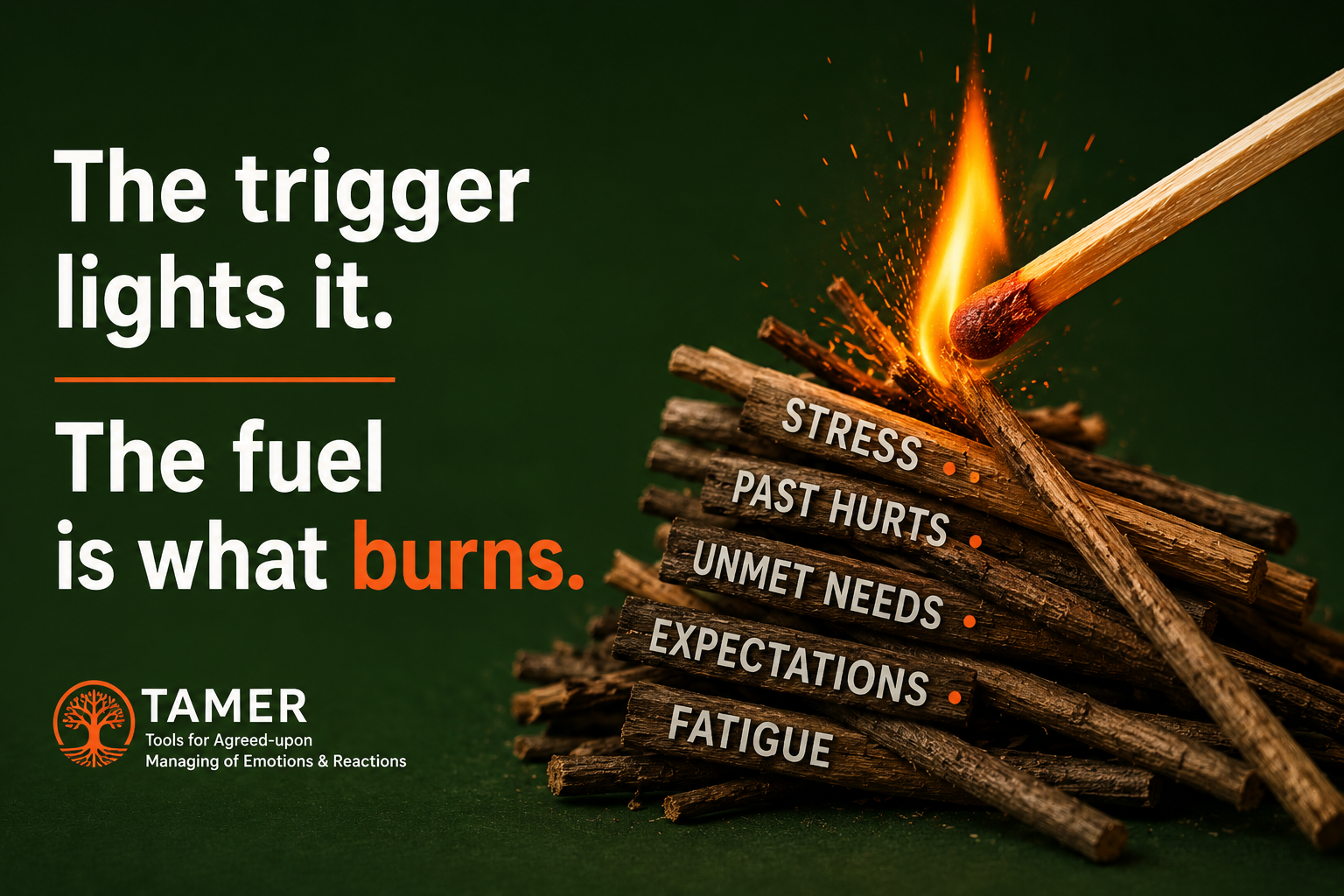
In the Awareness chapter I told you that awareness is the superpower you already have. Rumination is what happens when awareness goes to sleep at the wheel.
Here's the plainest way I can put it: rumination is like a broken record player in your mind. You replay the same angry thoughts over and over, and — this is the cruel part — you usually make yourself angrier in the process. It's one of the most destructive anger habits I've ever seen, because it keeps you stuck in anger long after the event that triggered it is over and done.
The trigger came and went. The other person has moved on. But you're still standing in it, pressing play again.
The one idea to take from this whole module: the trigger lasts a moment, but rumination is what turns a moment into an afternoon — or a week.
2 · What Rumination Looks Like
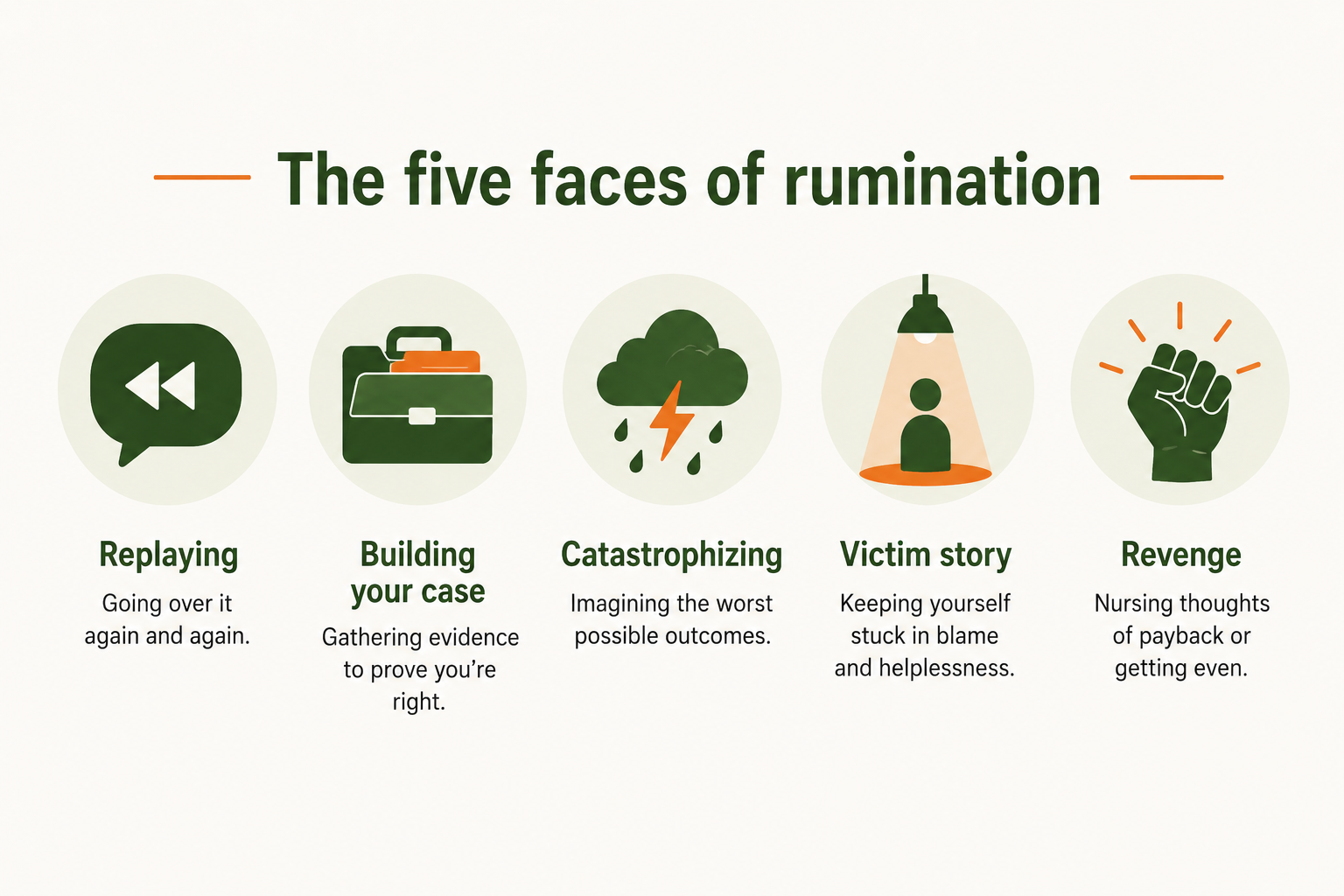
Rumination wears a few different costumes. See if you recognize any of these — most of us have a go-to:
- Replaying conversations. Going over what happened word by word — often rewriting it with the better comeback you wish you'd said.
- Building your case. Quietly collecting evidence of how wrong the other person was, like a lawyer prepping for a trial that's never going to happen.
- Catastrophizing. Imagining all the terrible things that might happen next.
- Victim stories. Telling yourself the story of how unfairly you're always treated — turning one event into proof of a lifelong pattern.
- Revenge fantasies. Imagining the ways you'd get back at someone.
There's a second flavor worth naming: angry rumination tends to circle around injustice, angry memories, thoughts of revenge, and angry afterthoughts — chewing on the causes, trying to fully "understand" why it happened, as if one more lap around the track will finally settle it. It never does.
3 · Why Rumination Is So Destructive
People underestimate rumination because it feels harmless — it's "just thinking." But here's what it actually does:
- It increases the intensity of your anger. This is the engine of the whole thing: the more you think about something upsetting, the more upsetting it becomes. You're not cooling down. You're stoking the fire.
- It stretches the anger out. What should have been a brief emotional response — a flash, then gone — becomes hours, or days, of suffering.
- It blocks problem-solving. You get so locked onto the problem that you can't see a single solution. Rumination can impair thinking, motivation, concentration, memory, and problem-solving.
- It wears on your body. When you keep the anger running, your body keeps the stress chemicals — adrenaline and cortisol — running too. Your fight-or-flight system stays switched on. When you neither fight nor flee, those chemicals just sit in your system, and over time that's hard on your sleep, your immune system, and your overall well-being.
- It hurts your relationships. Rumination drives away the very people who'd support you — and it carries yesterday's anger into today's conversations, so the people around you get the fallout from a fight they weren't even in.
Evidence, not advice: keeping stress chemicals elevated for long stretches is simply hard on the body. That's a fact about how the stress response works — not a prediction about you. The point is just this: your body pays a real price for the replays.
4 · You Don't Have to Keep Pressing Play
Rumination is a habit, not a life sentence. You do not have to chew the same thought over and over. And like any habit, the way you break it is to catch it early — before it's been running for an hour.
Here is the tool — the Rumination Buster. Four steps:
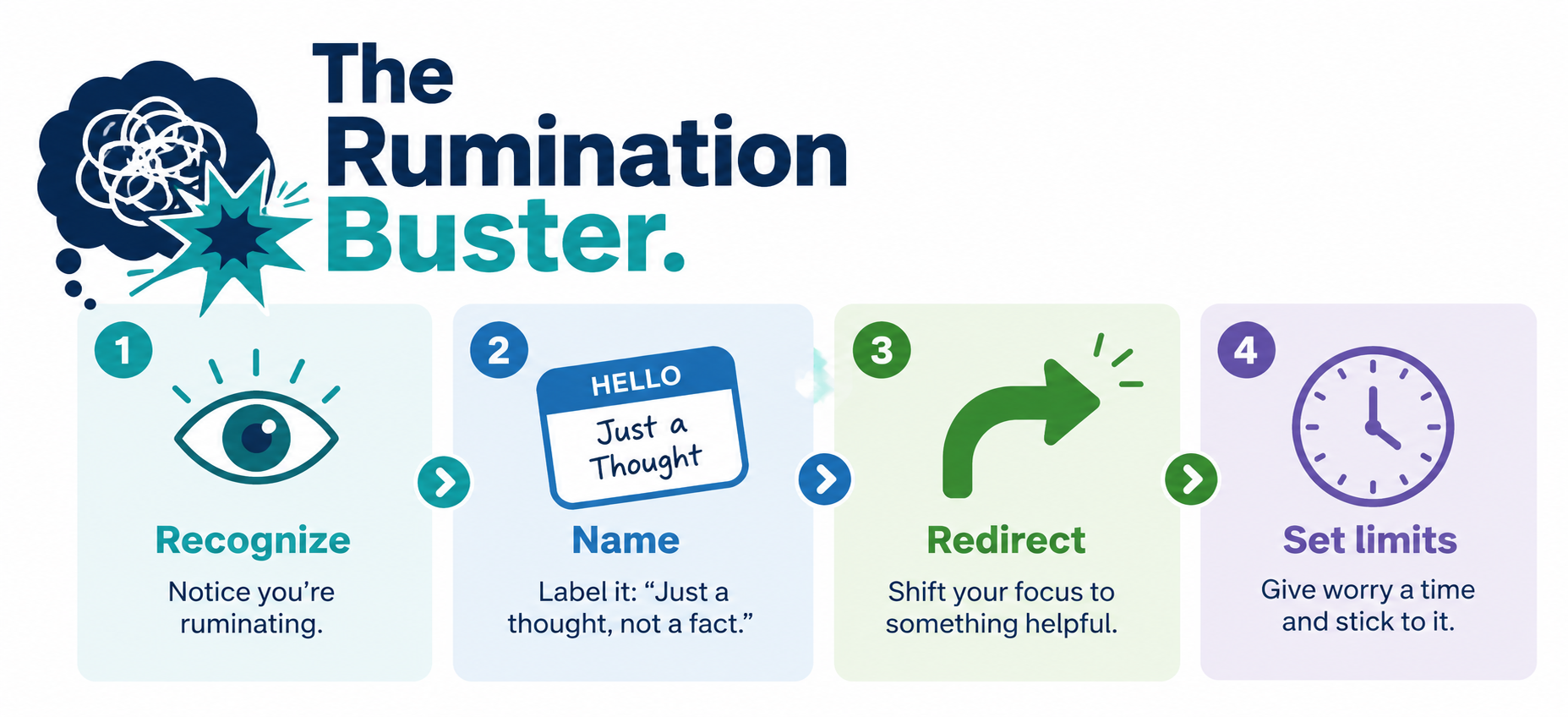
- Step 1 — Recognize it early. Notice the moment you start to replay an event. Early is everything. A loop you catch in the first minute is far easier to stop than one that's been spinning for an hour.
- Step 2 — Name it. Say it to yourself, plainly: "I'm ruminating again." Naming it breaks the spell — it turns the loop from something you're inside of into something you can see.
- Step 3 — Redirect your attention. Do something that genuinely requires mental focus — exercise, call a friend, a puzzle, music, reading, cleaning, cooking. You can't ruminate and concentrate hard on something else at the same time. Pick your redirect before you need it.
- Step 4 — Set limits ("worry time"). If you truly must think about it, schedule it. Tell yourself: "I'll think about this for ten minutes at 7 PM — and then I'm done." Containing it is the opposite of letting it run all day.
5 · Trade the Questions That Feed It for the Questions That Break It
Rumination runs on questions that have no exit. "How could they do this to me?" keeps you circling, because there's no answer that ever satisfies it. The skill is to swap the question.
| Feeds the loop | Breaks the loop |
|---|---|
| "How could they do this to me?" | "What do I actually need to do about this?" |
| "Why does this always happen to me?" | "Have I got the facts right — or did I jump to a conclusion?" |
| "I can't believe they said that…" (replay) | "Could there be another reason for what happened? Maybe I misunderstood." |
| "This is so unfair." | "Will this matter in five years? Does it really matter that much right now?" |
A few more honest check-questions for when you catch yourself mid-loop:
- Does ruminating over this actually help me?
- Would I advise a friend to think this way? What would a friend say to me if they knew I was doing this right now?
- Am I tired or irritable — and is that doing some of the talking?
- Am I looking at the whole picture, or just the part that makes me angriest?
And then the closer: get calm, remind yourself of what you were doing before the loop started, and decide — "I'll act when I'm calm and have thought about it clearly." Not while the record's still spinning.
Workbook tie-in — Part G: The Rumination Buster. Your workbook activity walks you through your own pattern: What situations do you replay most often? What time of day is rumination worst for you? What physical position are you usually in when you ruminate — lying in bed, driving? Then you'll build your personal interruption plan (Name it → Redirect → Set limits) and pick your go-to redirect activities. Awareness is a skill that improves with practice — be patient with yourself as you build it.
Knowledge Check
Your knowledge check for this lesson is an interactive game you will play inside the course — it's built right into the next activity. Keep going; it builds on everything you just read.