Responses to Anger Triggers
- Explain the difference between a trigger and the cause of your anger — and why that difference is good news.
- Name the three kinds of response a trigger sets off in you — emotional, cognitive (thoughts), and physical — and catch them as they start.
- Recognize the four response patterns people fall into — Exploder, Imploder, Displacer, and Healthy Responder — and identify your own go-to pattern without shame.
- Identify your personal hot buttons and the core need that's threatened when one gets pushed.
- Spot rumination early and use a simple tool to interrupt it before it amplifies your anger.
1 · The Spark and the Fuel: Trigger vs. Cause
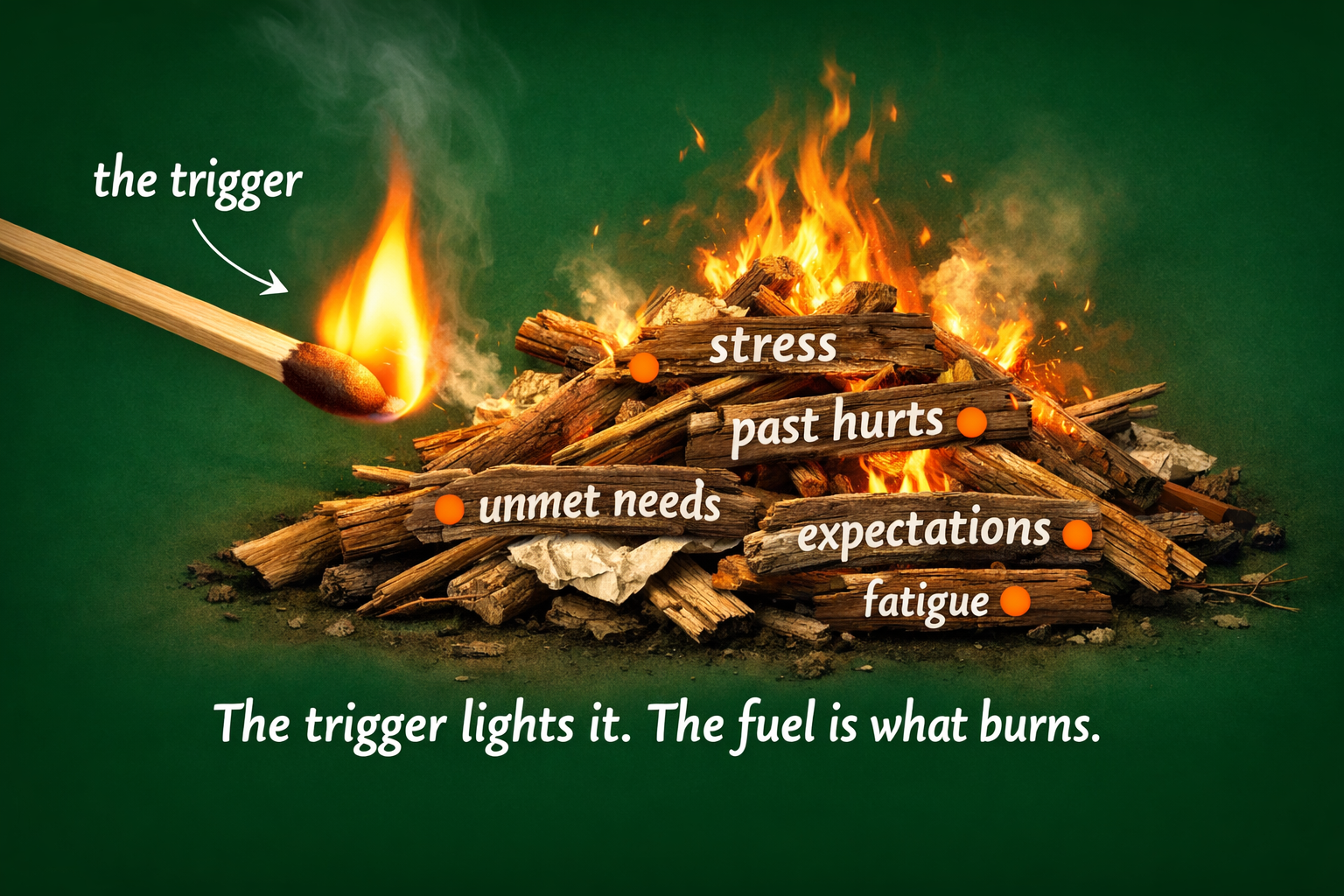
Let's start with a distinction that, once it clicks, changes how you see every angry moment of your life. Thirty years in criminal justice and anger management taught me that most people blame the wrong thing for their anger — and that one mix-up keeps them stuck.
A trigger is anything that switches on your anger response — a thing that happens to you, or a thought that fires off inside you. Someone cuts in line. Your phone won't connect. A memory surfaces. That's the trigger.
But here's the part almost everyone gets wrong: the trigger is not the cause. The trigger is just the match. The cause is all the combustible material that was already piled up before the match ever struck — your stress, your past hurts, your unmet needs, your unrealistic expectations, your fatigue.
Same trigger, different fuel, completely different reaction.
Trigger: someone cuts in line.
Low fuel (rested, calm, not much riding on it): mild irritation, easily handled.
High fuel (high stress, old hurts, exhausted, expecting the worst): an explosion.
Now sit with why this is good news. You can't always control your triggers — people will cut you off in traffic, the line will be long. But you have a great deal of control over the fuel. And that means you have far more power over your anger than you've probably been told.
2 · Where Triggers Come From: Outside and Inside
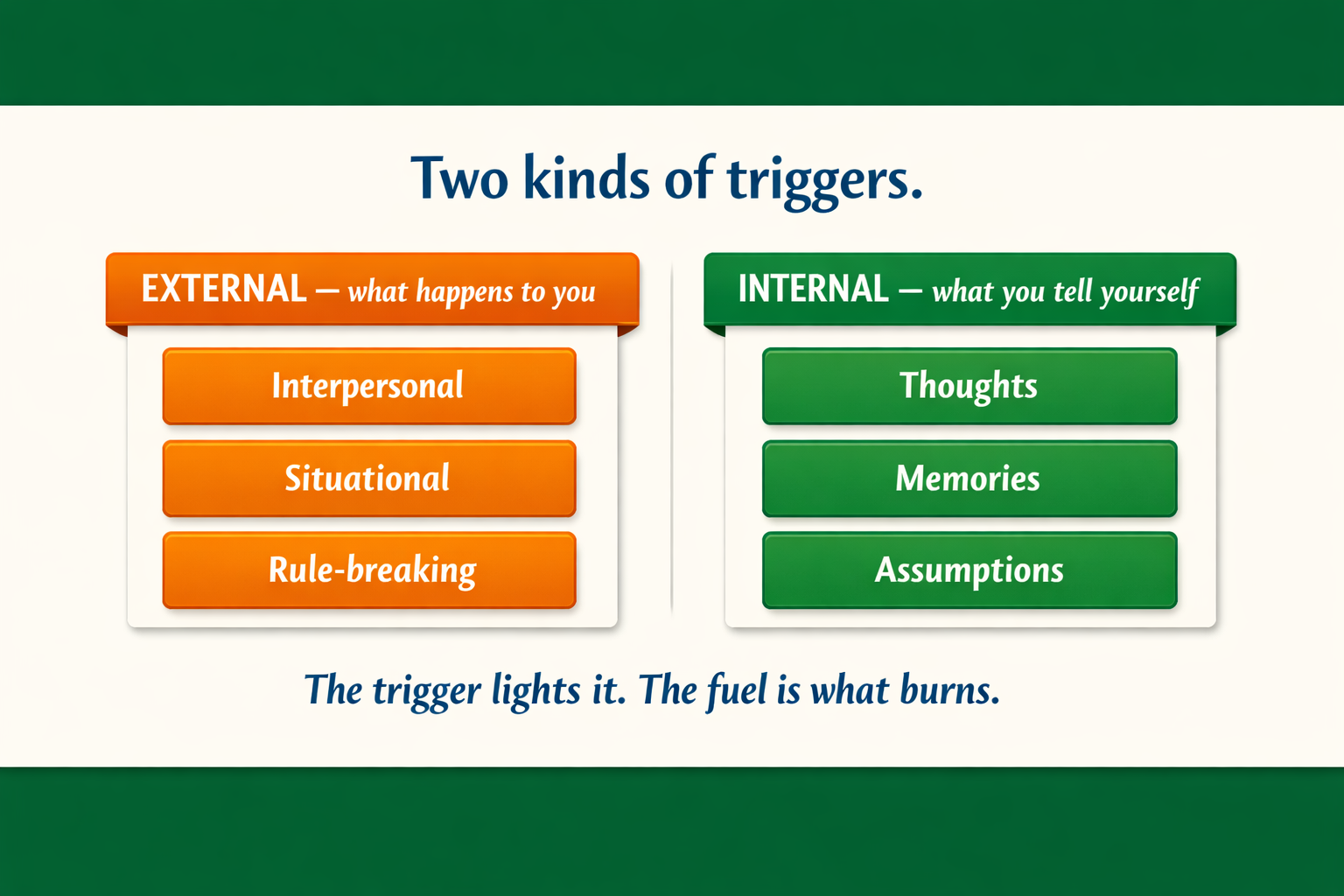
Triggers come from two directions.
External triggers are events that happen outside of you. They sort into a few familiar groups:
- Interpersonal — being interrupted or talked over, feeling disrespected or dismissed, being lied to, having your words twisted, being blamed for something you didn't do.
- Situational — traffic jams and slow drivers, long lines and delays, technology that won't work, loud noises, crowded or chaotic places.
- Rule-breaking — people cutting in line, others ignoring the procedures, witnessing unfairness, someone taking advantage of others.
Internal triggers are the thoughts, memories, and interpretations that happen inside your head — and they're often built on assumptions or incorrect information:
- Thought triggers — "They did that on purpose," "This is so unfair," "I always get treated badly," "Nobody respects me."
- Memory triggers — past hurts and betrayals resurfacing; a situation, or a person who resembles someone who hurt you.
- Assumption triggers — assuming negative intent, expecting the worst, believing you already know what someone else is thinking.
Where do the strong ones come from? Often, from old wounds. If you were made fun of as a child because of your weight, then years later, when you hear someone joking about being overweight, that can be an anger trigger for you. The event is small; the fuel underneath it is old. Naming your triggers honestly is the first step toward real, lasting change.
3 · Three Ways a Trigger Hits You
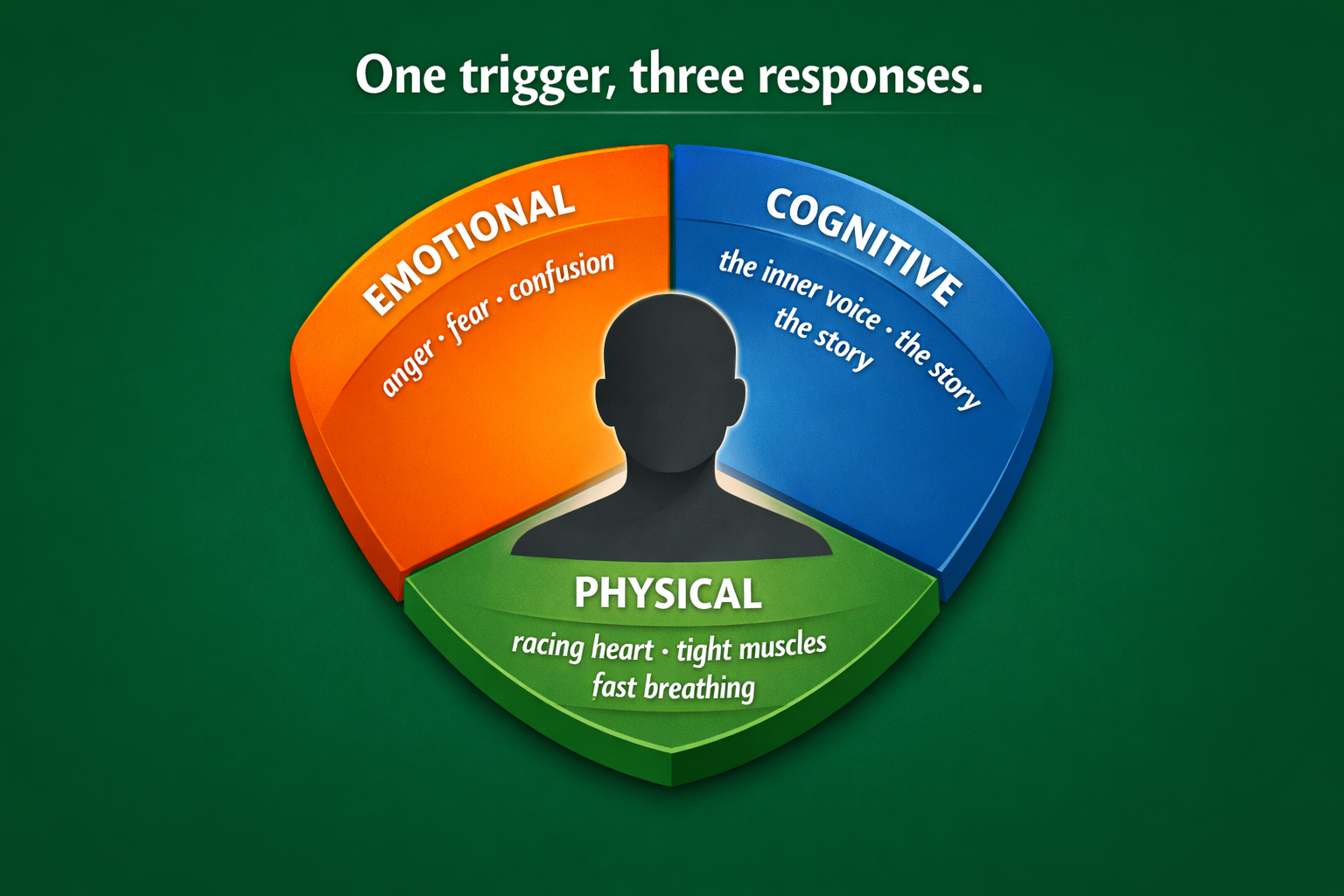
When a trigger fires, your response shows up in three places at once. This is the heart of this lesson, and it's worth slowing down for — because if you can feel all three starting, you can catch your anger early.
- Emotional response — what you feel. The feelings that wash up in conflict, ranging from anger and fear to despair and confusion. Anger is usually the loudest, but it's rarely traveling alone.
- Cognitive response — what you think. Your ideas and interpretations about the conflict: the "inner voice," the running commentary, the story you tell yourself about what just happened and why.
- Physical response — what your body does. Heightened stress and tension, more perspiration, shallow or fast breathing, nausea, a pounding heartbeat. This is where stress- and anxiety-management skills do their work.
The thought and the body usually move before the feeling peaks. Learn to notice the clenched jaw, the fast breath, the "they did that on purpose" thought — and you've bought yourself the few seconds where choice lives.
4 · Four Response Patterns: Which One Is Yours?
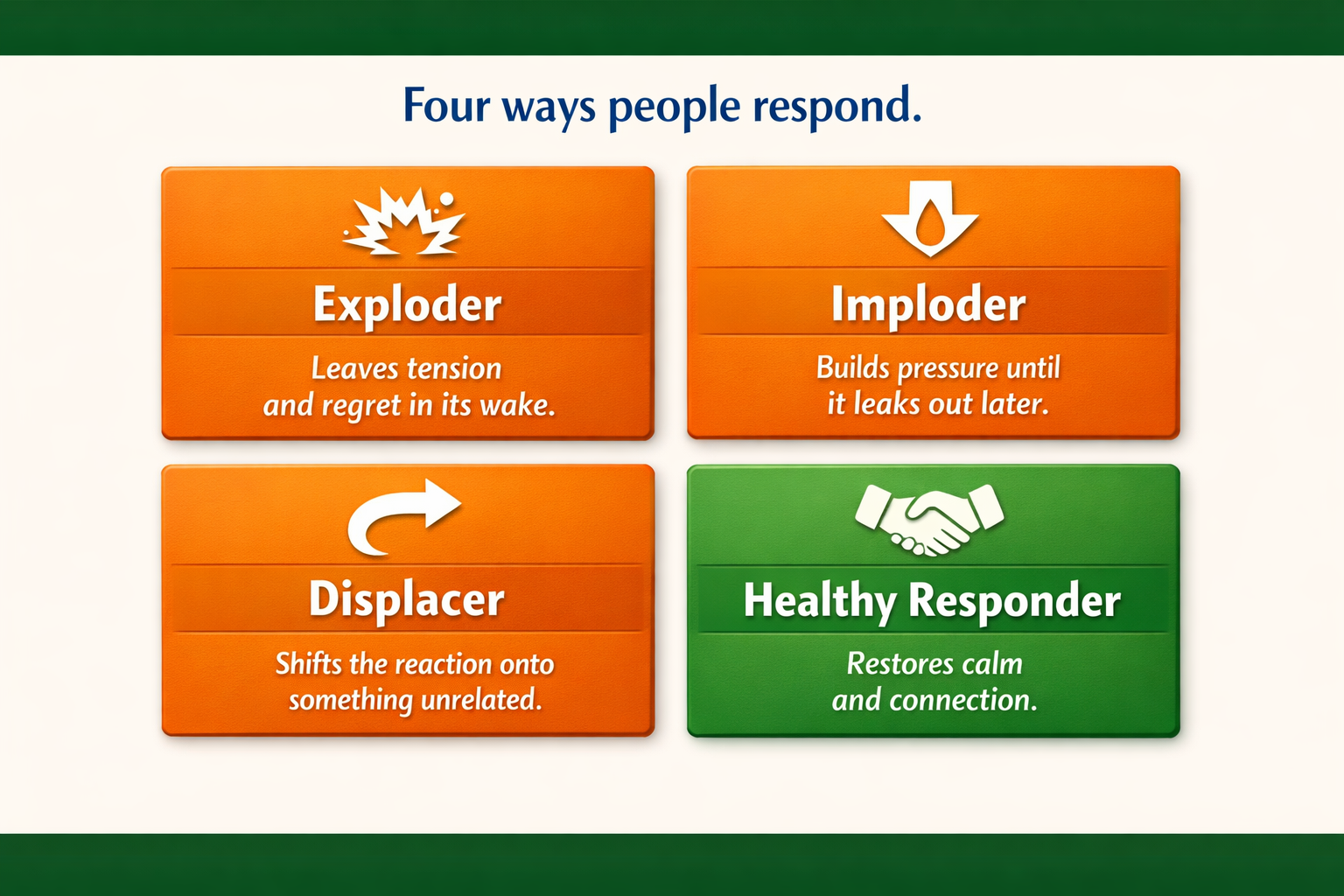
The three responses tell you what's happening inside in the moment. But over time, most of us settle into a habitual pattern — a default way we handle the anger once it's here. There are four. Three of them cost you; one of them serves you. See which sounds like you.
- The Exploder. Immediate, intense, all of it out right now. The thought is "I have to let them know how I feel — now!" The behavior is yelling, arguing, aggressive confrontation. The aftermath: it often feels better immediately, but it damages relationships.
- The Imploder. Anger turned inward, suppressed, pretended away. The thought is "I shouldn't feel this way" or "It's not worth making a fuss." The behavior is the silent treatment, withdrawal, saying "I'm fine" when you clearly aren't. The aftermath: it builds up until it finally explodes — or shows up as physical symptoms.
- The Displacer. Can't aim the anger at the real target, so it lands somewhere "safer." The thought is "I can't say anything to my boss, but I can let my family know how I feel." The behavior is nice at work, angry at home. The aftermath: the real problem never gets addressed, and innocent people get hurt.
- The Healthy Responder. Recognizes the anger, understands what it's about, and responds on purpose. The thought is "I'm angry about this, and I need to figure out the best way to address it." The behavior is direct-but-respectful communication, focused on solving the problem. The aftermath: problems get solved, and relationships stay intact — or even improve.
There's no shame in any of these. Most of us learned our pattern young, before we had a say in it. Naming yours isn't a verdict — it's a starting line. The whole rest of this program is how an Exploder, an Imploder, or a Displacer becomes a Healthy Responder.
5 · Your Hot Buttons: Personal Landmines
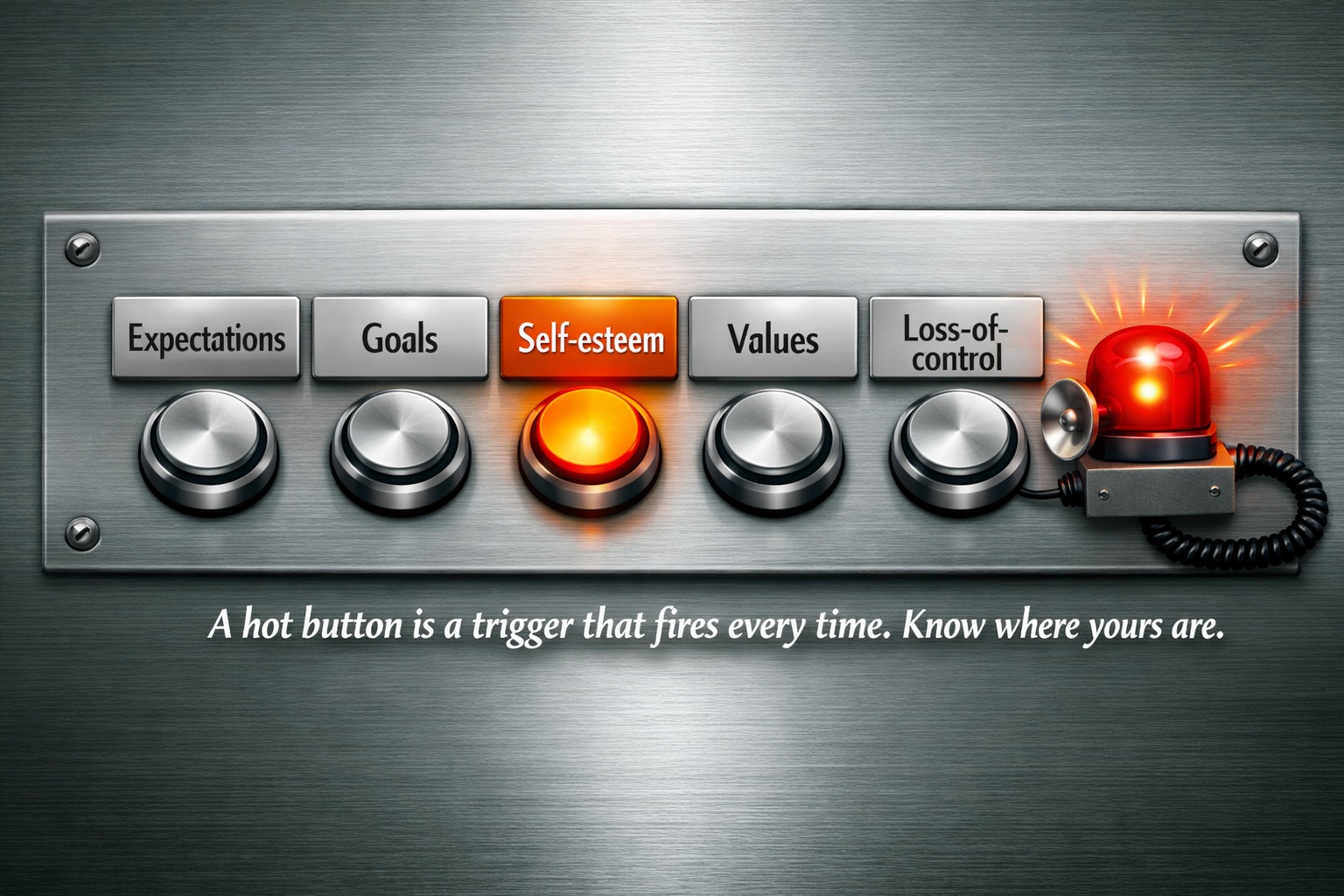
Not all triggers are equal. Some barely move you; others light you up every time. The ones that reliably set off an intense reaction are your hot buttons — your personal landmines.
A hot button is a trigger that frequently sparks anger and can evoke a reaction all out of proportion to the moment. Hot buttons tend to be things that:
- fall short of your expectations,
- block your goals,
- attack your self-esteem,
- violate your values, or
- give you a feeling of loss or helplessness.
To map your own, ask yourself four questions — the same ones you'll work through in your trigger-inventory activity:
- Which category of trigger resonates most strongly with you?
- What specific situations in that category set off the strongest reactions?
- What core need is threatened when that button gets pushed — respect? fairness? safety? control?
- How do you typically react when it's activated?
That fourth question loops right back to your response pattern. When you can say "my hot button is feeling disrespected by authority, my core need is respect, and my pattern is to explode" — you've gone from "I have anger issues" to a specific, workable target. That's the difference between a vague label and a plan.
6 · The Anger Amplifier: Rumination
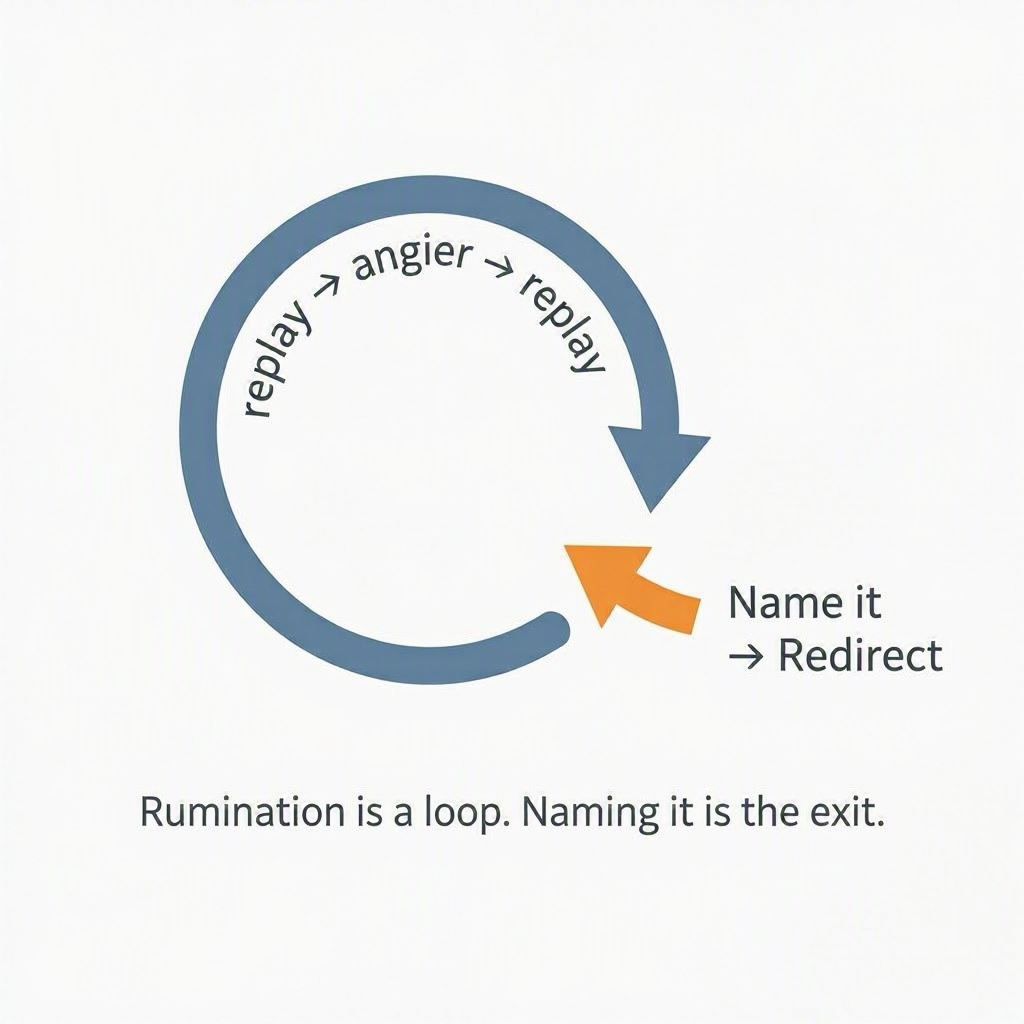
Here's a habit that quietly does more damage than the trigger ever did: rumination. It's the broken record in your mind — replaying the same angry thoughts over and over, getting angrier with each lap, long after the triggering event is over.
What rumination looks like:
- Replaying conversations — going over it word by word, inventing better comebacks.
- Building your case — collecting evidence of how wrong the other person was.
- Catastrophizing — imagining all the terrible things that might happen next.
- Victim stories — telling yourself how unfairly you're always treated.
- Revenge fantasies — imagining ways to get back at someone.
Why it's so destructive: the more you think about something upsetting, the more upsetting it becomes. What should have been a brief flash turns into hours or days of suffering; your stress hormones stay elevated; you get so focused on the problem you can't see solutions; and you carry yesterday's anger into today's conversations.
Breaking the cycle:
- Recognize it early — notice the moment you start replaying.
- Name it — "I'm ruminating again."
- Redirect attention — do something that demands real mental focus.
- Set aside "worry time" — if you truly must think about it, schedule a specific window instead of letting it run all day.
- Ask a better question — swap "How could they do this to me?" for "What do I need to do about this?"
7 · From Reaction to Response: Catching It in Time
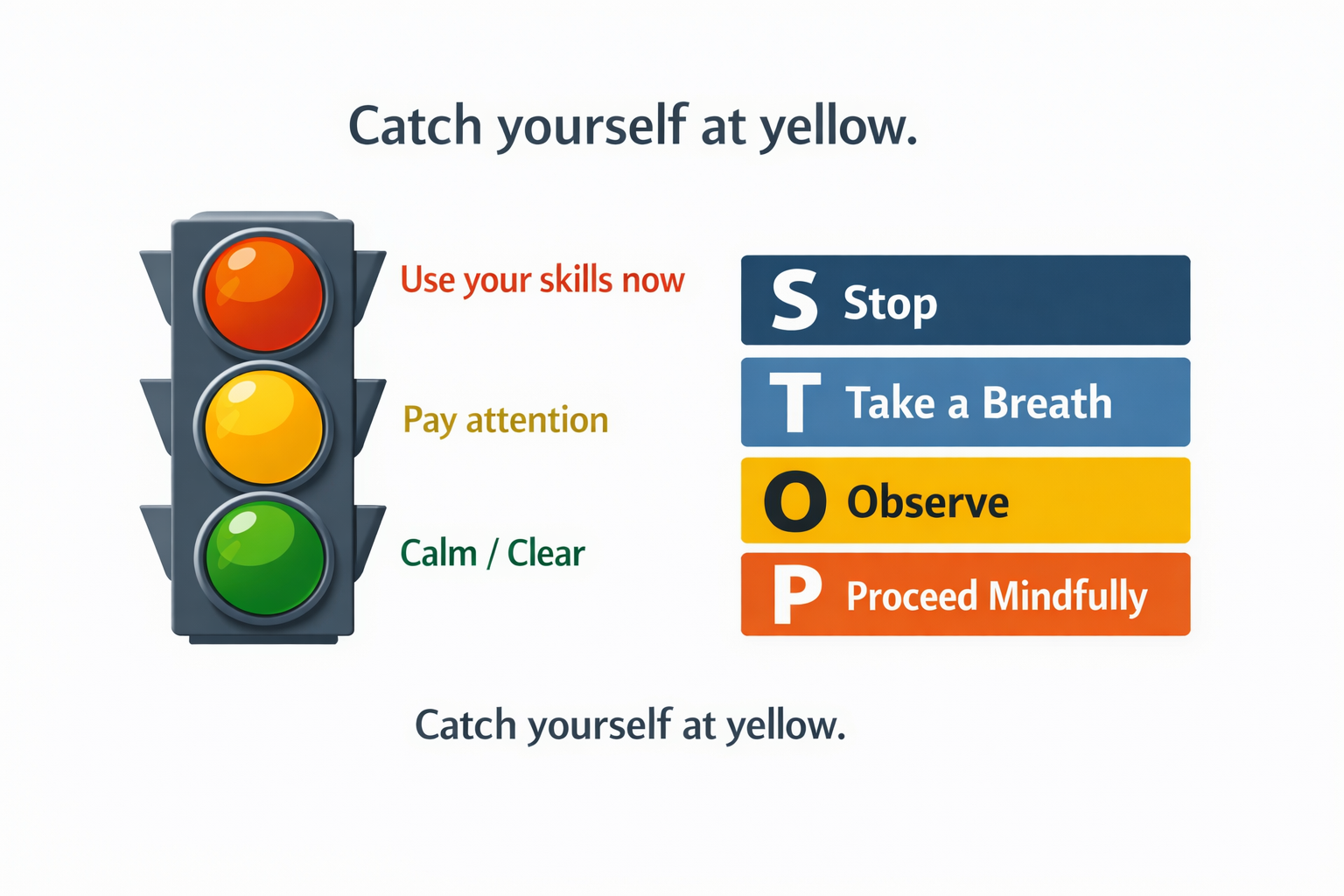
You can't always choose your triggers. What you can build is the gap between the trigger and your response — the few seconds where a reaction becomes a choice. Two simple tools make that gap bigger:
The Traffic Light. Check yourself like a signal:
- Green — I'm calm and thinking clearly.
- Yellow — I'm starting to feel triggered; time to pay attention.
- Red — I'm emotionally activated; I need to use my management skills now.
The skill is catching yourself at yellow, before red.
The STOP technique. When you notice anger building:
- S — Stop what you're doing.
- T — Take a breath (or several).
- O — Observe what's happening in your body and mind.
- P — Proceed with intention, not reaction.
And the truth that holds it all together: if you do not become the master of your feelings, your feelings will become the master of you. You don't get there by never being triggered. You get there by learning to notice the response rising — emotional, cognitive, physical — and choosing your next move on purpose.
Knowledge Check
Your knowledge check for this lesson is an interactive game you'll play inside the course. It's a quick, low-pressure way to lock in what you just learned — and it feeds the final exam. Keep going when you're ready.