Fight or Flight
- Explain, in plain language, what your brain and body actually do in the first few seconds of anger.
- Name the three-part brain system — survival brain, emotional brain, thinking brain — and what each does under threat.
- Describe the fight-or-flight response and why a Stone-Age survival system fires over traffic and emails.
- Tell apart the sympathetic ("gas pedal") and parasympathetic ("brake pedal") nervous systems — and know you can hit the brake on purpose.
- Recognize your own physical early-warning signs and the five phases of the anger cycle, so you can step in while you still have power.
1 · Your Body Launches a Full Emergency Response
Here's something thirty years in this work has taught me: if you've ever wondered why anger feels so intense and overwhelming, this is your answer. When anger hits, your body doesn't ease into it. It launches a full-scale biological emergency response — the same one built to help your ancestors survive a life-threatening attack.
The catch is that this ancient survival system is firing in response to modern problems: a traffic jam, a rude email, your teenager rolling their eyes. It's like having a fire department that responds to burnt toast with the same five-alarm urgency it would bring to a real fire.
So when you've told yourself "I just need to calm down" and it didn't work — you weren't failing. You were trying to out-talk a system that's older and faster than your thinking brain. Once you understand how it works, you can finally work with your biology instead of fighting it.
2 · Stress Sets the Stage
Before we dive into anger itself, we need a quick word about stress — because stress sets the stage for how intensely you'll feel anger when it arrives.
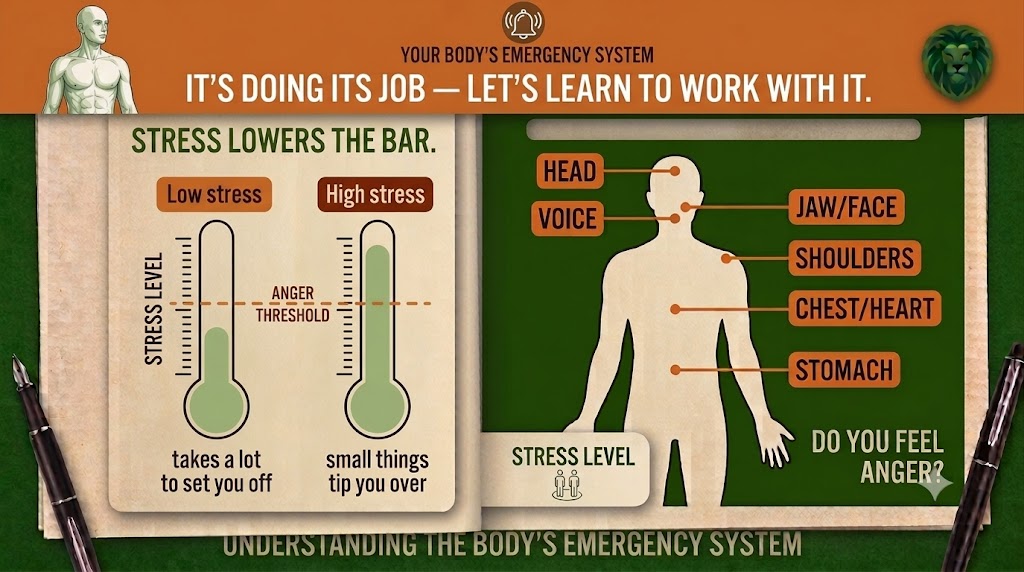
Stress is like background music for your emotions. It's always there, influencing everything else. When your stress level is low — say a 3 out of 10 — it takes a real trigger to push you into anger. But if your stress is already sitting at a 7, even small annoyances can tip you over. (That's the thermometer above: stress lowers the bar.)
I've worked with so many people who couldn't understand why they'd "suddenly" gotten so irritable. Every time, we found the same thing: their stress had been quietly climbing — work, money, health, relationships — and it had lowered their anger threshold. They weren't becoming angrier people. They were people whose stress had loaded the spring.
And anxiety is stress's restless cousin. Where stress is about current pressure, anxiety is about future threats, real or imagined — so an anxious brain is constantly scanning for danger, which makes you far more reactive. The three feed each other: stress makes you more prone to anger, anger creates more stress, and both feed anxiety about the next conflict. The way out is to address all three, not just the anger.
3 · Your Three-Part Brain
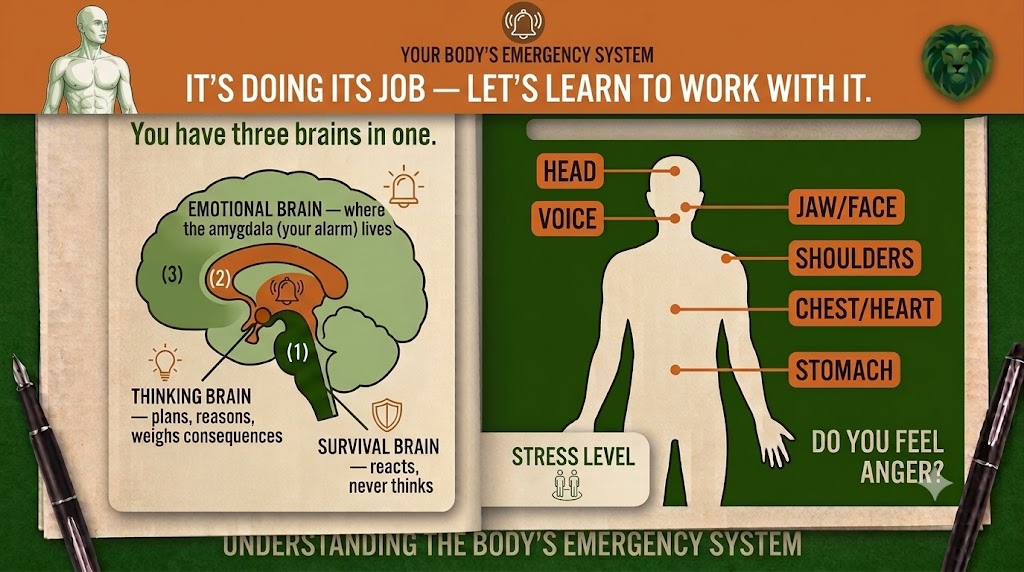
Your brain isn't just one thing. It's actually three systems that evolved at different times — and they sometimes have very different ideas about how to handle a problem.
1. The survival brain (brainstem). The oldest, most primitive part — the same basic equipment every backboned animal has. It runs the things you never think about: breathing, heartbeat, body temperature. It can't reason or weigh consequences. It just reacts. And here's the crucial part: it can't tell the difference between a charging predator and your teenager's eye-roll. To this brain, threat is threat.
2. The emotional brain (limbic system). This is where your feelings live — and where you'll find two small, almond-shaped structures called the amygdala (ah-MIG-da-lah). Think of your amygdala as your personal security guards. They're always on duty, scanning your surroundings, asking one question over and over: "Is it safe?" They get the information before your thinking brain does — and they tend to shoot first and ask questions later. Sometimes that's lifesaving; sometimes it's got you ready to fight over a parking space.
3. The thinking brain (prefrontal cortex). This is the part just behind your forehead that makes you human and not just a clever animal — planning, reasoning, problem-solving, weighing right and wrong. It's the voice that says, "Maybe there's a good reason they did that" or "Let me think about the consequences first."
The whole drama of anger, in one line: when your emotional brain sounds the alarm, it can flood your thinking brain with stress chemicals and take the wheel. Ever notice you can't quite remember what you said when you were really angry? That's your thinking brain getting chemically benched while your emotional brain drives.
4 · The First Five Seconds
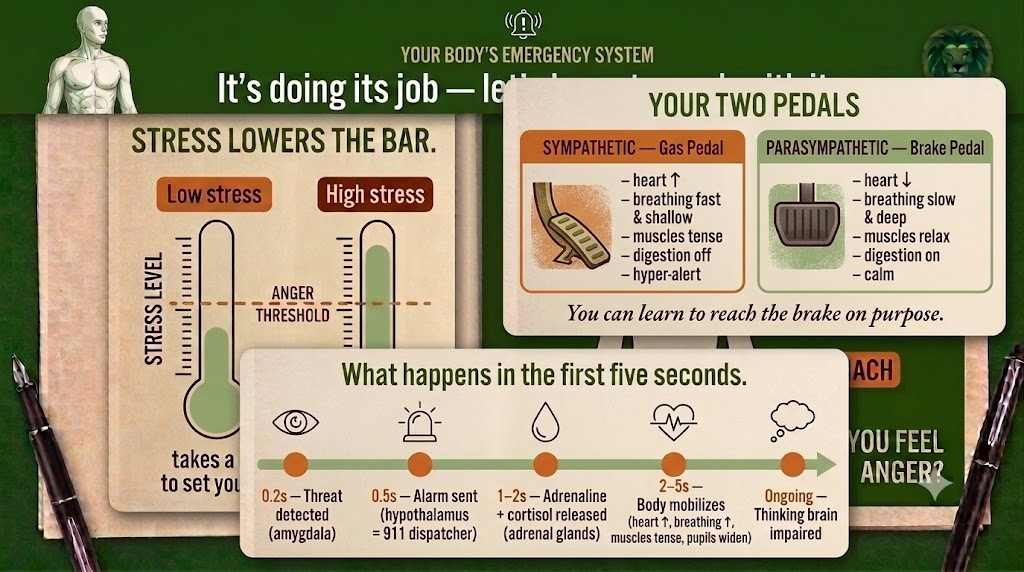
When anger hits, your brain runs a predictable sequence — faster than conscious thought. Watching it in slow motion shows you exactly where you still have power:
- 0.2 seconds — Threat detected. Your amygdala spots a possible threat and hits the panic button — before you're even consciously aware of what you're reacting to.
- 0.5 seconds — Emergency broadcast. The amygdala fires an urgent message to your hypothalamus — your brain's 911 dispatcher — which broadcasts an alert through your whole body.
- 1–2 seconds — Chemical flood. Your adrenal glands dump adrenaline and cortisol into your bloodstream, prepping you for battle or escape.
- 2–5 seconds — Body mobilizes. Heart rate jumps (it can nearly double), blood pressure climbs, breathing turns rapid and shallow, blood moves into your big muscles, pupils widen, you sweat, muscles tense.
- Ongoing — Thinking takes the hit. Those same chemicals make it harder to weigh consequences, see another person's side, or remember the very skills you're learning right now.
The hopeful part: this is why "just calm down" doesn't work in the moment — you're asking a chemically-flooded thinking brain to do its hardest job at its weakest moment. The fix isn't willpower. It's catching the wave earlier, and knowing how to hit the brake.
5 · Two Pedals: Your Autonomic Nervous System
Your autonomic nervous system runs everything you don't consciously control — heartbeat, breathing, digestion, temperature. It has two branches, and the simplest way to picture them is the two pedals in your car (shown on the card above).
The gas pedal — the sympathetic nervous system. Your accelerator. When anger fires it up, heart rate and blood pressure rise, breathing turns rapid and shallow, digestion slows, muscles tense, and stress hormones flood your system. It's brilliant for a short-term emergency — but exhausting and hard on your body when it's switched on again and again over everyday stress.
The brake pedal — the parasympathetic nervous system. Your calming system. When it's active, heart rate and blood pressure come down, breathing turns deep and slow, digestion resumes, muscles relax, and stress hormones clear.
Here's the good news that changes everything: you can learn to press the brake pedal on purpose. Slow breathing — in for about 4 counts, out for about 6 — is one of the most reliable ways to switch the parasympathetic system on. You'll practice the specific techniques in later modules; for now, just know the brake exists and it's yours.
Picture a cat: it snaps to full alert at a strange sound, then — the moment it decides the coast is clear — drops straight back to relaxed. That quick swing from gas to brake is exactly the balance you're building.
6 · The Cycle of Anger — Where You Still Have Power
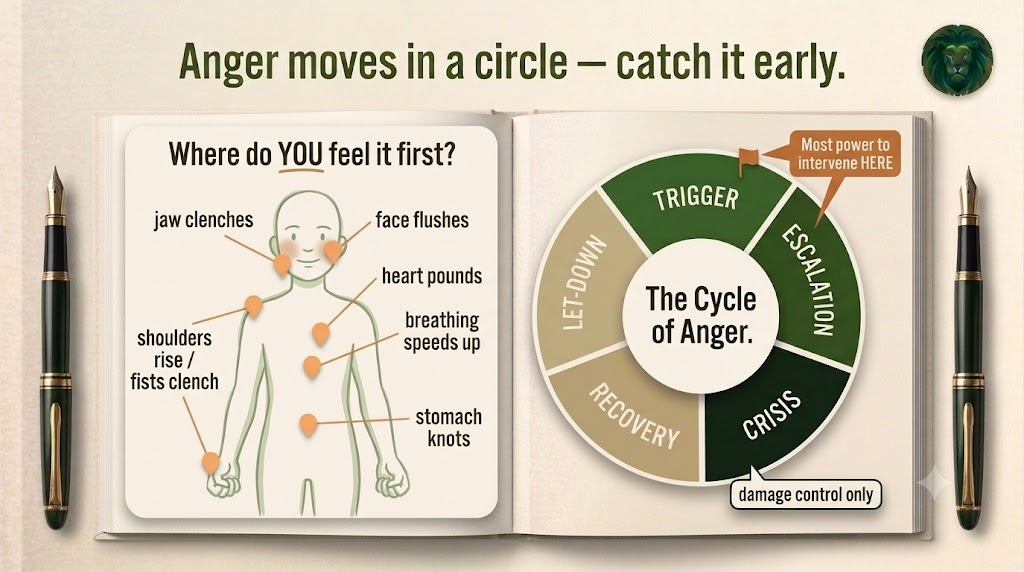
Anger doesn't appear out of nowhere as one big explosion. It moves through a predictable five-phase cycle — and that's genuinely good news, because a cycle gives you several chances to step in before things go too far.
- Trigger. Something happens that your brain reads as a threat or an injustice — external (someone cuts you off) or internal (a memory resurfaces).
- Escalation. Your body starts the physical response: heart rate up, muscles tightening, breathing changing. This is where you have the most power to change what happens next.
- Crisis. Full fight-or-flight. Thinking is impaired and behavior is most likely to be aggressive or destructive. Here, the only real goal is damage control.
- Recovery. The crisis passes, but the stress chemicals are still in your system. You may feel shaky, drained, or easily re-triggered.
- Let-down. Your body returns toward normal, but guilt, shame, or regret can move in. This is when repair happens — with others and with yourself.
The one insight to carry out of this section: your power is greatest at the trigger and escalation phases. Once you're in crisis, your options shrink fast. Everything else in this program is about helping you notice the early phases and act while you still can.
7 · Read Your Own Body: Early-Warning Signs
The reason all this body-science matters is simple and practical: your body tells you anger is coming before your mind admits it. Learning to read those signals is your single best early-warning system — because the earlier you catch the wave, the more power you have. As anger builds, people commonly notice:
- Head & face: clenched jaw or grinding teeth, tight facial muscles, a hot or flushed face, narrowed eyes.
- Breathing & heart: rapid, shallow breathing (or holding your breath), a faster or pounding heartbeat, a pulse you can feel in your neck or temples.
- Muscles & movement: shoulders rising, hands curling into fists, neck and back tension, fidgeting or the urge to pace.
- Voice: tone climbing, talking faster, getting louder, a tight or strained voice.
- Stomach & other: a tightening stomach or "butterflies," nausea, dry mouth, sweating.
There's a real reason behind each one. Blood pumps to your big muscles so you can fight or flee — that's the pounding heart. Rapid breathing pulls in extra oxygen. Your digestive system shuts down to save energy — that's the queasy stomach and dry mouth. Your body heats up from the effort, so you sweat to cool down. None of this is you malfunctioning. It's a healthy body doing exactly what it was designed to do.
Your move: in your workbook activity for this chapter ("Identifying Your Physical Response"), you'll rate these signs and pick your own top five earliest warnings — the first things your body does. That personal list becomes your tripwire: when you feel sign number one, that's your cue to hit the brake before you ever reach crisis.
8 · The Big Question — Working With Your Biology
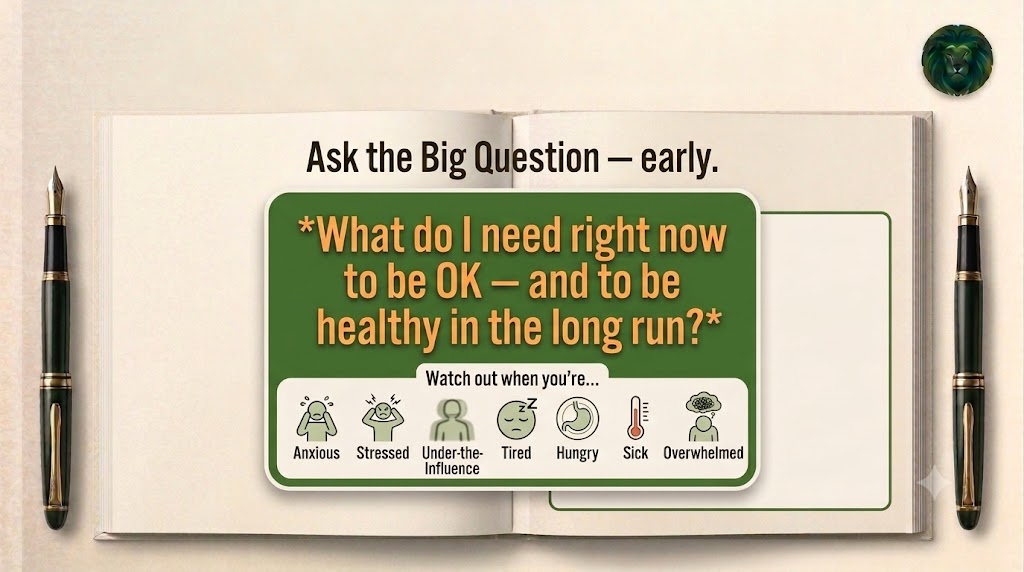
There are at least seven conditions that quietly tip you into operating from your survival brain — and when you're angry and any of these are present, you're far more likely to react impulsively, in ways you'll regret:
Anxious • Stressed • Under the influence • Tired • Hungry • Sick or unwell • Overwhelmed
When your survival brain is in the driver's seat, it isn't interested in solving anything — it just wants to punish, hurt, or get back at whoever your anger is aimed at. The way out is to get your thinking brain back online, and the fastest tool for that is a single question — the Big Question:
"What do I need right now to be OK — and to be healthy in the long run?"
That question does something clever: it pulls you out of "what they did wrong" and into "what I actually need." The answer is often simple and humane — "I need a ten-minute break," "I need to eat before this conversation," "I need more information before I react," "I need to handle this when I'm not exhausted."
Timing is everything. Because survival-brain reactions are fast and automatic, you have to ask the Big Question early — before your anger climbs too high. Ask it during the trigger or escalation phase and it can change everything. Wait until crisis, and it's too late to land.
Understanding the physiology of anger isn't just interesting science — it's practical, and it's kind to yourself. Your body is doing exactly what it was built to do. The goal was never to shame that system. It's to learn to work with your biology instead of against it.
Knowledge Check
Answer all six, then check your answers. (These feed your final-exam question pool.)
1. The set of automatic sensations your body produces in reaction to a real or perceived threat is known as the ___.
2. Stress and anxiety are common, normal responses to situations that make you feel threatened or unsafe.
3. In the three-part brain, which part acts as your fast "alarm system," sounding off before your thinking brain even gets the information?
4. Which branch of your autonomic nervous system is the "brake pedal" that slows your heart, deepens your breathing, and lets your body re-balance?
5. In the first couple of seconds of anger, which two stress chemicals do your adrenal glands release to prepare you for "fight or flight"?
6. According to the cycle of anger, when do you have the most power to change what happens next?