Empathy
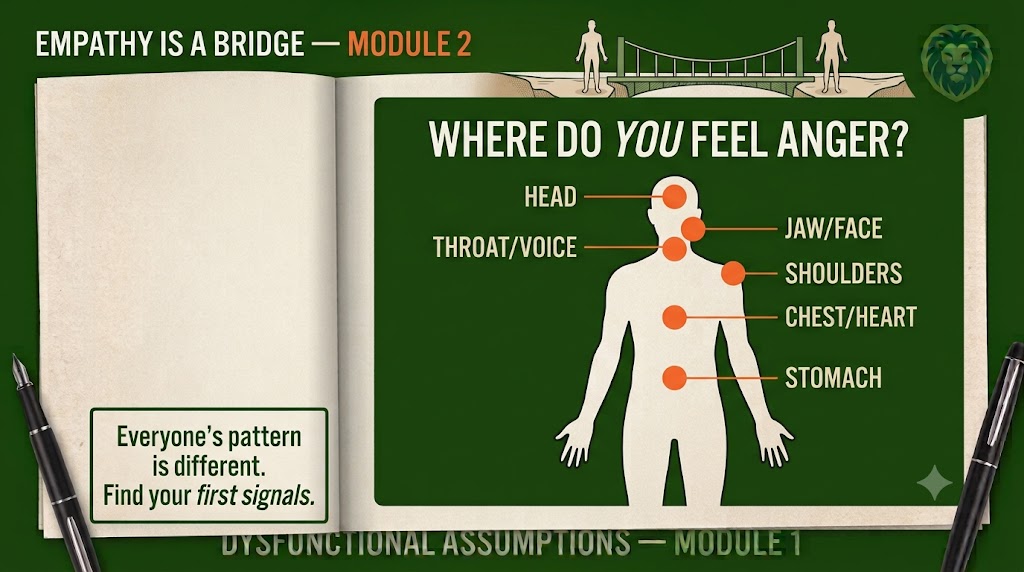
- Explain what empathy is, and why it's one of the most powerful tools you have for cooling your own anger.
- Tell the difference between cognitive empathy (understanding what someone feels) and emotional empathy (feeling an echo of it) — and know which one you can build on purpose.
- Walk through the four-step Empathy Process — pause the judgment, get curious, consider possibilities, choose compassion — the next time someone gets under your skin.
- Use everyday practices (perspective-taking, listening for feelings, the "Just Like Me" reflection) to strengthen your empathy like a muscle.
- Hold empathy and a boundary at the same time — because empathy is a bridge, not a doormat.
1 · Why I Put Empathy at the Center of Anger Work
When I teach the foundation that everything else in this program rests on, I describe it as three pillars: acceptance, empathy, and mindfulness. Acceptance gives you peace with what you can't change. Mindfulness keeps you present instead of reactive. And empathy connects you with others and reduces the anger that flares up between people.
Here's the plain-English version of why empathy belongs at the center of anger work: it's very difficult to be furious at someone when you truly understand their perspective. Anger loves a villain. Empathy quietly takes the villain costume off the other person and hands you back a complicated human being — and you can't rage at a complicated human being the same way you can rage at a cartoon enemy.
After thirty years of doing this work, I can tell you with certainty: it is very, very hard to stay furious at someone once you truly understand where they're coming from. Empathy doesn't excuse what anybody did. It just takes the other person out of the role of "enemy" — and that one shift changes everything about how your anger behaves.
2 · The Two Kinds of Empathy
Empathy is simply your ability to understand and share the feelings of others. It shows up in two forms:
- Cognitive empathy — understanding what someone else is thinking or feeling. This is the "I can see why they'd feel that way" kind. You don't have to feel it yourself; you just have to get it.
- Emotional empathy — actually feeling an echo of what the other person feels. When a friend is grieving and your own chest tightens, that's emotional empathy.
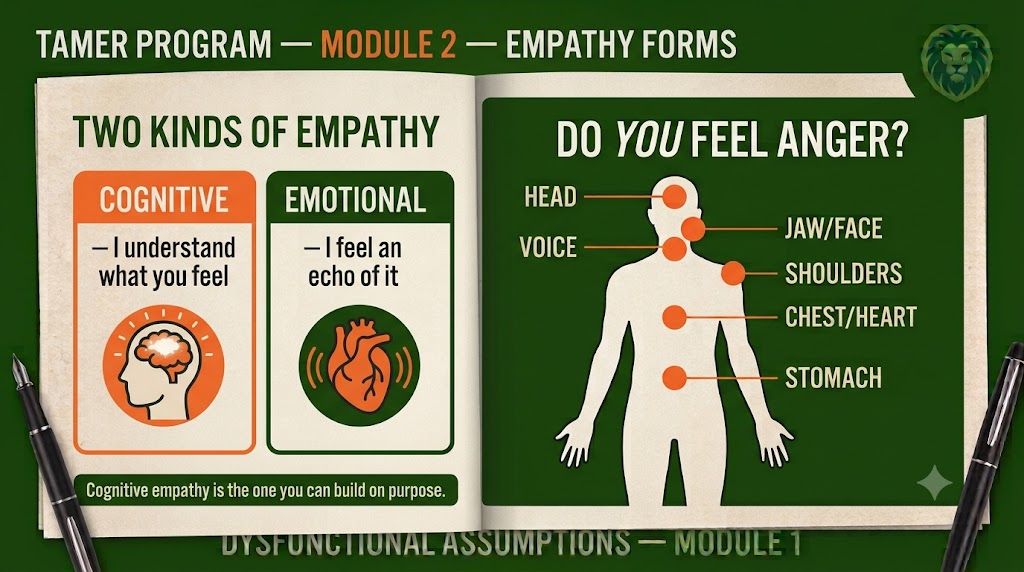
Both are valuable. But here's the key point for anger work: cognitive empathy is the more practical one, because you can develop it consciously. You can choose to ask "what's going on for them?" even in the heat of a moment when you feel zero warmth toward the person. That makes it a skill you can train, not just a feeling you wait to have.
The heart of empathy still holds: it means operating "as if I were that other person" — stepping into their shoes using your imagination, while never losing track of the fact that you are still you.
3 · Why Empathy Actually Cools Anger
Empathy isn't a soft, feel-good add-on. It does four concrete things that take the fuel out of anger:
- It humanizes others. When you understand someone's perspective, they stop being just an obstacle or an enemy and become a complex human being again — and it's much harder to stay enraged at a whole person than at a cardboard villain.
- It reveals hidden information. Very often, what looked like deliberate malice makes complete sense once you know the full context. The "rude" coworker was up all night with a sick kid.
- It reduces personalizing. When you realize that other people's behavior is usually about their struggles, not about you, you stop taking the hit personally — and personalizing is rocket fuel for anger.
- It creates connection. Empathy builds bridges instead of walls, which makes actually solving the conflict far more likely.
4 · The Empathy Process: Four Steps in the Heat of the Moment
The next time someone does something that irritates you, run these four steps before you react:
- Pause the judgment. Resist the instant urge to label them inconsiderate, stupid, or malicious. That label is what locks your anger in.
- Get curious. Ask yourself: "What might be going on in their world that would explain this?"
- Consider possibilities. Generate more than one explanation: What pressures might they be under? What fears might be driving them? What need are they trying to meet? How might they see this completely differently than I do?
- Choose compassion. Even if you don't agree with what they did, can you understand it as a human response to hard circumstances? You can. That's the whole move.
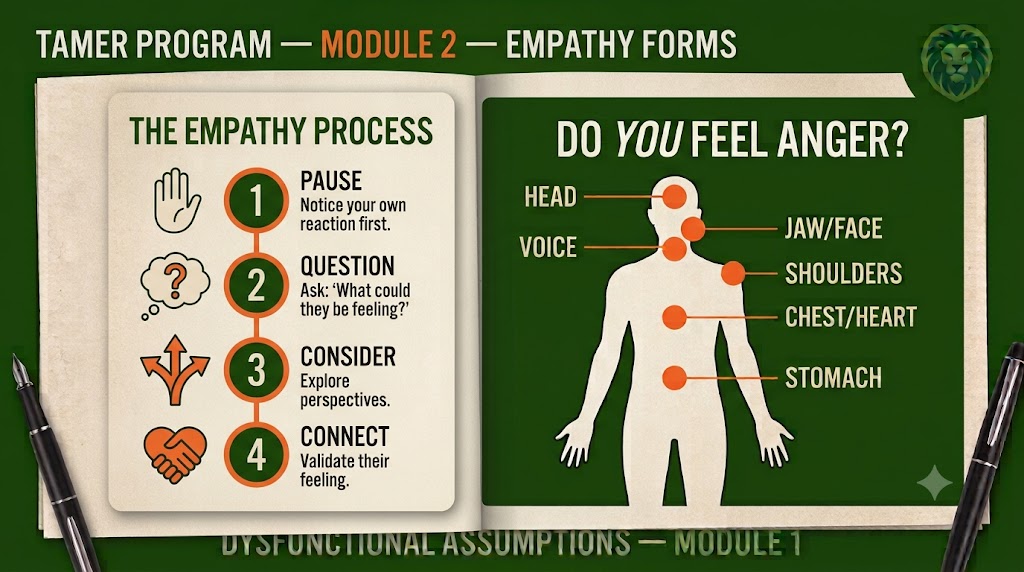
These also describe how to build an empathic link with someone in real time: show up; pay attention; be open; drop your judgments; track the other person's emotions; watch their face and eyes; ask yourself what you'd be feeling in their shoes; and look beneath the surface — investigate, ask questions, don't assume.
And here's what genuine empathic understanding looks like in practice: you step into the other person's shoes — and you can step back out again. You stand back far enough to stay unbiased instead of making rigid assumptions. You get close to them without becoming them. You perceive their world roughly as they see it, and then you offer that understanding gently — as a question rather than a verdict ("It sounds like you were really under the gun today — is that what was going on?").
Picture this: a coworker snaps at you in a team meeting. The non-empathic response writes itself — "What is their problem? They're being totally unprofessional and rude." And just like that, a wall goes up and your anger has somewhere to live. Now run the empathy process instead. Pause. Get curious — "I wonder what's going on with them; they're usually not like this." Float a few possibilities — maybe they're under real pressure, maybe they're dealing with something hard. And choose to understand it, even without approving of it. Now, instead of firing back, you might check in with them later — or you just don't carry it. Same exact moment. The only thing that changed was you.
5 · Building Empathy Like a Muscle
You build empathy the way you build any skill — with reps. Four everyday practices:
- Practice perspective-taking. When you're watching a show or reading the news, deliberately imagine the situation from a different character's point of view.
- Ask questions. Instead of assuming you know why someone did something, get curious and actually ask.
- Listen for feelings. Pay attention to the emotion underneath someone's words, not just the literal content.
- Share your own struggles. Being honest about your own hard times helps you connect with other people's humanity — and reminds you everyone is carrying something.
And one short reflection to come back to again and again. When you're dealing with a difficult person, silently repeat the "Just Like Me" lines:
"This person has feelings, just like me. This person has known fear and pain, just like me. This person wants to be happy and free from suffering, just like me. This person is still learning about life, just like me."
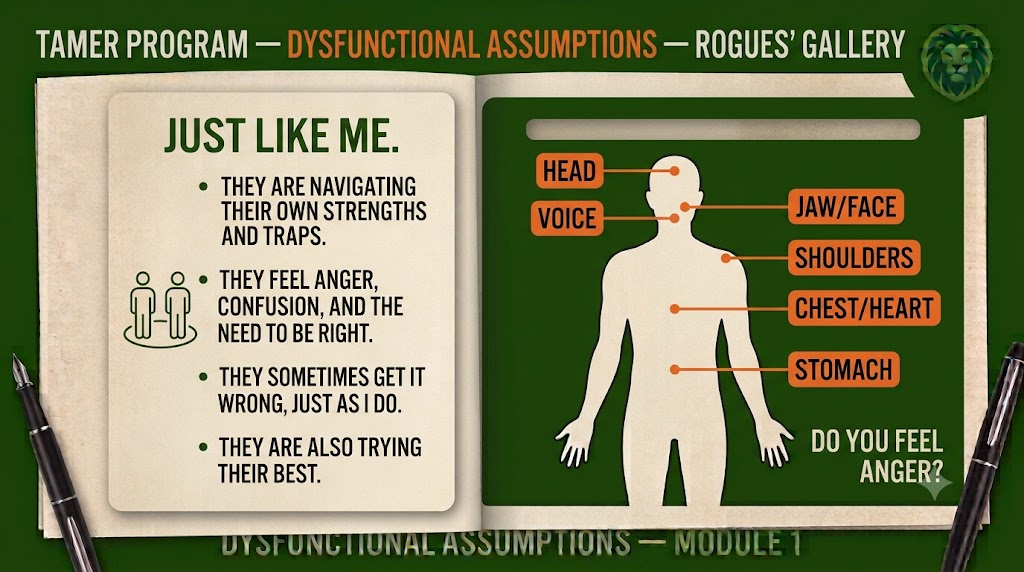
It sounds almost too simple. But try it on the very person who's irritating you and watch how quickly they turn back into a human being.
6 · Empathy Is a Bridge, Not a Doormat
This is the part I never let anyone skip, because it's where people get scared of empathy: they worry that understanding someone means letting that someone run them over. It doesn't. You can fully understand a person's perspective and hold a firm line at the same time:
"I understand you're stressed about the deadline, and I'm not willing to be yelled at. Let's take a break and figure out how to solve this together."
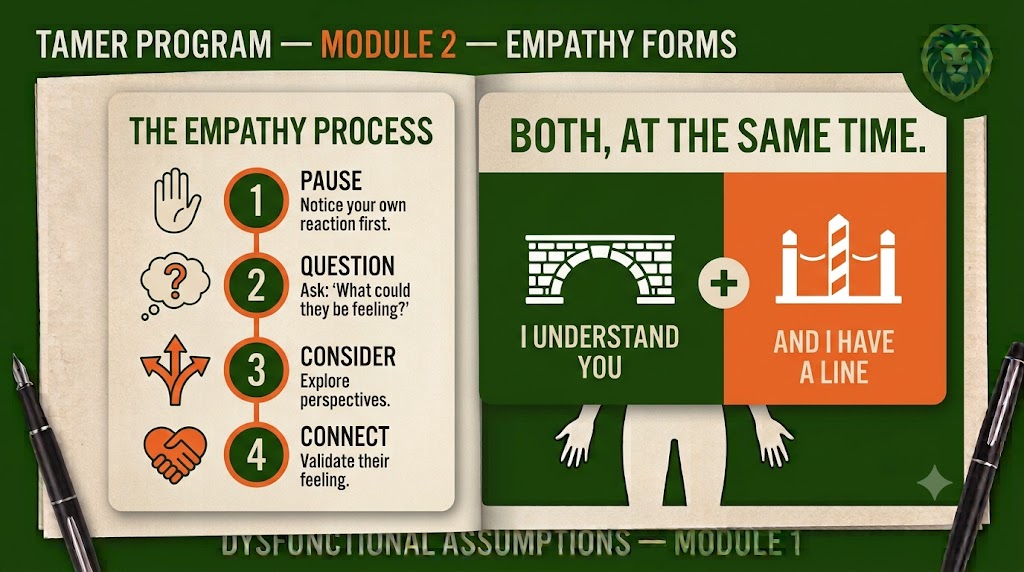
To be crystal clear, empathy does NOT mean:
- Taking responsibility for someone else's emotions.
- Excusing harmful behavior.
- Sacrificing your own needs.
- Agreeing with everyone.
- Becoming an emotional sponge that soaks up everybody's stress.
You can understand someone's perspective without agreeing with their actions. You can have compassion for someone's struggle without enabling their dysfunction. Empathy is a bridge, not a doormat.
Empathy is the second of your three foundation pillars, and it's the one that does its work between you and other people. You won't get it perfect, and you don't have to. Just make one empathic response a day — one moment where you pause the judgment, get curious, and choose to understand. That's how the muscle grows. And the better you get at it, the fewer people will be left standing in the "enemy" role your anger keeps trying to cast.
Knowledge Check
Your knowledge check for this lesson is an interactive game you will play inside the course — it is built right into the next activity. Keep going and you will find it waiting for you.