Dysfunctional Thinking
- Explain the single most important idea in this module: it isn't what happens to you that makes you angry — it's what you think about what happens.
- Recognize the common thinking errors that amplify anger — mind reading, fortune telling, all-or-nothing, "shoulds," personalization, catastrophizing, and the rest — and catch them in your own head. In this version of the lesson, you'll actually practice catching them, right here on the page.
- Walk through the ABC model (Activating event → Beliefs → Consequence) and see how the same event can produce three different emotions depending on the thought — and try all three yourself.
- Use a simple challenge-and-replace process to turn a rigid, anger-fueling belief into a flexible, realistic one — and put one of your own thoughts on trial.
- Understand that these thinking habits were learned — which means they can be unlearned.
1 · The Stories We Tell Ourselves
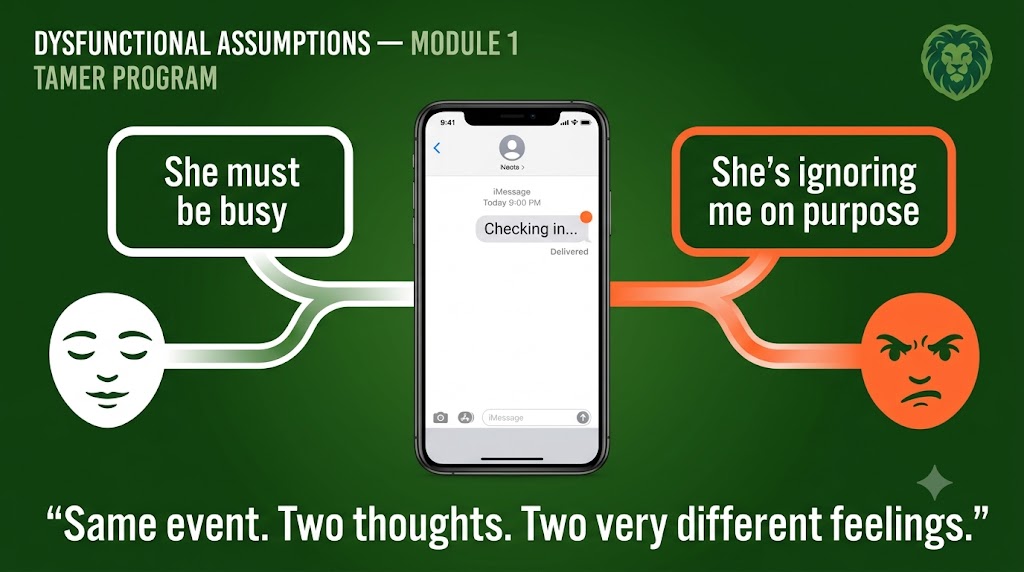
Let me start with the idea this whole module rests on.
Most people believe their anger is caused by what happens to them — the rude driver, the disrespectful coworker, the kid who won't listen. That feels true. But thirty years in criminal justice and anger management taught me something that surprises almost everyone: the event doesn't create your anger. Your thoughts about the event create your anger.
The chronically angry person isn't living a worse life than everyone else. They've just developed thinking habits that practically guarantee frequent anger. The calmer person has developed thinking habits that promote balance. That's it. That's the difference — and it's learnable.
The key insight that changes everything: It isn't the situation that makes you angry. It's the meaning you give the situation.
Fair warning before we go further: this part can be a little uncomfortable. We're going to look at some thoughts and beliefs you might have been carrying around for years without ever questioning them. Stick with me. Understanding how your thoughts create your emotions is the doorway to lasting change.
2 · What Dysfunctional Thinking Actually Is
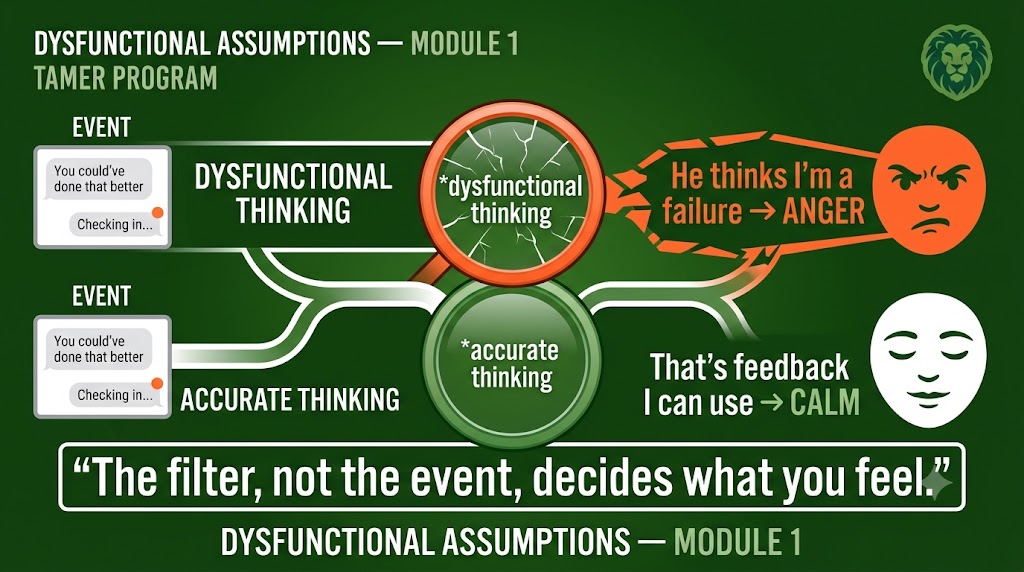
So what is "dysfunctional thinking"? Let's keep it plain.
Dysfunctional thinking is simply having assumptions about yourself, others, and life in general that work against you. It also includes plain old errors in how you process information — drawing conclusions from unreliable thoughts. These thoughts push you toward negative interpretations, push you into reactions you regret, and leave you less able to actually solve the problem in front of you.
Everyone has these patterns to some degree. It's like driving a truck that pulls a little to the right. You can still drive it just fine — but if you don't notice the pull and correct for it, you'll end up in the ditch. Same with your thinking. The goal isn't a perfect truck. The goal is knowing your pull and steering for it.
These habits don't make you a bad person, and they don't mean something's wrong with you. They're a pull in the wheel — and the rest of this module is about learning to feel that pull and correct it.
3 · The Anger Amplifiers: Common Thinking Errors
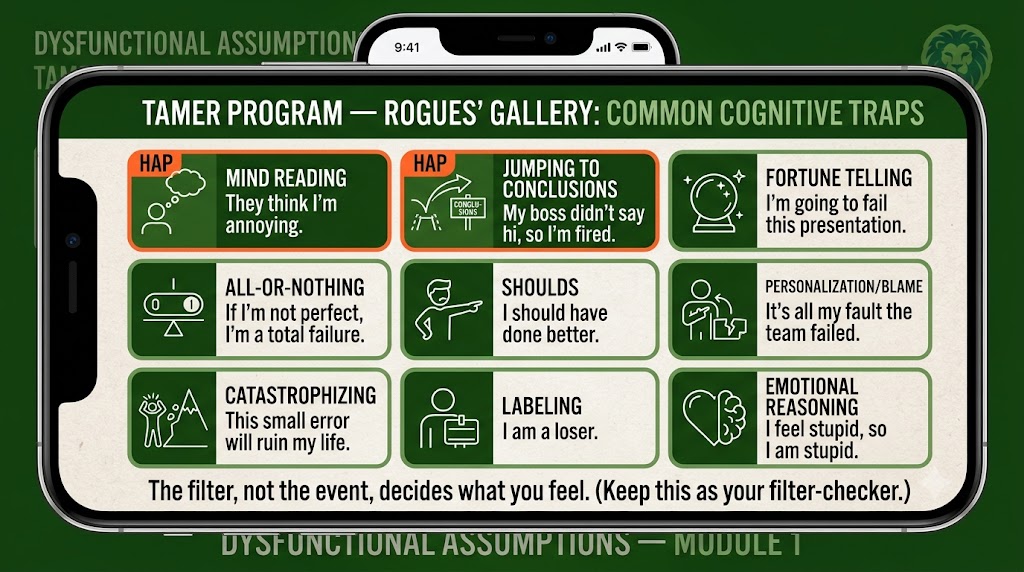
Anger has favorite tricks. Once you can name them, you can catch them. Here are the big ones — and notice that the first two are the engine of the Hostile Attribution pattern, where everything starts to look like somebody's out to get you.
Mind Reading (HAP core) — Assuming you know what someone's thinking, and assuming it's bad. "She thinks I'm incompetent." "He doesn't respect me." The trouble: you respond to your guess instead of reality.
Unless you've developed psychic powers nobody told me about, you're not reading minds — you're making educated guesses on thin information. And most of us are terrible guessers.
Jumping to Conclusions (HAP core) — Reading hostile intent into a situation with no facts to support it. "He let the kids go to that party to punish me for our argument." Assumptions made without ever checking them out.
Fortune Telling — Predicting a bad outcome with no evidence. "This is going to be a disaster." "Nothing good ever happens to me." When you expect things to go wrong, you're already primed to be angry the second they do.
All-or-Nothing Thinking — Seeing everything in black and white, no middle ground. "You never listen." "I always get treated unfairly." "If it's not perfect, it's worthless." Listen for the words always and never — they're the fingerprints.
"Shoulds" (BAP-adjacent) — Rigid rules about how you and everyone else ought to behave. "People should always be on time." "Life should be fair." When reality doesn't match the rule, you get angry instead of adapting.
"Should" is often just code for "I want the world to work differently than it does." It's like getting mad at gravity for making things fall down instead of up.
Personalization & Blame (BAP core) — Two sides of one coin. One side takes responsibility for everything ("She's in a bad mood because of me"). The flip side — the Blame Attribution side — dumps all the responsibility on someone else ("My marriage is lousy because my partner is impossible") and overlooks your own part in it.
Catastrophizing — Blowing it out of proportion. A setback at work becomes "I'm going to get fired." You leap to the very worst "what if," even when it's wildly unlikely.
Labeling — Slapping a whole-person label on one event. Instead of "I made a mistake," it's "I'm a loser." Instead of "He forgot," it's "He's an idiot." Now the problem is somebody's character instead of a behavior — and character feels unfixable, which keeps the anger burning.
Emotional Reasoning — Treating a feeling as proof. "I feel angry, so I must be getting treated unfairly." But feelings are real and temporary — they're one piece of the truth, not the whole verdict.
Focusing on the Negative — Filtering out everything good and obsessing over the one bad thing. Your boss thanks you for hard work and suggests one improvement, and all you hear for the rest of the day is the criticism.
Practice: The Lineup — Name That Thinking Error
Naming the trick is how you beat it. I'm going to show you eight hot thoughts, one at a time — every one of them pulled straight from the errors you just read. Your job: pick the thinking error behind each one. Wrong guesses cost you nothing. Look again and pick a better answer — that's the whole skill, in the game and in life.
Suspect 1 of 8
Lineup complete
Here's the point of the exercise: every one of those thoughts felt true in the moment. Naming the error is what breaks the spell.
4 · The Four Thinking Personalities
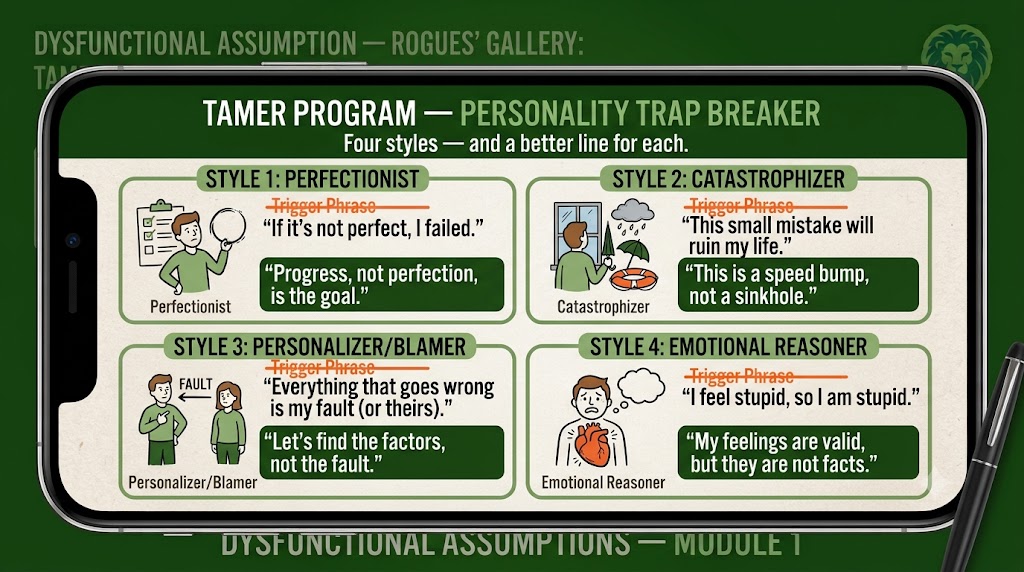
These thinking errors often gather into a recognizable style. Most of us live in at least one of these. There's no shame in any of them — and each one has a better line you can practice instead.
Try it yourself: guess the better line
For each voice below, you'll see its favorite phrase. Before you reveal the answer, come up with your own better line — say it out loud or in your head. Then click and see how close you got. Don't skip the guessing part; the guessing part is the workout.
The Pessimist
Lives on the horizon, scanning for trouble. Anticipates the worst before anything has happened.
Favorite phrase: “What if…?”
The Faultfinder
Constantly judging, comparing, pouncing on every mistake — yours or theirs.
Favorite phrase: “You could've done better.”
The Victim
Feels helpless; sees every obstacle as insurmountable.
Favorite phrase: “I'll never be able to…”
The Perfectionist
Self-worth riding on achievement and approval; intolerant of setbacks.
Favorite phrase: “I have to…”
Which voice lives in YOUR head?
Be honest — most of us know our voice the second we see it. Pick the one that sounds most like the narrator in your head on a bad day. (Mine, for years, was the Faultfinder.)
5 · The ABC Model: How a Thought Becomes a Feeling
This is the engine room of the whole module — a simple three-letter map:
- A — Activating event. What actually happened. The objective facts.
- B — Belief. The thought you have about what happened.
- C — Consequence. The emotion you feel and the action you take.
Almost everyone assumes A causes C — the event makes me angry. But that's the great myth. B causes C. Your belief about the event is what produces the feeling. Watch it work with one event and three different thoughts — and this time, don't just read it. Try each thought on and feel where the needle lands.
The Unreturned Phone Call: You Pick the B
A — the event: A friend doesn't return your call. That's it. That's all that actually happened. Now pick a thought — pick all three, one at a time — and watch what each one does to the anger needle.
C — what that thought produces:
Here's where your power lives. You can't always control A (what happens). But you have real influence over B (how you think about it). Some thoughts reliably build anger — "They did that on purpose," "This is so unfair," "They should know better." Others reliably cool it — "I wonder what's really going on here," "This is frustrating, but it's not the end of the world," "Maybe there's something I don't understand."
Most of us think the event causes the feeling. It doesn't. The event never changes — your thinking does. And that, right there, is the part you get to steer.
6 · Challenge and Replace: Putting It Into Practice
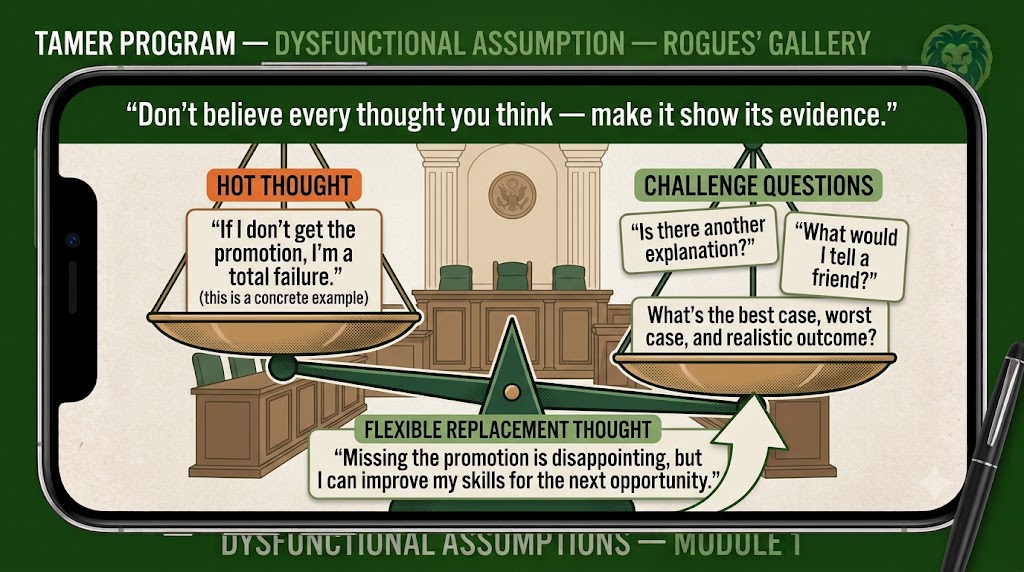
Catching a thinking error is step one. Step two is doing something about it. The move is simple: challenge the thought, then replace it. You're not trying to think positive — you're trying to think accurate.
The rigid version vs. the flexible version. Anger-fueling beliefs tend to be rigid and demanding. Calmer beliefs tend to be flexible and realistic:
| Rigid / anger-fueling | Flexible / realistic |
|---|---|
| "People must treat me fairly." | "I prefer fair treatment — and I can handle it when I don't get it." |
| "It's terrible when things don't go my way." | "It's disappointing, but it's not the end of the world." |
| "I can't stand difficult people." | "I don't enjoy them, but I can handle them." |
| "I'm a complete failure." | "I failed at this specific thing." |
The challenge questions. When a hot thought shows up, put it on trial:
- Is this based on facts, or on an assumption?
- What's the evidence for it — and against it?
- Where is it written that things must be this way?
- Is this thought helping me or hurting me?
- What would I tell a friend who had this exact thought?
- How will I feel about this in a week? A month? A year?
A worked example — the coworker who takes credit.
Situation: A coworker takes credit for your idea in a meeting.
Hot thought: "He should never do that! It's awful! I can't stand working with people like this!"
Challenge: "Where is it written that coworkers never take credit? Is this truly awful, or just frustrating? What's my evidence that I can't handle it?"
Replacement: "I'd prefer he gave credit where it's due, and I can handle it when he doesn't. This is frustrating — and I can address it directly with him and my supervisor."
Same situation. The anger went from a 9 to a 3, and now there's a plan instead of a slow burn. Now it's your turn — with a thought of your own.
Your Turn: Put a Thought on Trial
Think of a hot thought that shows up when you're angry — a real one, one you've actually caught yourself thinking. We're going to run it through the exact same process as the coworker example: rate it, challenge it, replace it, and rate it again.
Step 3 — Now put it on trial. Ask it the challenge questions:
- Is this based on facts, or on an assumption?
- What's the evidence for it — and against it?
- Where is it written that things must be this way?
- What would I tell a friend who had this exact thought?
Write both the hot thought and the replacement first — the trial needs both sides.
7 · Where Dysfunctional Thinking Comes From (and Why That's Hopeful)
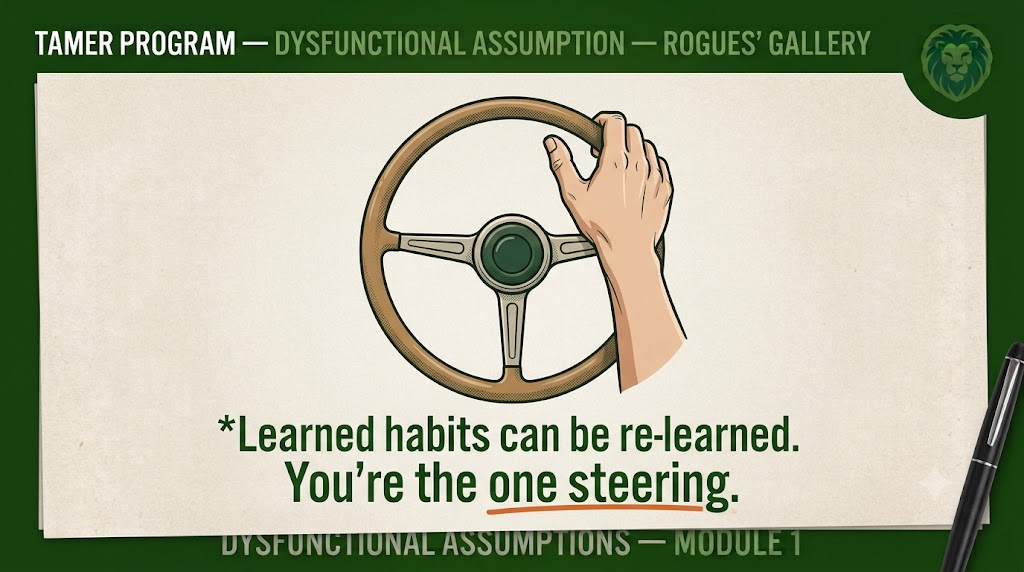
Here's the most hopeful idea in this module. These thinking patterns aren't your fixed nature. They were learned — picked up from parents, teachers, peers, and the wider world while you were growing up. They got so basic and so automatic that you stopped seeing them as patterns. You just took them as truth.
And that's exactly why there's hope: what was learned can be unlearned. Changing a belief system isn't about pretending problems don't exist or plastering on positive thoughts. It's about thinking more accurately so you can respond to life with wisdom instead of reflex.
Your thoughts in response to a situation mostly determine how you feel. That means you are primarily responsible for how you feel — not to blame, responsible. At the very least, you're responsible for examining the thoughts behind the feeling instead of pinning it all on the situation or the other person.
Let me show you what this looks like in a real life.
Robert's story. Robert came to my program after road-rage incidents started threatening his job — he was a delivery driver. His head was full of shoulds and judgments: "People should know how to drive." "Idiots shouldn't be allowed on the road." "They're doing this on purpose to make me late."
As Robert worked on his thinking, he realized his anger wasn't really about other drivers at all. It was about his need for control and his fear of getting criticized at work for late deliveries. Once he saw that, he could deal with the real problem: he talked to his supervisor about realistic delivery times and built some better stress habits.
Robert didn't turn into a perfect, serene driver. He still noticed bad driving. But he stopped taking it personally — and that one shift changed everything.
Notice what was underneath Robert's thinking errors: not bad character, but a learned set of "shoulds" and a fear he'd never named. That's the whole game. Catch the thought, find what's under it, and choose a more accurate one.
Private reflection: what's underneath YOUR pattern?
Robert's shoulds weren't really about traffic — they were about control and a fear he'd never named. Now you. Take the thinking pattern you've noticed most in this lesson — your voice, your favorite error — and take one honest guess at what might be underneath it. A fear? A need? An old rule from growing up?
Stays on this page only.
Knowledge Check: Thought Court
All rise — Thought Court is in session, and you're the judge. Six cases are on the docket below. Rule on each one correctly and the court will deliver its final verdict. Wrong rulings cost you nothing — re-examine the evidence and rule again. That's the method, on the bench and in your own head.
Unlocks when all six cases are ruled.
COURT ADJOURNED
The verdict is in: the event was never the guilty party.
The thought did it — every time.
And the thought is the one thing on that docket you can change. Well ruled, Your Honor.