Dysfunctional Assumptions
- Explain the idea that changed everything for so many of my students: the event doesn’t create your anger — your thoughts about the event do.
- Define a dysfunctional assumption in plain language, and tell it apart from a one-time angry thought.
- Recognize the hostile-intent assumption — “they did that on purpose, against me” — and why it’s the fast lane to anger.
- Walk the ABC model (Activating event → Belief → Consequence) on a real moment from your own week.
- Catch your own most common assumptions among nine themes, and challenge them with a simple five-step process.
- Replace an old, unhelpful assumption with a more flexible, accurate one — and understand that because these were learned, they can be unlearned.
1 · The Stories We Tell Ourselves
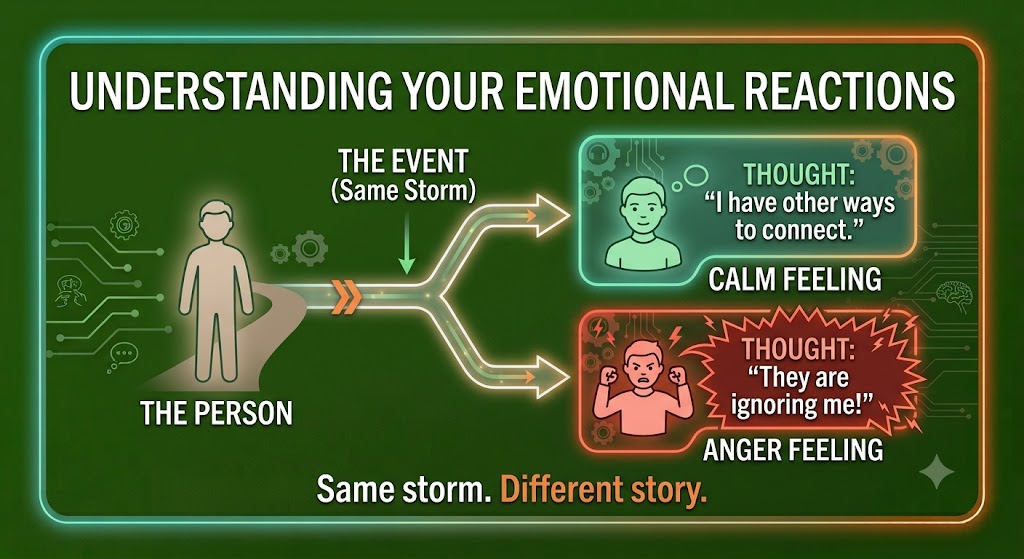
Let me tell you the most important thing in this whole module, and I’ll say it plainly: the event doesn’t cause your anger — your interpretation of the event does.
That’s not me being soft on the people who wronged you. Plenty of things in this world genuinely deserve your anger. But thirty years in criminal justice and anger management taught me that the chronically angry person and the steady person are usually standing in the same storm. The difference is the story running in their head about it.
This chapter is about finding the thinking patterns that manufacture unnecessary anger in your life — and changing them. Fair warning: this might get a little uncomfortable. We’re going to look at some beliefs you may have carried around for years without ever once stopping to ask, “Is that actually true?” Stick with me. It’s worth it.
2 · Three Levels of Thinking (and Where Assumptions Live)
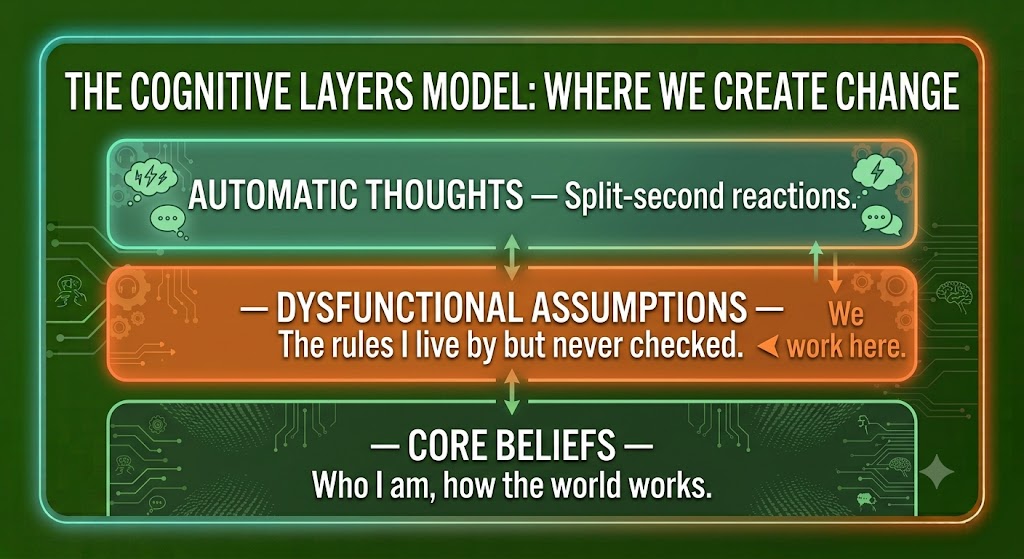
Researchers who study how thinking shapes emotion describe three levels of it. You don’t need the jargon, but the map is genuinely useful:
- Core beliefs — the deepest, most absolute ideas about yourself, other people, and the world (“I’m not good enough,” “People can’t be trusted,” “I’m helpless”). These get learned early and feel like plain fact.
- Dysfunctional assumptions — the rules you build on top of those beliefs (“If I ask for help, people will think I’m weak,” “Unless I’m perfect, I’m worthless”). This is the level we work in this whole module.
- Automatic thoughts — the split-second reactions that fire in the moment (“He did that on purpose,” “This is so unfair”).
So what is a dysfunctional assumption? Plainly: it’s an assumption about yourself, others, or life in general that works against you. It’s an error in how you process information, built on shaky beliefs, that pushes you toward negative interpretations, reactive behavior, and conflict you can’t seem to resolve.
Oklahoma common-sense moment. Everybody has some of these — it’s like driving a truck that pulls a little to the right. You can still get where you’re going, but if you don’t know it pulls and correct for it, you’ll end up in the ditch. People with a chronic anger problem aren’t broken; they’ve just got a few more of these pulls, and they’re not correcting yet. By the end of this module, you’ll know how to correct.
3 · The Hostile-Intent Assumption
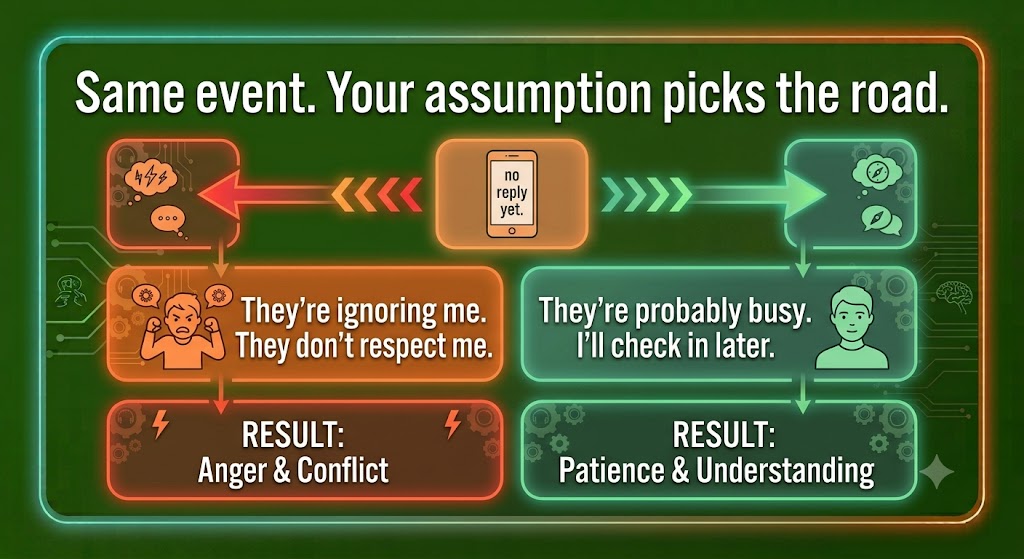
If anger has a favorite doorway, this is it: assuming hostile intent — reading deliberate, personal hostility into other people’s behavior, then reacting to that instead of to what really occurred.
It usually sounds like:
- “He’s deliberately trying to annoy me.”
- “She thinks I’m incompetent.”
- “They don’t respect me.”
- “The waiter is being slow on purpose to get under my skin.”
Why it sets off anger so fast: when you decide someone meant to harm you, your body responds as if you’re under attack — because, in your mind, you are. You skip right past curiosity and land on defense. And the more often you do it, the more the world starts to look hostile, which makes you assume hostility even faster next time. It’s a loop.
My reality check, straight up: unless you’ve developed psychic powers nobody told me about, you’re not actually reading minds. You’re making an educated guess on limited information — and here’s the kicker most people miss: most of the time, other folks aren’t thinking about you at all. They’re wrapped up in their own concerns, their own bad day, their own to-do list. What felt like an attack was usually just somebody else’s distraction.
Two close cousins of this assumption show up constantly, and they’re worth naming:
- Mind reading — “I know what they’re thinking about me,” without ever checking. (It also runs the other direction: expecting people to know what you need without you saying it — “You should have known I’d want to go to dinner for my birthday.”)
- Jumping to conclusions — interpreting a situation negatively with no evidence. (James hears that Lauren let their teenager go to a party without asking him first, and instantly concludes she’s punishing him over a recent argument — never once checking whether that’s true.)
4 · The ABC Model: A Doesn’t Cause C
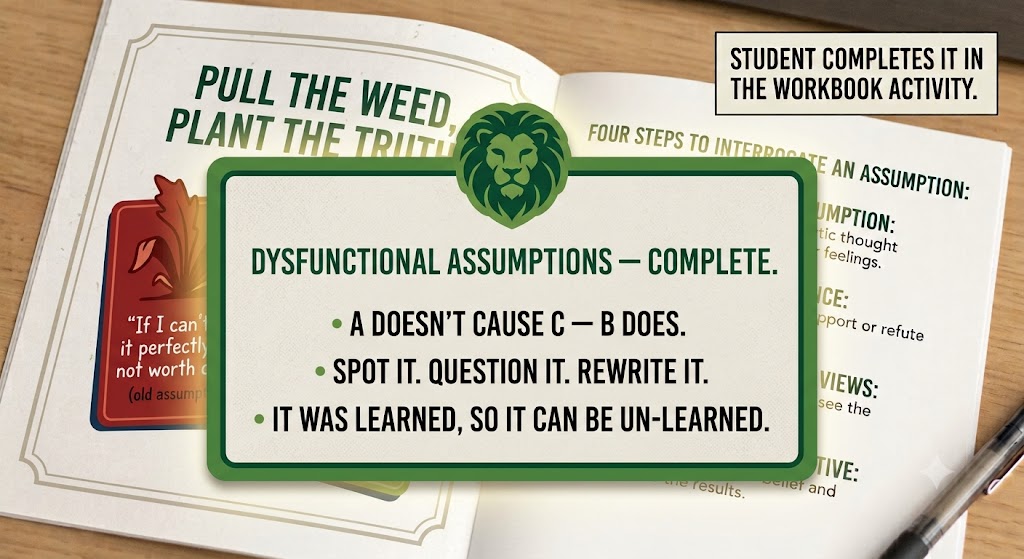
Here’s the one tool from this chapter I’d want you to remember if you forgot everything else. It’s three letters: A, B, C. A is the activating event — the thing that happened. C is the consequence — how you ended up feeling and acting. Most of us believe A causes C: the traffic made me furious, he made me blow up. But there’s a step in the middle we skip right over. B — your belief, your interpretation. And here’s the insight that changes everything: A doesn’t cause C. B causes C.
Here’s the model, with a real example. Same event, three different beliefs, three completely different outcomes:
A — Activating event: Your friend doesn’t return your phone call.
- B1: “She’s probably swamped with work and family.” → C1: You feel fine. Mildly curious, maybe.
- B2: “She’s ignoring me. I must’ve done something wrong.” → C2: You feel hurt and anxious.
- B3: “She’s being rude and inconsiderate.” → C3: You feel angry and resentful.
One event. Three stories. Three emotions. The friend’s behavior never changed — only the sentence you told yourself about it did.
| A (Event) | B (Belief) | C (Consequence) | |
|---|---|---|---|
| You can control it? | Often no | Yes — this is your power | Follows from B |
| Example | Boss points out an error | “She’s picking on me to make me look bad” | Angry, defensive |
| Re-write B → | (same event) | “Good feedback. I want to do quality work.” | Motivated to improve |
The whole power of this is right there in the middle letter. You can’t always control A — what life throws at you. But you have real, trainable control over B — the story you tell about it. Change B, and C changes with it. That’s not denial, and it’s not pretending bad things are good. It’s thinking more accurately.
5 · Nine Common Assumptions (Find Yours)
Dysfunctional assumptions tend to fall into a handful of familiar themes. Read the nine below slowly. Notice which ones you actually believe — not which ones you know are unreasonable, but which ones you live by when you’re tired and stressed. I don’t want you to grade yourself or feel ashamed — everybody owns a few of these. Just notice the one or two that make you go, “oof, that one’s mine.” That flinch of recognition? That’s not a failure. That’s the start of the whole skill.
- “Asking for help is a sign of weakness.”
- “If I allow other people to influence me, I will lose my independence.”
- “If I can’t do something perfectly, it’s not worth doing at all.”
- “If someone dislikes you, that means there’s something wrong with you.”
- “If someone is better at something than me, it means they are a better person than me.”
- “If you upset people, they will reject you.”
- “Unless I am loved, I cannot be happy.”
- “Unless I have the highest possible standards, I will never do anything well.”
- “Unless I keep a tight rein on my feelings at all times, I will be a complete emotional mess.”
Notice the shape most of them share: a rigid “if… then…” or “unless… I will…”. That’s the tell of an assumption — an absolute rule, no gray area, no exceptions, never once tested against real life.
6 · Challenging an Assumption (the Five Steps)
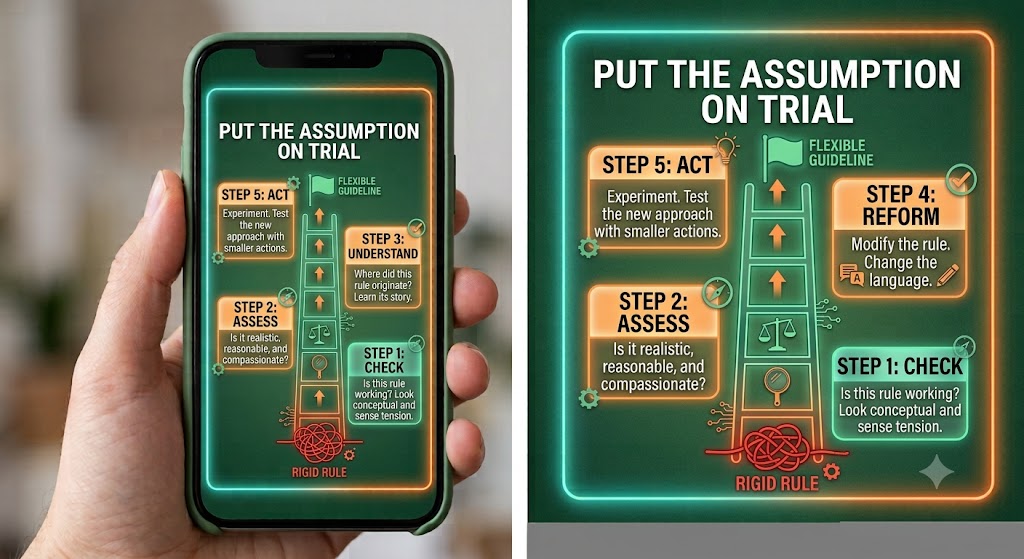
Pick one assumption you just recognized as yours. Now walk it through the five steps I teach in the course:
- Check the dysfunctionality. Weigh it honestly — what are the advantages of believing this, and the disadvantages? (Most of these rules cost far more than they pay.) Ask: “Am I being balanced in my thinking about this?”
- Assess the irrationality. How unreasonable, exaggerated, or impossible is it? Does it leave any room for being human? Ask: “What’s the worst scenario here? Then what would actually happen?” and “Has this ever been true before?”
- Understand its origins. Where did this rule come from? Ask: “Did I choose this belief — or did it come out of my experiences growing up?” (Almost always the second one. These were learned — from parents, teachers, peers, the world around you — usually so early you mistook them for facts.)
- Develop a reformulation. Write a new guideline for living that keeps any real wisdom but loses the rigidity — flexible instead of absolute. Ask: “Does this belief promote my well-being?”
- Implement an action plan. Beliefs don’t change by thinking about them once. Decide how you’ll practice the new rule the next time the old one fires.
Here’s the reformulation in action — old, rigid rule on the left, more accurate rule on the right:
| Old assumption | More accurate, flexible belief |
|---|---|
| “People should always treat me fairly.” | “I prefer fair treatment, and I can handle unfairness when it shows up.” |
| “If someone criticizes me, they don’t respect me.” | “Criticism might hold useful information, even when it’s delivered badly.” |
| “I shouldn’t have to deal with difficult people.” | “Difficult people are part of life, and I can learn to handle them skillfully.” |
| “If I get angry, I have to express it right now.” | “Anger gives me information, and I get to choose how I respond to it.” |
| “I can’t stand it when someone gets angry with me.” | “It’s uncomfortable when someone’s angry with me, and I can stay steady through it.” |
7 · Where These Came From (and Robert’s Story)
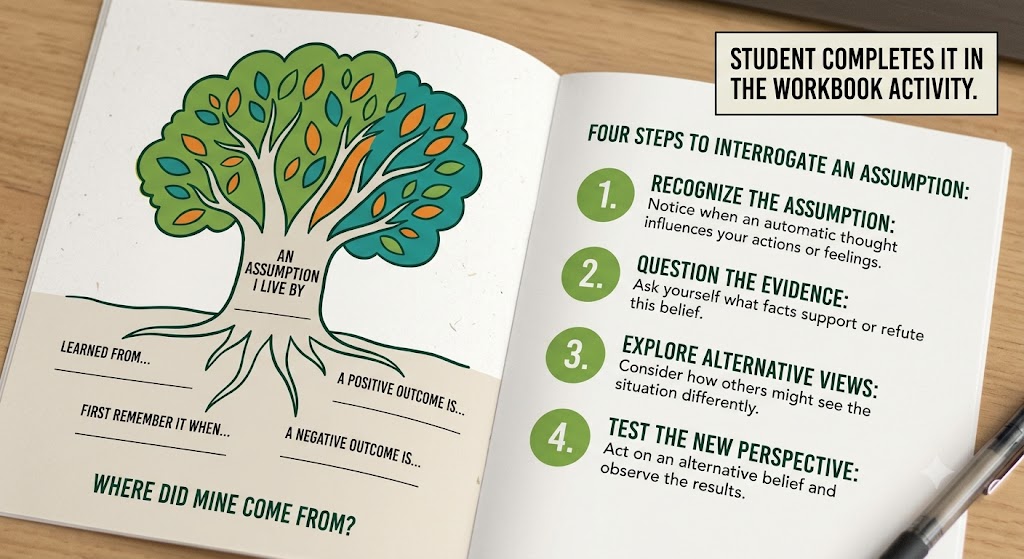
Your assumptions weren’t beamed in from outer space. They were learned — from parents, teachers, peers, and the larger world while you were growing up. They became so basic to how you think and feel that you stopped seeing them as beliefs at all. You just took them as fact.
That’s exactly why they can change. Un-learning a dysfunctional assumption takes four moves, and you already have them: become aware of the specific thought, understand where it came from, challenge whether it’s actually valid, and replace it with one or more healthier thoughts. Awareness first — you can’t change a rule you can’t see.
Robert’s story. Robert came to my program after road-rage incidents started threatening his job — he drove deliveries for a living. His thinking was wall-to-wall shoulds and judgments: “People should know how to drive.” “Idiots shouldn’t be allowed on the road.” “They’re doing this on purpose to make me late.”
Working through his belief system, Robert realized something: his anger wasn’t really about other drivers at all. It was about his need for control, and his fear of getting chewed out at work for late deliveries. Once he saw that, he could deal with the real problem — he talked to his supervisor about realistic delivery times and built some better stress habits. Robert didn’t turn into a perfect driver, and he didn’t stop noticing bad ones. But he stopped taking them personally — and that made all the difference.
Notice what Robert’s loudest assumption was: “they’re doing this on purpose to make me late.” That’s the hostile-intent assumption from Section 3, in a delivery van. The other drivers weren’t plotting against Robert. They were just driving — wrapped up in their own days, same as everyone.
8 · Coping Statements: Stocking the New Shelf
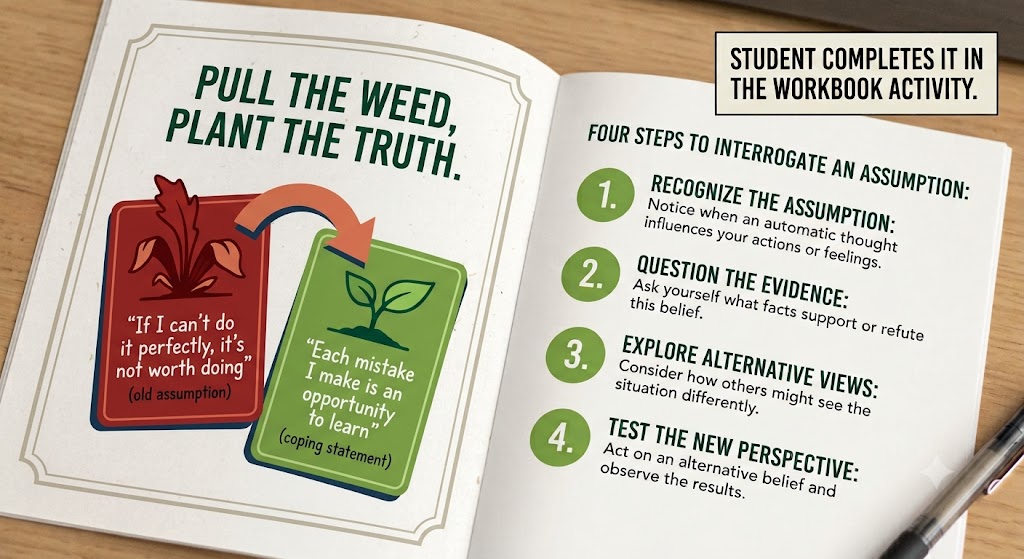
A coping statement is a short, direct phrase that affirms your worth — “I believe in myself.” They work because they hand your mind a positive, accurate thought to grab when the old, dysfunctional one comes knocking. Two tips that make them stick: keep them in the present tense (not “I will be,” but “I am”), and say them out loud or write them down — that drives them deeper than reading silently.
A handful from the course to start your own shelf:
- “I am a worthwhile, deserving person.”
- “I am acceptable just because I’m a human being.”
- “Each mistake I make is an opportunity to learn.”
- “I have the power to forgive myself for past mistakes.”
- “I can set my own boundaries.”
- “I accept my feelings and manage them effectively.”
- “I express anger in appropriate ways.”
And remember the destination, one more time — same one I give every student: not a person who never has another unhelpful thought (nobody gets that), but a person who can catch the thought, question it, and choose a truer one. That’s the whole skill. You’ve just learned how it works.
Knowledge Check
Your knowledge check for this lesson is an interactive game you’ll play in the course — it’s built to make the ideas stick, and you’ll enjoy it. Keep going and you’ll get there.