Communication Styles
- Name and tell apart the four communication styles — passive, aggressive, passive-aggressive, and assertive — and recognize each one in everyday life (including in yourself).
- Explain why assertive communication is the goal, and how it differs from both bulldozing and being a doormat.
- Use the Assertiveness Formula and the "I-message" to say a hard thing without attacking the other person.
- Read what your body and voice are saying, since most of any message is carried without words.
- Walk through the CALM method to stay effective when emotions — yours or theirs — are running high.
1 · Most People Are Great Communicators… Until Anger Shows Up
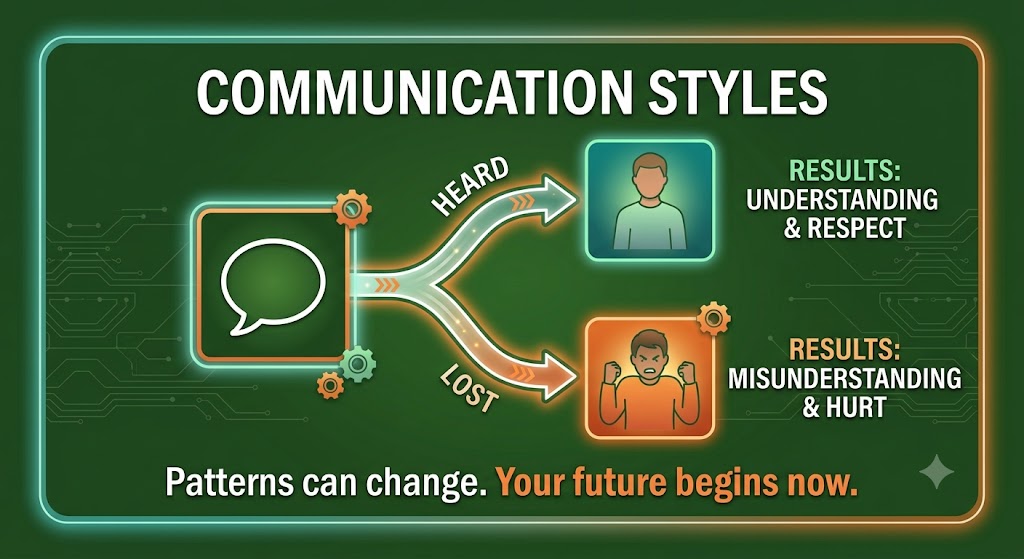
Let's be honest with each other. Most people believe they communicate just fine — until anger enters the picture. Then a lot of us become masters of everything that doesn't work: yelling, interrupting, name-calling, dragging up the past, making threats, and generally making sure that whatever point we were trying to make gets completely lost in the chaos we just created.
Thirty years in criminal justice and anger management taught me this: effective communication during conflict isn't just possible — it's a learnable skill. And once you have it, something remarkable happens. People actually want to listen to you. Problems get solved instead of escalated. Relationships get stronger instead of more damaged.
Effective communication isn't about being nice, avoiding conflict, or always agreeing. It's about creating understanding, solving problems, and preserving relationships — even when the conversation is hard.
Sometimes that means a difficult conversation. Sometimes it means a firm boundary. But it's always done in a way that treats the other person with dignity and aims at a solution, not damage.
2 · Janet's Story: When the Message Gets Lost in the Delivery
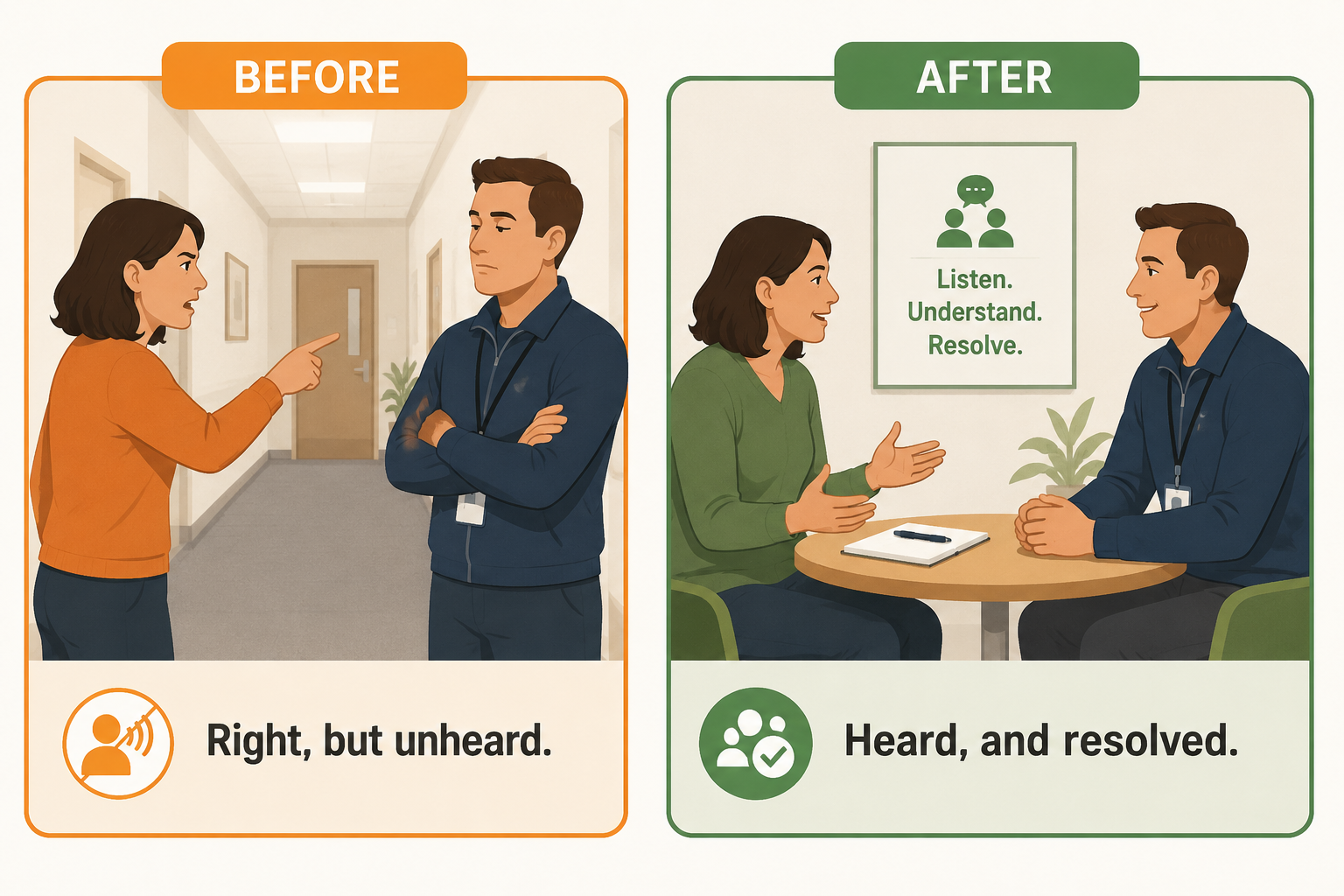
Let me tell you about Janet, a nurse supervisor who came to my program after a heated confrontation with a doctor. Janet was a dedicated professional who cared deeply about patient care. But when she disagreed with a medical decision, she'd get so worked up that her message got lost in her delivery.
The incident that brought her to anger management: a doctor wanted to discharge a patient Janet felt wasn't ready to go home. Instead of presenting her concerns professionally, Janet cornered him in the hallway and — in front of other staff and patients — accused him of "not caring about patient safety" and being "more worried about bed turnover than people's lives."
Here's the thing. Janet's concerns were valid. That patient did need more monitoring. But her delivery was so aggressive and so public that the doctor got defensive, the staff felt uncomfortable, and Janet got written up for unprofessional behavior. The patient issue got buried under the interpersonal drama.
When Janet learned to communicate differently — stating her observations, asking questions, and suggesting solutions instead of hurling accusations — she discovered most doctors were actually receptive to her input. Her patient advocacy became more effective, because people could finally hear her message instead of just reacting to her delivery.
Keep Janet in mind for the rest of this module. Being right isn't enough. How you deliver it decides whether it lands.
3 · The Four Communication Styles
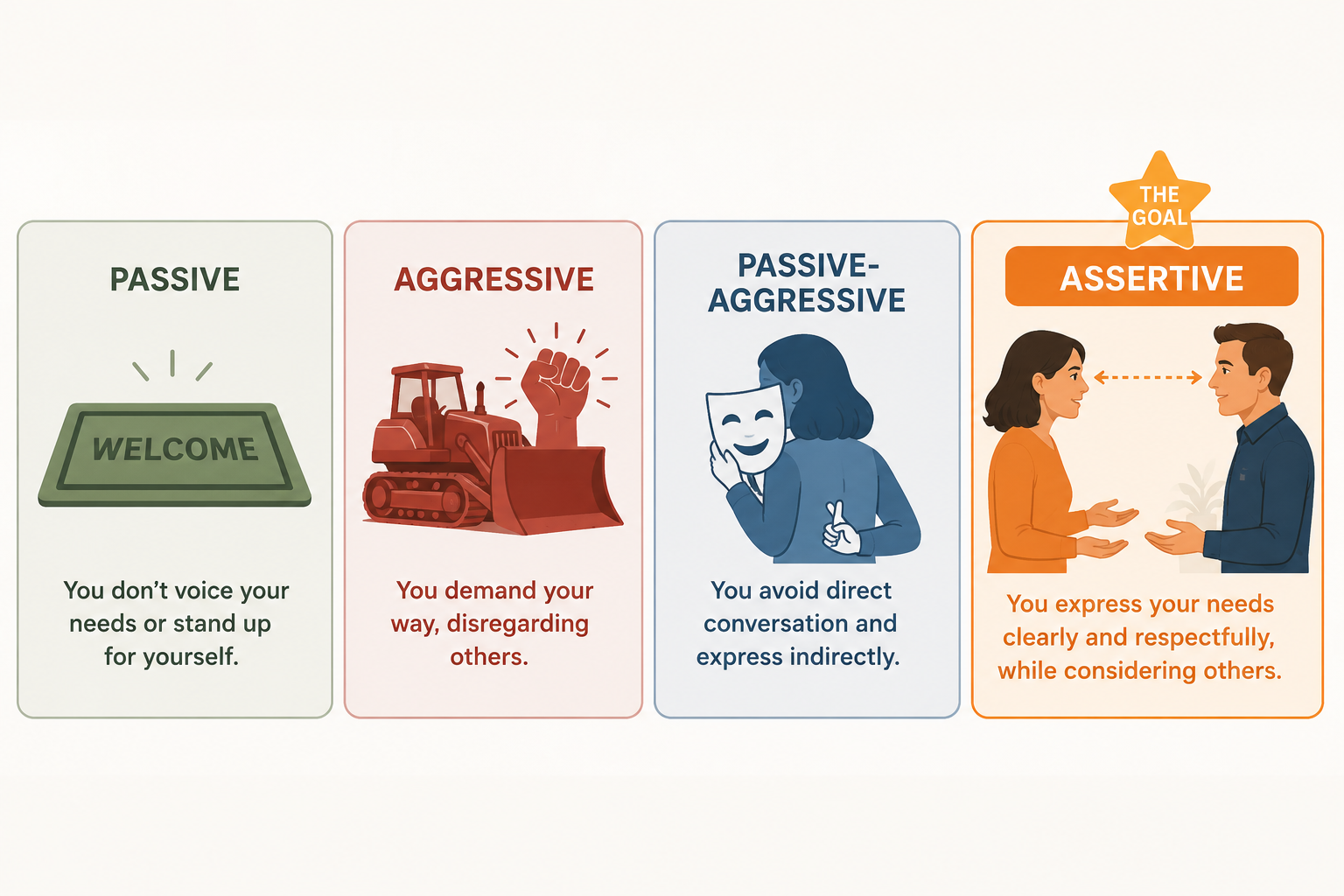
There are generally four recognized communication styles. Three of them cause trouble; one is the goal. As you read, notice which one sounds most like you on a hard day — without judging yourself. That noticing is the whole skill.
1. Passive — "The Doormat."
You prioritize everyone else's needs over your own and avoid expressing your feelings. You agree, or say nothing, while you boil inside. The result is misunderstanding and built-up resentment.
Example: Your coworker keeps leaving their mess in the shared break room. You say nothing — and secretly seethe every time you see it.
2. Aggressive — "The Bulldozer."
You express your needs in a way that violates the other person's rights — through dominance or hostility. Yelling, blaming, criticizing, making YOU-statements, intimidating others with your opinion.
Example: You storm into your coworker's office: "You're such a slob! Clean up your disgusting mess or I'm reporting you to HR!"
3. Passive-Aggressive — "The Sniper."
On the surface you look passive, but your anger leaks out indirectly — sarcasm, backhanded compliments, the silent treatment. You're angry but never specific about what you're angry about. You take pot shots with a smile, so the other person is never quite sure if you meant it, and ends up feeling that maybe they're being too sensitive.
Example: You leave notes about "certain people" not cleaning up, or make pointed comments about "some people not being taught basic manners."
4. Assertive — "The Goal."
You express your feelings, needs, and opinions openly and respectfully, without violating anyone else's rights. Clear, direct, with appropriate body language. It honors both people.
Example: "Hey Sarah, I've noticed the break room gets pretty messy after lunch. Could we work out a system where everyone cleans up their own stuff as they go? It'd keep the space nice for all of us."
Most people think there are only two choices: bulldoze the other person, or be a doormat and let them bulldoze you. But there's a third option, and it's the one that actually works. The point is to see your pattern. You can't change a pattern you can't name.
4 · Assertiveness: The Sweet Spot
Assertiveness is the ability to express your thoughts, feelings, and needs directly and respectfully, while honoring the rights and dignity of others. It's the balance point between the doormat and the bulldozer.
People confuse it with aggression all the time, but they're opposites in one key way:
- Assertive = communicating your own feelings, needs, rights, and opinions, and helping others understand them.
- Aggressive = forcing your opinion on others and making the other person feel bad for holding a different one.
When you communicate assertively:
- People respect you more, not less.
- Conflicts get resolved more quickly.
- You feel better about yourself.
- Relationships become more authentic.
- You get more of what you actually need.
- Others feel safe around you during disagreements.
The Communication Styles Matrix — the four styles plotted on two simple questions: How much do I care about myself? and How much do I care about the other person?
| High concern for others | Low concern for others | |
|---|---|---|
| High concern for self | ASSERTIVE (The Goal) — direct & respectful, honors both, problem-focused, builds relationships | AGGRESSIVE (The Bulldozer) — forces will on others, wins battles / loses wars, creates fear & resentment |
| Low concern for self | PASSIVE-AGGRESSIVE (The Sniper) — indirect anger, sarcasm & silence, builds resentment | PASSIVE (The Doormat) — avoids conflict, others decide, says yes and means no |
If your anger tends to be used as a tool to win or control, the matrix is the mirror. The aggressive quadrant feels effective because it wins the moment. But look at the long run: it "wins battles and loses wars," creating fear and resentment that cost you later. Assertive gets you the same goal without the bill coming due.
5 · How to Say the Hard Thing: The Formula and the "I-Message"
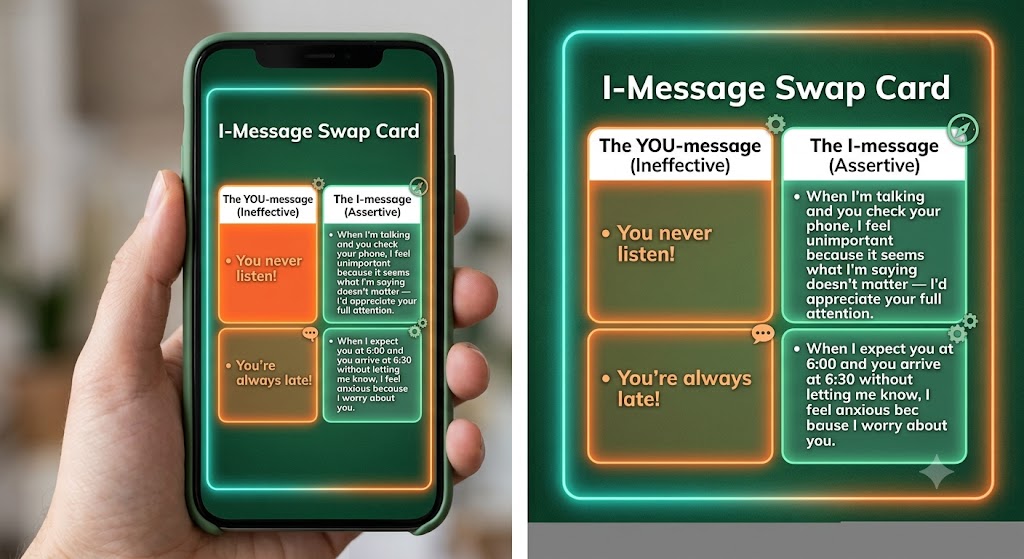
Knowing the goal is one thing. Having the words in the moment is another. Here are two tools you can use today.
The Assertiveness Formula — four steps:
- State the facts. Describe the specific behavior or situation, no interpretation, no judgment.
- Express your feelings. Use "I" statements to share your emotional response.
- Explain the impact. Describe how it affects you or others.
- Request a change. Be specific about what you need.
In action: Facts: "When meetings start fifteen minutes late…" Feelings: "…I feel frustrated…" Impact: "…because it makes me late for my next appointment and throws off my whole schedule." Request: "Could we start on time, or adjust the schedule if we need more?"
The "I-Message" — the engine inside the formula. An I-message has three parts and one rule:
- A description of the behavior, objective and non-blameful: "When…"
- Its effect on you, concrete and tangible: "The effect is…"
- A suggestion for what you'd prefer: "I'd prefer…"
The rule: an I-message is neutral. No threat, no argument, no blame. Its whole essence is "I have a problem" instead of "You have a problem." That one shift is what keeps the other person from getting defensive — and keeps your message audible.
Eliminate the YOU-messages. "You always…," "You never…," "You're so…" — those put a wall up before you finish the sentence. Trade them for "When… I feel… because… I'd prefer…"
6 · Your Body Is Talking Before You Are
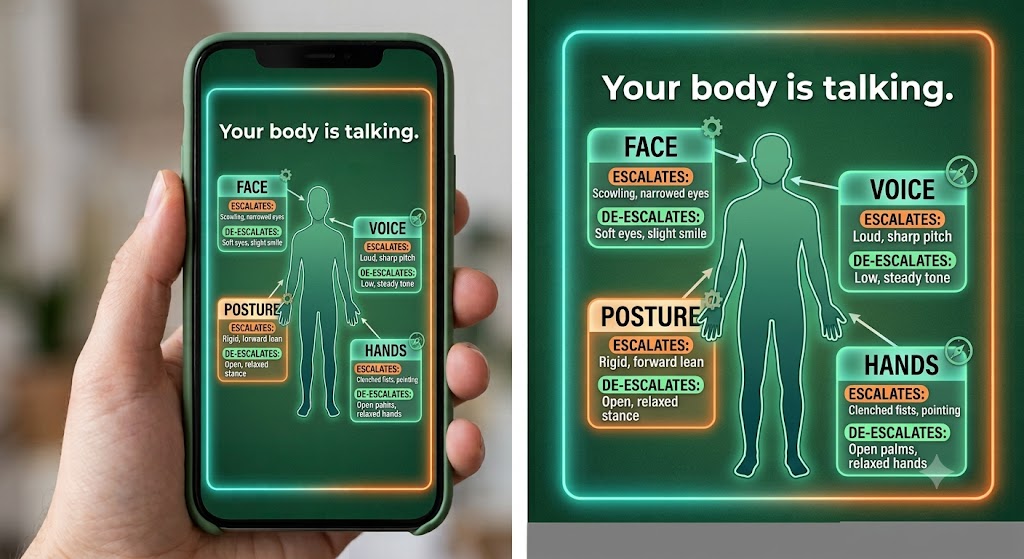
Here's a startling fact from the research: when you're face-to-face, only a small fraction of your message comes from your actual words. Albert Mehrabian's research (1960) found that 55% of a message's meaning comes from the face and body, 38% from how you say it — tone and volume — and only 7% from the words themselves.
Which means you can say "I'm not angry" while clenching your fists, talking through gritted teeth, and glaring daggers — and guess which message people believe? (Hint: not the words.)
Most people are completely unaware of what their body is broadcasting. Start noticing yours:
| Channel | What to watch for when anger creeps in |
|---|---|
| Face | Frowning or scowling; glaring, avoiding, or rolling eyes; clenched jaw; pursed lips or a tight smile |
| Voice | Getting higher or tighter; speaking faster; volume climbing; a strained sound |
| Posture | Shoulders tense or raised; leaning in aggressively or pulling back defensively; arms crossed or hands on hips |
| Hands / Arms | Fists; pointing or jabbing; fidgeting; big dramatic gestures |
And it runs both directions — you can read others the same way and adjust:
| What you see | What it might mean | How to respond |
|---|---|---|
| Arms crossing, body turning away | Getting defensive | Soften your approach; validate their view |
| Fists clenching, face flushing | Getting aggressive | Give space; lower your voice; de-escalate |
| Avoiding eye contact, slumping | Shutting down | Check in gently; make it safe to speak |
| Glancing at exits, fidgeting | Feeling trapped or anxious | Offer a break; don't corner them |
7 · Putting It All Together: The CALM Method
When emotions are running high — yours or the other person's — you need something simple to hold onto. That's the CALM method. Four moves, in order.
- C — Check yourself first. Before you respond to someone else's anger, take a beat and read your own state. What am I feeling? What is my body saying? What do I actually need from this conversation? Am I even calm enough to do this right now? If not, center yourself first.
- A — Acknowledge the other person. Recognize their feelings — which is not the same as agreeing. "I can see you're frustrated." "Help me understand your perspective." "I can tell this matters to you."
- L — Listen more than you talk. Give them room. Most people just want to be heard. Ask clarifying questions, summarize what you heard, watch their nonverbal cues — and resist the urge to interrupt or defend.
- M — Make your point respectfully. Now it's your turn. Use "I" statements, stick to specific behaviors (not character attacks), stay on the current issue (not old grievances), and offer solutions, not just complaints.
A few phrases worth keeping in your back pocket:
"Help me understand…" · "What would be most helpful right now?" · "I want to work this out with you." · "Let's take a step back." · "I can see this is really important to you."
And a few to never say:
"Calm down!" (has never once calmed anyone in the history of human communication) · "You're being irrational." · "You always…/You never…" · "That's not what happened." · "You're wrong." · "I don't care."
8 · A Quick Word on Safety
Most conflict is just two upset people talking past each other. But after three decades in criminal justice, I'll tell you plainly: violence rarely comes out of nowhere. There are almost always warning signs, and many are written in body language long before the first word.
Worth recognizing — in others, for your own awareness:
- Verbal: direct or implied threats, a threatening tone, explosive outbursts, an inability to take any criticism, constant blaming.
- Nonverbal: clenched fists, a squared-off stance, a hard unblinking stare, sudden stillness, or unwelcome physical contact.
- Behavioral: fixation on feeling insulted, following or monitoring someone, or an extreme interest in weapons.
Important — and this is the line TAMER holds: these signs indicate possible risk; they do not prove anyone will act, and noticing them is not a diagnosis. This is awareness, not assessment. If you observe behavior that worries you, your job is not to handle it alone or to label the person — it's to keep yourself safe and report it to the appropriate authorities. TAMER teaches you to notice and refer, never to diagnose.
Bringing it home. You don't have to be perfect at any of this. Even small improvements in how you communicate make a huge difference in how people respond to you and how conflicts unfold. The goal was never to make you a flawless communicator overnight — it's to make you conscious of how you communicate, and committed to getting a little better each time. Start in low-stakes moments. Build from there.
Knowledge Check
Your knowledge check for this lesson is an interactive game you'll play inside the course — it's coming up next. Keep going — you've got this!