Building a House
- Explain why lasting anger management is built on a foundation, not just a toolbox of techniques — and name the three pillars that hold it up: acceptance, empathy, and mindfulness.
- Describe what acceptance really is (and the things it is not), and use the Acceptance Paradox to stop wasting energy on battles you can't win.
- Sort a situation into what you can change and what you can't, using the control framework, so you can aim your energy where it actually works.
- Use three everyday acceptance practices — the Reality Check, the Acceptance Statement, and the Control Circle — when frustration starts to build.
- Recognize how empathy and mindfulness are already built into the house from your earlier work, and how all three pillars combine into a sustainable way of living — not a temporary fix.
1 · Why We're Building a House
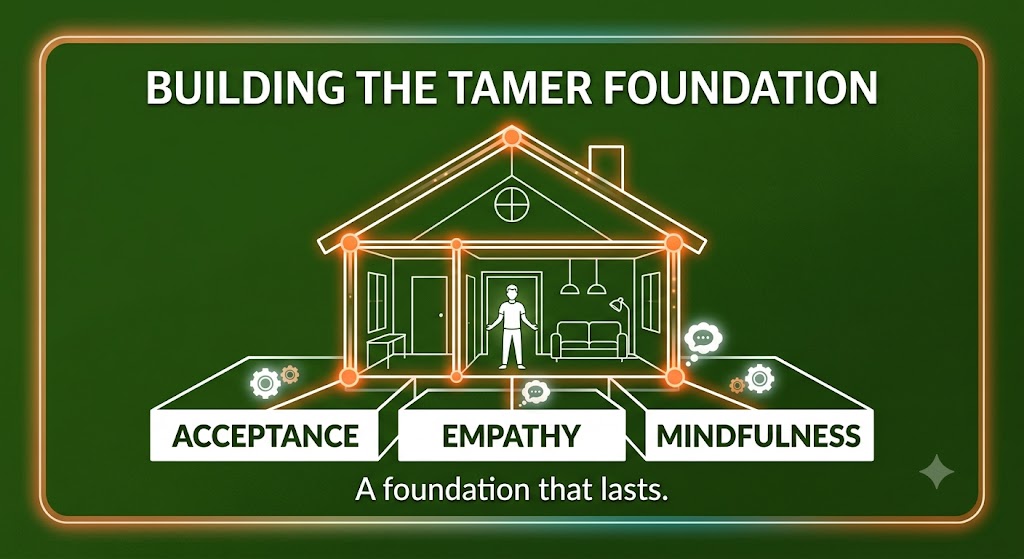
When I was growing up in Oklahoma, I learned something about building houses that turned out to be just as true about people: you can have the most beautiful structure in the world, but if the foundation is weak, the whole thing crumbles when the storms come. And trust me — in Oklahoma, the storms always come.
The same thing is true about anger management. You can learn all the techniques, master all the skills, and understand every concept in this program. But if you haven't built a strong emotional foundation, you'll find yourself right back in the old destructive patterns the moment life turns difficult. This module is about laying that foundation — the core qualities that hold up every other skill you've learned and help you weather whatever comes. I call it "Building a House," because, like building a real home, it takes patience, the right materials, and a foundation that's built to last.
After three decades of working with people who struggled with anger, I noticed something: the ones who achieved lasting change all developed the same three qualities. Not by accident — these are the load-bearing pillars.
Your emotional foundation rests on three pillars:
Acceptance — gives you peace with what you can't change.
Empathy — connects you with others and lowers the anger between people.
Mindfulness — keeps you present and aware instead of reactive.
They're not separate tricks you pull out one at a time. They work together to create something stronger than any single skill: emotional resilience. This module leans hardest on the first pillar — acceptance — because it's the starting point for everything else. Empathy and mindfulness you've already been building in earlier work; here we'll set them into the foundation alongside acceptance so the whole house stands.
2 · Acceptance Is Not What You Think
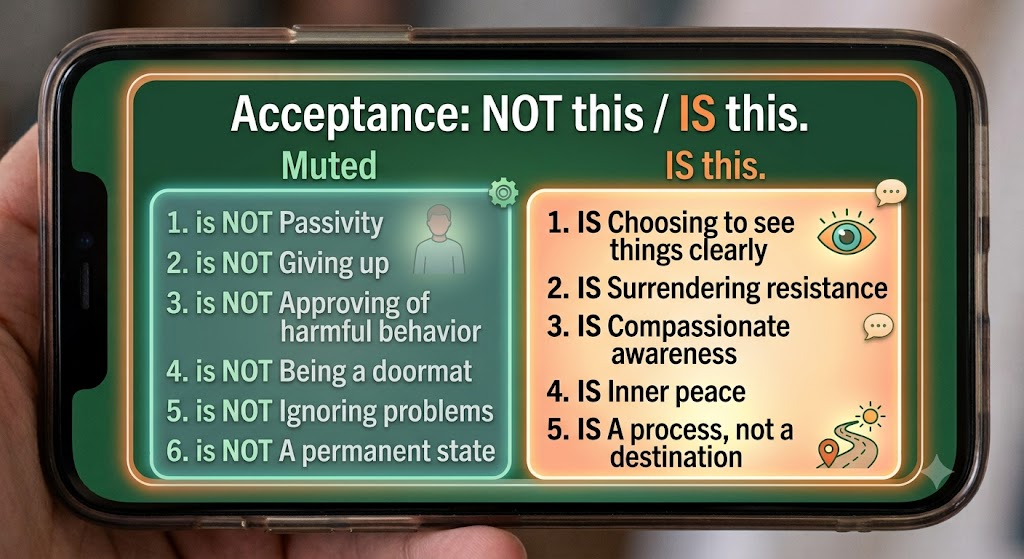
Acceptance is probably the most misunderstood concept in this whole field. Most people hear the word and assume it means being passive, giving up, or letting others walk all over them. But real acceptance is the opposite of that — it's the foundation of all effective action.
Let's be very clear about the things acceptance is NOT:
- Passivity or resignation
- Approving of bad behavior
- Giving up on change
- Letting others mistreat you
- Pretending problems don't exist
- Being weak or spineless
Now here's what it actually IS:
- Acknowledging reality as it is — not as you wish it were
- Stopping the struggle against the things you can't change
- Creating space for effective action
- Conserving your energy for what you can actually influence
- The starting point for all genuine change
Read that second list again. Every item is active. Acceptance isn't the white flag — it's clearing the field so you can actually fight the battles worth fighting.
3 · The Acceptance Paradox
Acceptance of what is creates the possibility for what could be. When you stop fighting reality, you free up enormous amounts of energy — energy you can put toward actual problem-solving.
Let me tell you about Michael, a client who was furious about his ex-wife's parenting decisions. He spent countless hours raging about her choices, arguing with her, and trying to control how she raised their children during her custody time. The anger was consuming his life — and, painfully, it was damaging his relationship with his own kids.
Michael's breakthrough came when he accepted something difficult: he could not control his ex-wife's parenting. Once he stopped fighting that reality, he could finally focus on what he could control — being the best father he could be during his own time with the children, and communicating more effectively with his ex-wife when it mattered. The anger didn't vanish overnight. But it stopped dominating his life, because he was no longer pouring himself into an impossible battle.
That's the paradox in action. Michael didn't approve of his ex-wife's choices. He accepted that they weren't his to control — and got his life back.
Whitney's Reality Check: Acceptance is like learning to swim. You can fight the water all you want, but you'll just exhaust yourself — and maybe drown. When you accept that water is water, and work with its properties instead of against them, suddenly you can move through it gracefully.
4 · What You Can Change, and What You Can't
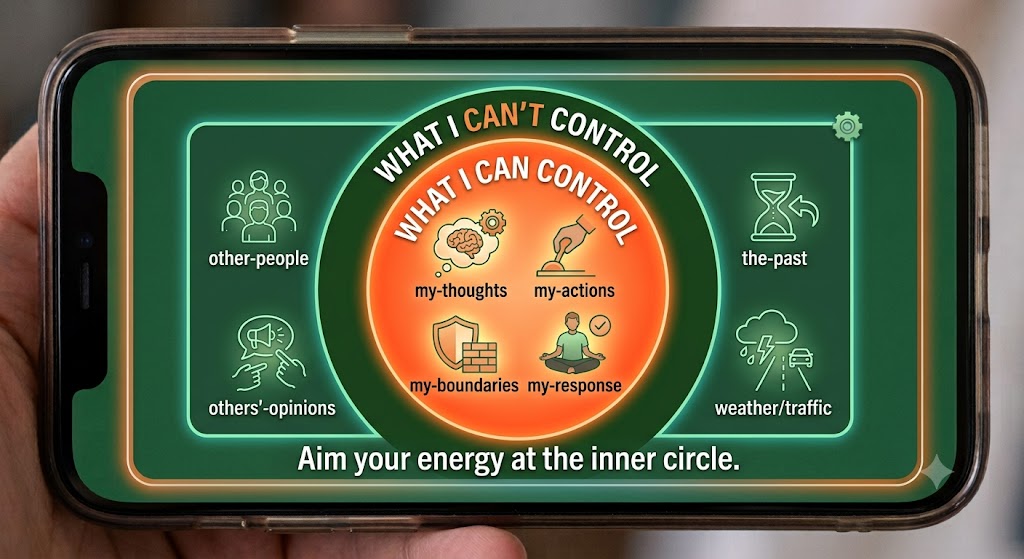
You've probably heard the old framework: the serenity to accept the things you cannot change, the courage to change the things you can, and the wisdom to know the difference. People treat it as a nice saying. I want you to treat it as a practical sorting tool — because almost all wasted anger comes from spending energy on the wrong side of that line.
Things you CANNOT change:
- Other people's behavior, thoughts, or feelings
- The past
- Natural aging and death
- Economic conditions
- Other people's opinions of you
- Traffic, weather, and other people's schedules
Things you CAN change:
- Your own thoughts, feelings, and behaviors
- Your responses to situations
- Your boundaries and standards
- Your environment (to some degree)
- Your relationships (by changing your part)
- Your goals and priorities
The wisdom to know the difference is the key. Learning to quickly assess what's in your control and what isn't saves an enormous amount of emotional energy. Most of the anger that runs people's lives is energy spent trying to change something in the first list. Move it to the second list, and the same energy starts producing results.
5 · Three Acceptance Practices You Can Use Today
Acceptance isn't a feeling you wait to arrive — it's a practice you do, especially right when frustration starts to climb. Here are three to keep in your back pocket.
-
The Reality Check. When you feel anger building, ask yourself four quick questions:
- What am I fighting against right now?
- Is this something I can actually change?
- What would happen if I accepted this situation as it is?
- What energy would I free up for things I can influence?
-
The Acceptance Statement. Practice saying — out loud or in your head:
"This is what's happening right now. I don't have to like it, but I can accept it and decide how to respond."
That one sentence buys you the space between the trigger and the reaction. In that space lives every good choice you'll ever make. - The Control Circle Exercise. Draw two circles, one inside the other. In the inner circle, write the things you can control. In the outer circle, write the things you can't. Then — deliberately — pour your energy into the inner circle. When you catch yourself stewing over something in the outer circle, that's your signal: this isn't mine to carry.
6 · Empathy: The Pillar That Lowers the Anger Between People
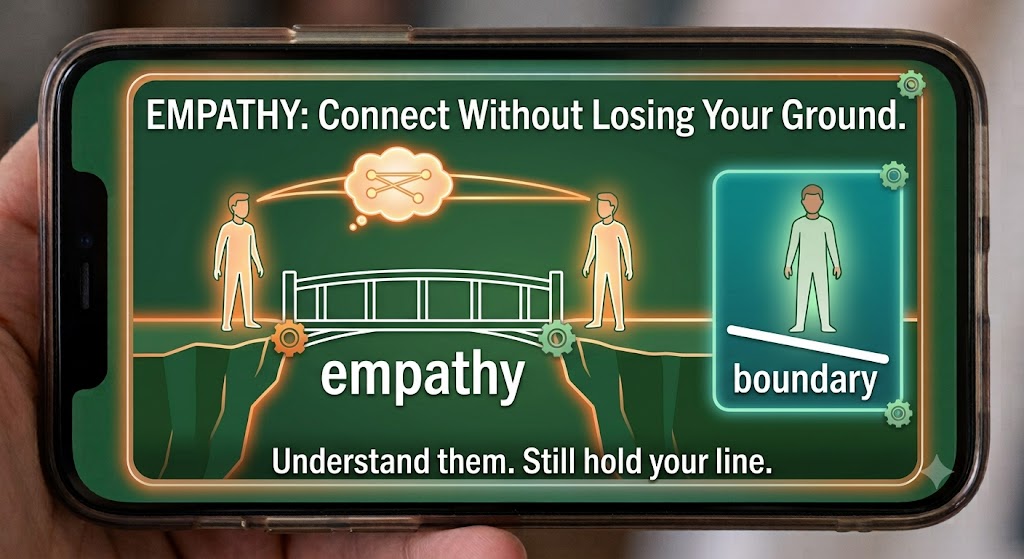
Acceptance turns outward, too. Empathy is your ability to understand and share what another person is feeling — and it's one of the most powerful antidotes to anger there is, because it's very hard to stay furious at someone once you truly understand their perspective.
A big part of this is non-judgment: choosing to accept people as they are, including their faults and weaknesses, instead of measuring them against your private set of rules. When you suspend that running judgment — of their strengths and weaknesses, their favorable and unfavorable qualities, their good reactions and their bad ones — the other person stops being an obstacle or an enemy and becomes a complicated human being, just like you.
Why empathy cools anger:
- It humanizes people. Understanding someone's world turns "my enemy" back into "a person."
- It reveals hidden information. What looks like malice often makes perfect sense once you know the full story.
- It lowers personalization. When you grasp that people's behavior is usually about their struggle, you take it less personally.
A practice I love for the hardest people in your life — silently repeat: "This person has feelings, just like me. This person has known fear and pain, just like me. This person wants to be happy, just like me. This person is learning about life, just like me."
You can understand someone's perspective without agreeing with their actions. You can have compassion for someone's struggle without enabling it. Empathy is a bridge, not a doormat. "I understand you're stressed about the deadline — and I'm not willing to be yelled at. Let's take a break and figure this out." That's empathy and a boundary, in the same breath.
7 · Mindfulness: Staying in the Room You're Actually In
The third pillar is mindfulness — paying attention to the present moment without judgment. It matters for anger because anger is almost always about the past (replaying old hurts) or the future (worrying about what might happen). Mindfulness brings you back to right now — and right now is the only place you actually get to choose your response.
Let me clear up the myths first, because they stop people before they start. Mindfulness is NOT emptying your mind of all thoughts, being calm and peaceful every minute, or some far-off spiritual achievement. It IS simply noticing what's happening right now, observing your thoughts and feelings without being swept away by them, and staying present instead of getting lost in mental stories. It's a plain skill you build with practice — and even thirty seconds of it helps.
Why it works on anger: it creates space between the trigger and your reaction, it quiets the mental replay (rumination) that keeps anger burning, and it helps you catch the early signs of anger while you can still steer.
Three simple practices — no special setting required:
- The 5-4-3-2-1 grounding technique. When anger rises, notice 5 things you can see, 4 you can touch, 3 you can hear, 2 you can smell, 1 you can taste. It drops you straight back into the present.
- Paced breathing. Breathe in for 4 counts, hold for 4, breathe out for 6. Repeat four to six times. The long exhale is what settles your body.
- The body scan. Start at the top of your head and slowly move your attention down through your body, noticing tension and breathing into it.
And the mindful-anger move itself, in the heat of it: Notice it without judgment ("I'm noticing anger rising in me right now") → get curious ("what is this trying to tell me?") → feel where it lives in your body → breathe with it instead of acting on it → then choose, consciously, how you want to respond.
8 · The Integrated Life: When the House Stands on Its Own
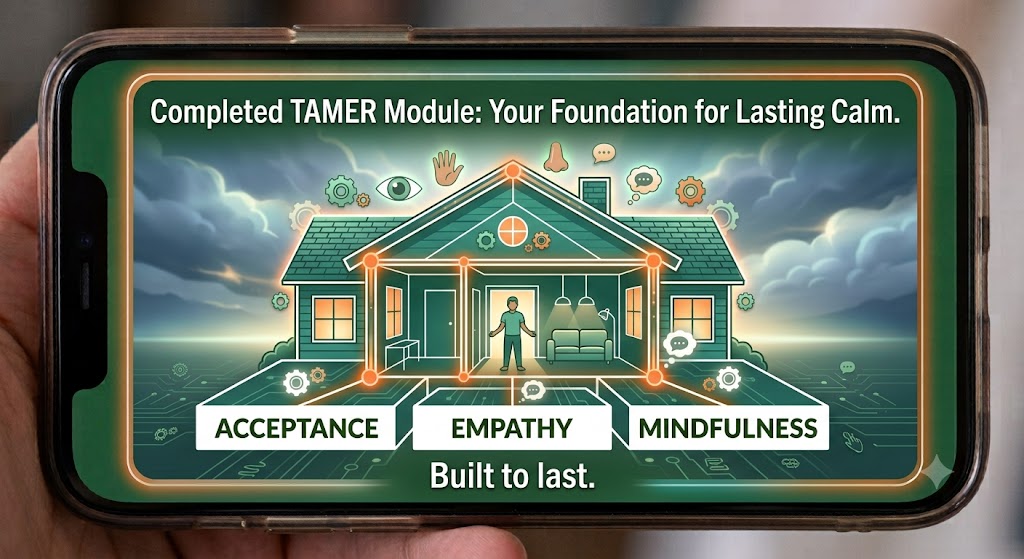
When you consistently practice acceptance, empathy, and mindfulness, something remarkable happens: they begin to integrate. You stop having to think about using them — they become part of who you are. They're no longer tools you reach for in a crisis; they're built into the house.
Acceptance helps you stop wasting energy on battles you can't win.
Empathy helps you connect with others instead of fighting them.
Mindfulness helps you respond on purpose instead of reacting automatically.
Together, they create a way of being in the world that naturally lowers anger and raises peace, effectiveness, and connection. That's what "sustainable" means — not white-knuckling your way through every hard day, but living from a foundation that holds.
Here's what I want you to carry out of this whole program. Hold these like nails in the frame:
- Change takes time. You didn't build these patterns overnight; you won't rebuild them overnight either. Be patient with yourself.
- Progress isn't linear. You'll have good days and hard days. The trend over time is what matters — not daily perfection.
- Practice makes progress. These skills only work if you use them. Make them a daily practice, not just a crisis intervention.
- Support matters. Build a team of people who support your growth and hold you accountable with love.
- Self-compassion is essential. Treat yourself with the same kindness you'd show a good friend who was learning all this.
After three decades in this work, I can tell you with absolute certainty: you have the power to change your relationship with anger. It isn't easy, and it takes practice — but it is absolutely possible. You don't have to be a victim of your emotions. You can learn to use anger as information, express it constructively, and build the kind of life and relationships you truly want.
The tools are in your hands. The foundation is yours to build. Now go build the house — and create the life you deserve.
Knowledge Check
Your knowledge check for this lesson is an interactive game you'll play inside the course. It's waiting for you — and you're more than ready for it.